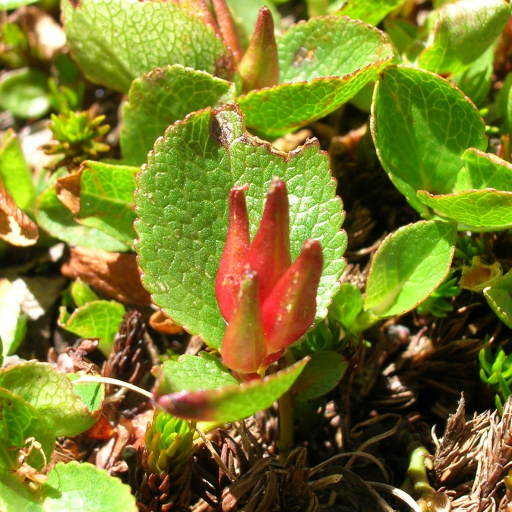
Plant Overview
Meet the Dwarf Willow, a botanical record-breaker that proves size isn't everything. Often called the "smallest tree in the world," this resilient little willow has traded towering heights for a life hugging the rocky ground of the Arctic and high mountain peaks. In the world of folklore, these tiny "forests" were said to be the hiding places of mountain spirits who needed cover where no other trees could grow.
🔍 How to Identify
- 🌿 Growth Habit: Unlike its weeping cousins, this willow is prostrate, meaning it creeps along the ground. It rarely grows more than 1–6 centimeters tall, often appearing more like a mossy carpet than a woody shrub.
- 🍃 The Leaves: The leaves are tiny, shiny, and round to heart-shaped. They feature distinct, net-like veins and finely toothed edges that turn a beautiful golden-yellow before dropping in the autumn.
- 🌸 The Catkins: Even though it’s tiny, it still produces "pussy willow" flowers called catkins. These appear in early summer and are usually reddish-pink or yellowish-green, standing upright at the tips of the branches.
🏔️ In the Wild & Garden
- 🪨 The Ultimate Survivalist: This plant is a "snowbed specialist." It thrives in areas where snow lingers late into the summer, using the white blanket as insulation against the harshest freezing winds.
- 💧 Soil & Drainage: In a rock garden or alpine trough, it demands "perfectly imperfect" conditions. It needs gritty, acidic soil that stays moist from melting snow but never becomes stagnant or swampy.
- 🌱 Root System: It spreads primarily through underground rhizomes. This allows it to colonize shifting scree and stabilize loose mountain soil, acting as a tiny anchor for its ecosystem.
⚠️ Safety & Toxicity
- ✅ Safe Status: Salix herbacea is generally considered non-toxic to humans and common household pets.
- 🐾 Medicinal Context: Like all members of the Salix family, the bark contains salicin (the natural precursor to aspirin). While a curious dog or cat is unlikely to eat enough to cause harm, it may have a bitter taste that naturally discourages browsing.
✨ Fun Fact
Despite reaching only two inches in height, a single Dwarf Willow can be decades old! Because they grow so slowly in the freezing cold, a "patch" of these tiny trees might have been growing since the time of your grandparents.

Detailed Care Instructions
To grow Salix herbacea, also known as dwarf willow or snowbed willow, follow these steps:
- Planting: Choose a suitable location where the plant can receive partial shade or full sun. Ensure the soil is well-draining and slightly acidic to neutral in pH. Additionally, make sure there is adequate moisture in the area, preferably with good drainage to prevent waterlogging.
- Propagation: Salix herbacea can be propagated from seeds or cuttings. If using seeds, collect them from mature plants in late summer or early autumn and sow them immediately. For cuttings, take small stems from healthy plants during the dormant season (late winter or early spring) and plant them in a mixture of peat moss and sand.
- Soil preparation: Prepare the planting area by removing any weeds or grass. Loosen the soil and mix in organic matter, such as compost or peat moss, to improve fertility and drainage.
- Planting seeds or cuttings: If using seeds, sow them directly in the prepared soil, ensuring they are not planted too deep. Gently press the soil down and water lightly. If using cuttings, make a hole in the soil, insert the cutting, and firm the soil around it. Water the cutting thoroughly after planting.
- Watering: Keep the soil consistently moist, but avoid overwatering. Salix herbacea prefers moist conditions, so regular watering is necessary, especially during dry periods.
- Mulching: Apply a layer of organic mulch, such as bark chips or straw, around the base of the plant to help retain moisture, suppress weeds, and insulate the soil.
- Maintenance: Prune Salix herbacea annually to maintain its shape and size. Remove any dead or diseased branches and trim back excessively long shoots. This will promote healthy growth and prevent the plant from becoming overly dense.
- Protection: If your area experiences harsh winters or heavy snowfall, consider protecting the plant during this period. Cover it with burlap or plant it in a sheltered area to prevent damage from freezing temperatures or heavy snow.
With proper care and maintenance, your Salix herbacea plant should thrive and grow into a beautiful ornamental addition to your garden or landscape.

Place in a bright room that is sun drenched almost all day. Or directly in a south-facing window.

Salix Herbacea is a plant that requires regular watering to keep it healthy and thriving. It's important to water it deeply and evenly, making sure that the soil is moist but not waterlogged. The frequency of watering depends on the climate and season, but generally, it needs to be watered twice a week. The soil surrounding the plant should be checked for dryness before watering.
When watering Salix Herbacea, avoid getting water on the foliage or flowers, as it could cause them to rot. Instead, direct the water at the base of the plant. It's also a good idea to water the plant during the morning or evening, as watering during the hottest part of the day can cause the water to evaporate too quickly.
In cases of dry and arid climates, you should water the Salix Herbacea more frequently, to keep the soil moist. If the plant is in a pot, make sure to check the drainage hole to ensure that excess water is getting removed.
Overall, Salix Herbacea requires proper watering to grow and thrive, so make sure to water it regularly and with care.
To fertilize this plant, begin by choosing a slow-release organic fertilizer that is high in nitrogen. Make sure to fertilize the plant during the growing season, usually in the springtime, as this is when it is actively growing. Apply the fertilizer directly to the soil, around the base of the plant, and water well. Avoid over-fertilizing as this can lead to excess growth and weaken the plant. Check the soil moisture regularly and adjust watering as needed.
The ideal soil for Salix Herbacea should be well-draining and rich in organic matter. It should have a slightly acidic pH level of around 6.0 to 6.5. The soil should retain moisture without becoming waterlogged, as Salix Herbacea prefers moist soil conditions. The plant also thrives in soils that have a good amount of nitrogen, potassium, and phosphorous. It is important to ensure that the soil is not too compacted, as this can hinder root growth and reduce the plant's ability to take up nutrients. When planting Salix Herbacea, it is recommended to mix a good quality compost or organic matter into the soil to provide additional nutrients and improve soil structure.
Propagation of this plant can be done through cutting. To propagate, take the stem of the plant and cut it into sections about six inches in length. These sections can then be planted in a pot or directly into the ground. Make sure the cut end of the stem is planted in the soil with the right orientation. Water the plant immediately after planting and keep it moist until it has established roots. It is also possible to propagate through layering. To do this, bend a stem of the plant to the ground and cover it with soil, keeping the top of the stem exposed. After some time, new roots will grow from the stem covered in soil. Once the roots have established, the stem can be cut from the parent plant and transplanted.








