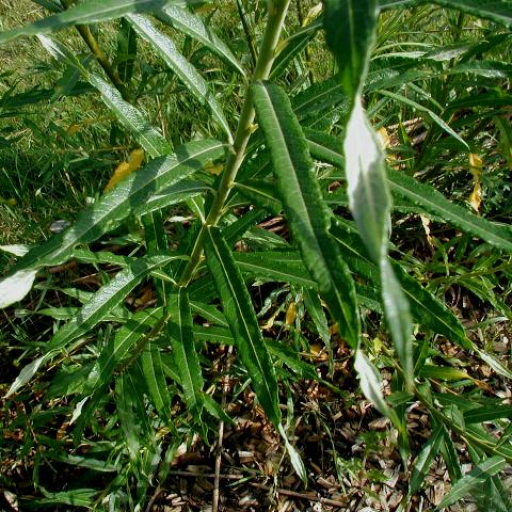
Plant Overview
Commonly known as the Basket Willow or Common Osier, Salix viminalis is the undisputed star of the weaving world. Originating from Europe and Western Asia, this elegant willow is famous for its remarkably long, flexible shoots that have been used to craft everything from humble baskets to sophisticated garden sculptures for centuries. It is a natural engineer, often found leaning gracefully over riverbanks where its vigorous roots prevent soil erosion.
🔍 How to Identify
- 🍃 Slender Foliage: The leaves are exceptionally long and narrow (lanceolate), sometimes reaching up to 25cm. They feature a smooth dark green top and a distinctive silky, silvery-grey underside.
- 🎋 Flexible Whips: Young branches are vibrant yellow or olive-green and incredibly "whippy." These "rods" can be bent almost into a circle without snapping.
- 🌾 Soft Catkins: In early spring, before the leaves emerge, the plant produces slender, fuzzy yellowish catkins that provide a vital early-season nectar banquet for bees.
🏡 In Your Garden
- 💧 The Water Lover: This plant is a "hydrophile," meaning it loves wet feet. It is the perfect solution for soggy, boggy corners of a yard or near a pond where other plants might succumb to root rot.
- ✂️ The Art of Coppicing: To maintain its sleek look and get those famous weaving rods, you should "coppice" the plant—cutting it back nearly to the ground every winter. This triggers a burst of straight, vigorous new growth in the spring.
- 🌍 Soil Healer: It is a champion of phytoremediation. Its roots are incredibly efficient at absorbing heavy metals and pollutants, effectively "cleaning" the ground and water in its vicinity.
⚠️ Safety & Toxicity
- 🐾 Pet Friendly: Salix viminalis is generally considered non-toxic to dogs, cats, and horses.
- 💊 Medicinal Bark: Like all willows, the bark contains salicin, the natural precursor to aspirin. While not harmful to touch, if pets or livestock chew excessively on the bark, it can cause minor digestive upset.
✨ Fun Fact
🎨 Before the invention of plastic, the Common Osier was the backbone of the shipping industry; almost all commercial crates and transport baskets were woven from this specific willow because of its incredible strength-to-weight ratio.

Detailed Care Instructions
| Lighting | Full Sun |
To grow Salix viminalis, also known as the basket willow or common osier, follow these steps:
- Select a suitable location: Salix viminalis prefers moist soil and full sun exposure. Choose a spot in your garden or backyard that receives at least 6 hours of direct sunlight each day and has well-draining soil.
- Obtain healthy cutting or rod: Salix viminalis can be propagated by taking cuttings or using rods. Cuttings are shorter sections of the stem while rods are longer sections. Obtain a healthy cutting or rod from an existing Salix viminalis plant or purchase it from a reputable nursery or garden center.
- Prepare the planting area: Clear the planting area of any weeds or debris. Loosen the soil to a depth of about 8-10 inches (20-25 cm) using a garden fork or tiller. Remove any rocks or large clumps of soil.
- Plant the cutting or rod: Dig a hole in the prepared area that is slightly larger than the length of the cutting or rod you have. Place the cutting or rod into the hole, making sure at least two-thirds of it is buried. Firmly press the soil around it to secure the cutting/rod in place.
- Water thoroughly: After planting, water the cutting/rod thoroughly to help settle the soil and remove any air pockets around the roots. Keep the soil consistently moist, but not waterlogged, during the growing season.
- Mulch the area: Apply a layer of organic mulch around the base of the Salix viminalis plant to help retain moisture, suppress weed growth, and provide some insulation. Use materials like wood chips, straw, or shredded leaves. Avoid piling the mulch directly against the stem.
- Prune as needed: Salix viminalis can be pruned to maintain desired size and shape. Prune weak or damaged branches in late winter or early spring before new growth emerges. You can also harvest the long, flexible branches to use in basket weaving or other crafts.
- Provide regular care: In addition to adequate watering, regular care for Salix viminalis includes fertilizing it with a balanced, slow-release fertilizer in early spring. Follow the instructions on the fertilizer packaging for proper application rates. Monitor for pests or diseases and take appropriate action if needed.
By following these steps, you can successfully grow Salix viminalis and enjoy its beautiful foliage and flexible branches.

Place in a bright room that is sun drenched almost all day. Or directly in a south-facing window.

Salix Viminalis is a type of plant that requires adequate watering for its proper growth and survival. When watering Salix Viminalis, it is important to ensure that the soil is moist but not waterlogged. This can be achieved by watering the plant deeply once or twice a week, depending on the climate and moisture levels of the surrounding environment.
The watering can be done either by hand or using a drip irrigation system. When watering by hand, it is important to ensure that the water reaches the roots and does not just wet the surface of the soil. This can be achieved by watering slowly and evenly, allowing the water to soak into the soil instead of running off.
When using a drip irrigation system, care should be taken to ensure that the system is designed to deliver water evenly to the Salix Viminalis plant. This can be achieved by using a micro-drip system with adjustable emitters that can be positioned near the base of the plant's stem. The emitters should be adjusted to deliver small amounts of water over a prolonged period, ensuring that the soil remains moist without becoming waterlogged.
It is also important to take into consideration the plant's growth stage and the surrounding environmental conditions when watering Salix Viminalis. During its early growth stage, the plant may require more frequent watering to support its growth. Similarly, during hot and dry weather conditions, the plant may require more water to compensate for moisture loss through transpiration.
Overall, proper watering is essential for the growth and survival of Salix Viminalis plant. By following these guidelines, one can ensure that the plant receives adequate moisture without being overwatered or underwatered.
For optimal growth and health of this plant, apply a balanced fertilizer in early spring before new growth appears. Use a slow-release fertilizer, unless you are applying liquid fertilizer, and apply according to package instructions. Avoid applying fertilizer during hot, dry weather. Water the plant deeply after fertilizing to help the nutrients move down to the roots. Repeat fertilization every 4-6 weeks during the growing season. Avoid applying too much fertilizer, as this can lead to excessive growth and weaken the plant.
Salix Viminalis is a type of plant that requires a specific type of soil in order to thrive. This plant prefers a soil that is well-draining and rich in nutrients, with a pH level that is slightly acidic to neutral. The best soil for Salix Viminalis is a loamy soil that contains a mixture of sand, silt, and clay, as this allows for good drainage while also retaining moisture and nutrients. It is important to avoid soil that is too compacted or heavy, as this can lead to poor root growth and waterlogging. To ensure the best possible soil for Salix Viminalis, it is recommended to amend the soil with organic matter such as compost or well-rotted manure, which will provide essential nutrients and improve soil structure. Overall, the key to success with Salix Viminalis is providing a soil that is rich in nutrients, well-draining, and has good structure and texture.
Salix viminalis, a deciduous perennial plant species, can be propagated through different methods such as rooting cuttings and by planting seeds. To propagate through cuttings, select a healthy, young shoot from the parent plant, remove any leaves on the lower half of the stem, and dip the cut end into rooting hormone powder. Place the cutting in a pot filled with moist rooting medium, keep in a warm and bright spot, and water regularly until the cutting has formed roots and can be transplanted.
To propagate through planting seeds, collect ripe seeds in the fall and sow them in a pot filled with well-draining potting soil, covering the seeds with a layer of soil. Keep the pot in a sunny and warm location, and keep the soil moist. Germination should occur within a few weeks, and once the seedlings have a few leaves, they can be transplanted to a larger pot or outdoors into the garden where they can grow into mature plants over time.








