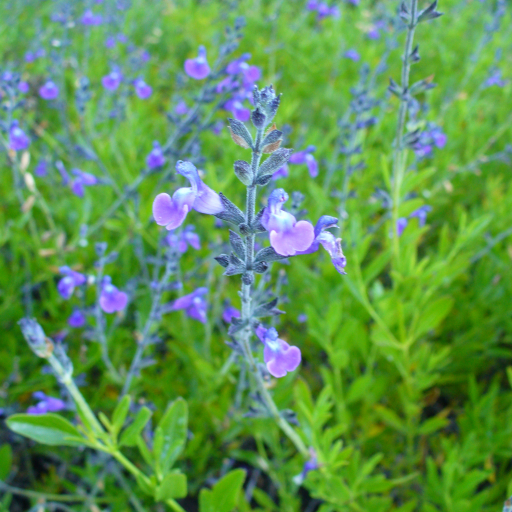
Plant Overview
Hailing from the high-altitude deserts of Northern Mexico, Salvia coahuilensis, commonly known as Coahuila Sage, is a hidden gem for water-wise gardeners. This resilient little shrub creates a low-growing carpet of deep green, topped with some of the most intense royal-purple flowers in the botanical world. It is the perfect choice for those who want a "tough as nails" plant that still looks delicate and aristocratic.
🔍 How to Identify
- 💜 The Blooms: Features small, tubular flowers of a strikingly deep violet-purple that appear in dainty clusters along the stems.
- 🍃 The Foliage: Unlike the broad leaves of common garden sage, these leaves are tiny, narrow, and almost needle-like, sporting a rich dark green color.
- 📏 Growth Habit: It typically stays low to the ground, reaching only about 1 foot in height but spreading outward to create a dense, woody cushion.
🏡 In Your Garden
- ☀️ Sun-Drenched Resilience: This sage thrives in the "hot spots" of your garden where other plants might wilt. It has evolved to handle intense sun and rocky, well-draining soil, making it a champion for rock gardens.
- 🐝 Pollinator Buffet: Despite the small size of the flowers, they are highly attractive to hummingbirds and bees. It’s a fantastic "utility plant" for supporting local biodiversity in urban spaces.
- ✂️ Low Maintenance: It is naturally "self-cleaning" and doesn't require much deadheading, though a light trim in late winter helps it stay tidy and prevents it from becoming too woody at the center.
⚠️ Safety & Toxicity
- ✅ Status: Generally considered non-toxic.
- 🐾 Details: Like most members of the Salvia family, Salvia coahuilensis is safe for pets and children. While it is highly aromatic, it isn't used for culinary purposes like common kitchen sage, so it’s best enjoyed with the eyes and nose rather than the palate.
✨ Fun Fact
Because it originates from the mountainous regions of Coahuila, Mexico, this plant is surprisingly cold-hardy for a desert species—it can survive temperatures dropping as low as 15°F (-9°C) if the soil is kept dry!

Detailed Care Instructions
Salvia coahuilensis is a low-maintenance plant that is native to Mexico. Here are some tips on how to grow and care for this beautiful plant:
- Planting: Salvia coahuilensis thrives in well-draining soil and full sun. Plant it in a location where it can receive at least 6 hours of sunlight per day.
- Watering: Water the plant regularly, especially during the growing season. Make sure the soil is moist but not waterlogged.
- Fertilizing: Fertilize the plant with a balanced fertilizer once a month during the growing season to promote healthy growth.
- Pruning: Prune the plant regularly to encourage bushier growth and more blooms. Deadhead spent flowers to promote continuous blooming.
- Mulching: Mulch around the base of the plant to help retain moisture and suppress weeds.
- Propagation: Salvia coahuilensis can be propagated from cuttings or seeds. Cuttings should be taken in the spring or early summer, and seeds can be sown in the fall or early spring.
- Pests and diseases: Keep an eye out for common pests such as aphids and spider mites. Treat any infestations promptly with insecticidal soap or neem oil. Ensure good air circulation around the plant to prevent diseases.
By following these tips, you can successfully grow and enjoy the beautiful blooms of Salvia coahuilensis in your garden.
Salvia Coahuilensis should be watered regularly, especially during the warmer months when the plant is actively growing. It is important to observe the soil and only water when it feels dry to the touch. Overwatering can lead to root rot and other issues, so it is best to err on the side of underwatering. When watering, it is best to water the plant at the base, avoiding wetting the leaves or flowers, as this can lead to disease and fungus. Additionally, using room temperature water is ideal, as cold water can shock the plant and disrupt its growth. Ensure that the plant has proper drainage to prevent waterlogged soil.
To fertilize the Salvia Coahuilensis plant, use a balanced fertilizer with equal parts nitrogen, phosphorus, and potassium. Feed the plant in the spring and summer months, using a half-strength dilution every two weeks. Avoid over-fertilizing, as this can lead to nutrient imbalances and damage the plant. Water the plant before and after fertilizing to help distribute the nutrients evenly throughout the soil.
Salvia Coahuilensis is a drought-tolerant perennial plant that thrives in well-drained soil. It is recommended to use a sandy or loamy soil mixture to provide optimal growing conditions for this plant. Additionally, a soil pH of around 6.0 to 8.0 is ideal for Salvia Coahuilensis. It is important to avoid using heavy or clay-like soils, as they can cause poor drainage and lead to root rot. Adding organic matter, such as compost or peat moss, to the soil can help improve its nutrient content and drainage capabilities. Overall, a well-draining soil mixture that is slightly acidic to neutral in pH is best for promoting healthy growth and blooming of Salvia Coahuilensis.
Salvia Coahuilensis can be propagated through division or cuttings. To propagate through division, gently separate the root ball into smaller sections, making sure each section has several healthy stems and roots. Plant each section in a well-draining soil mixture and water thoroughly.
To propagate through cuttings, take a healthy stem cutting from the plant, making sure it has at least two sets of leaves. Remove the lower set of leaves and dip the cut end in a rooting hormone. Plant the cutting in a well-draining soil mixture and keep it moist until roots develop.
Both methods of propagation should be done in the spring or early summer when the plant is actively growing. Keep the newly propagated plants in a warm, humid environment with bright, indirect light until they establish roots and can be transplanted into their permanent location.








