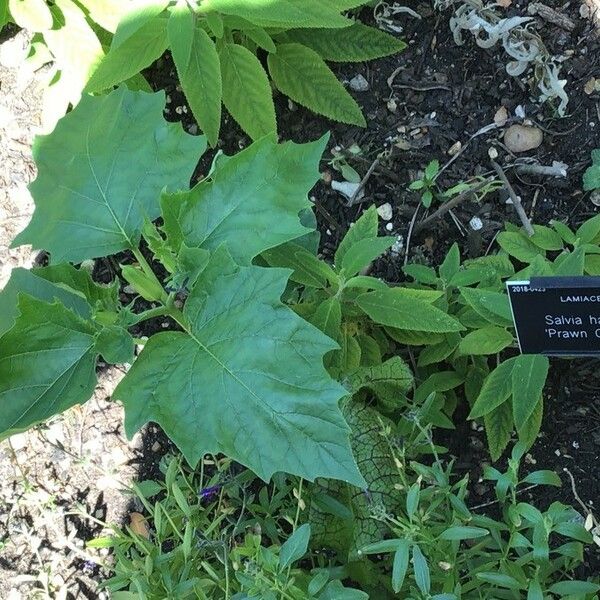
Plant Overview
Known affectionately as the Prawn Sage or Hummingbird Sage, Salvia haenkei is a true giant of the mint family. Hailing from the high altitudes of the Bolivian Andes, this perennial is famous for its architectural stature and its peculiar, fuzzy flowers that look remarkably like cooked shrimp. It is a favorite for gardeners looking to add vertical drama and a splash of fiery color to their landscape.
🔍 How to Identify
- 🦐 The "Prawn" Flowers: The most striking feature is the long, tubular, bright scarlet flowers. They are covered in fine, velvety hairs and have a distinctive curved shape that mimics a prawn.
- 🍃 Large Foliage: Unlike many smaller salvias, this one has broad, heart-shaped, bright green leaves that are slightly sticky to the touch and emit a mild, herbal scent.
- 📏 Stately Growth: It is a woody-based shrub that can easily reach 8 to 10 feet in height. It has a bit of a "scrambling" habit, often leaning on nearby plants for support.
🏡 In Your Garden
- ✂️ Pruning is Key: Because of its vigorous growth, this plant can become "leggy" or messy. Give it a hard prune in late winter or after its main flowering flush to keep it compact and encourage fresh, blooming wood.
- 🐦 Pollinator Magnet: In its native habitat, it is perfectly evolved for long-billed hummingbirds. In your garden, it will be the primary destination for any nectar-seeking birds and large butterflies.
- ☀️ Sun and Space: It loves the sun but appreciates a bit of afternoon shade in scorching climates. Give it plenty of "elbow room" so its sprawling branches don't overtake its neighbors.
⚠️ Safety & Toxicity
- ✅ Safe for Everyone: Salvia haenkei is generally considered non-toxic to humans, dogs, and cats.
- 🌿 Sticky Residue: While safe, the leaves are quite resinous and sticky. If you are pruning a large specimen, you might want to wear gloves just to keep the "goo" off your hands, though it is not harmful.
✨ Fun Fact
In Bolivia, this plant is known to live for decades. It has been used in traditional medicine for its purported anti-aging properties, and researchers have actually studied it for compounds that might help protect skin cells from oxidative stress!

Detailed Care Instructions
To grow Salvia haenkei, also known as Andean sage, follow these steps:
- Obtain seeds or young plants: Find a reputable nursery or botanical garden that sells Salvia haenkei seeds or young plants. Alternatively, you may ask local plant enthusiasts or horticultural societies for assistance in finding a reputable source for this particular species.
- Choose the right location: Salvia haenkei prefers growing in full sun but can tolerate partial shade. Make sure the location offers well-draining soil with a pH level between 6 and 7. If needed, amend the soil with organic matter like compost to improve its quality.
- Planting seeds or young plants: If you have seeds, sow them directly into the ground during spring or early summer. Lightly cover the seeds with soil and water gently. If using young plants, dig a hole slightly larger than the root ball, place the plant in the hole, backfill with soil, and firm it gently around the base. Water thoroughly after planting.
- Watering and maintenance: Salvia haenkei requires regular watering until it is well-established. Water deeply when the top inch of soil feels dry. However, be cautious not to overwater as the root system can rot. Once established, the plant is relatively drought-tolerant. It is also a good idea to apply a layer of mulch around the base to retain soil moisture and control weed growth.
- Fertilization: Salvia haenkei doesn't typically require heavy fertilization. However, you can apply a balanced, slow-release fertilizer in the spring to provide essential nutrients to the plant. Follow the instructions on the fertilizer packaging for the appropriate dosage.
- Pruning: Pruning is generally not necessary for Salvia haenkei, but you can trim back any dead or damaged foliage to maintain a tidy appearance. Additionally, removing spent flowers can encourage more prolific blooming.
- Pests and diseases: Salvia haenkei is generally resistant to pests and diseases, but keep an eye out for common garden pests like aphids or snails. You can manually remove pests or use organic pest control methods to keep them at bay.
- Propagation: Salvia haenkei can be propagated by taking stem cuttings in late spring or early summer. Dip the cut end in rooting hormone and place it in a well-draining growing medium. Keep it consistently moist and warm until roots develop.
Remember to always research and follow specific guidelines for your particular environment and growing conditions to ensure the proper care of Salvia haenkei.
Salvia Haenkei is an herbaceous perennial plant that requires a moderate amount of water. It is important to provide well-draining soil to avoid waterlogging that may cause root rot. One of the best ways to water this plant is by using the drip irrigation method. This helps to deliver a slow and steady supply of water directly to the plant's roots while reducing the risk of water evaporation. Another method is to water the plant deeply once a week to ensure that the soil is moist but not waterlogged. When watering, avoid getting water on the leaves as this can lead to fungal growth. It is also important to water the plant early in the morning or late in the evening to avoid the heat of the day and allow the water to reach the roots before it evaporates. Finally, it is important to adjust watering to suit the plant's growing conditions, such as hot or dry weather, to ensure that it receives adequate moisture.
To fertilize the plant, apply a slow-release granular fertilizer with balanced NPK values (such as 10-10-10) to the soil at the beginning of the growing season. Water the plant thoroughly after application. Alternatively, you can use a liquid organic fertilizer every two weeks throughout the growing season. Avoid over-fertilizing as it can lead to leggy growth and reduced blooming.
The Salvia Haenkei plant prefers well-draining soil that is nutrient-rich and has a slightly acidic to neutral pH. A mix of loamy soil, sand, and perlite can provide the ideal growing medium for this plant. It benefits from soil that has good water retention capabilities, yet doesn't become waterlogged. To maintain the plant's health, it's essential to avoid using soil with high salt or heavy clay content. Additionally, adding organic matter to the soil, like compost or aged manure, can help improve its nutritional value and enhance its water retention properties.
Salvia Haenkei plant can be propagated through stem cuttings. To do this, select a healthy stem from the parent plant that is at least 4-6 inches in length. Cut the stem just below a node (where the leaves are attached to the stem). Remove the leaves from the bottom 2 inches of the stem, leaving only a few leaves at the top. Dip the cut end of the stem in rooting hormone and plant it in a well-draining soil mix. Water the soil and cover the plant with a plastic bag to maintain humidity. Place the plant in a warm, bright location but not direct sunlight. Mist the cutting occasionally to keep it moist and within a few weeks, roots should start to develop. Once the plant has established roots, remove the plastic bag and transplant it to a larger container or in the garden.








