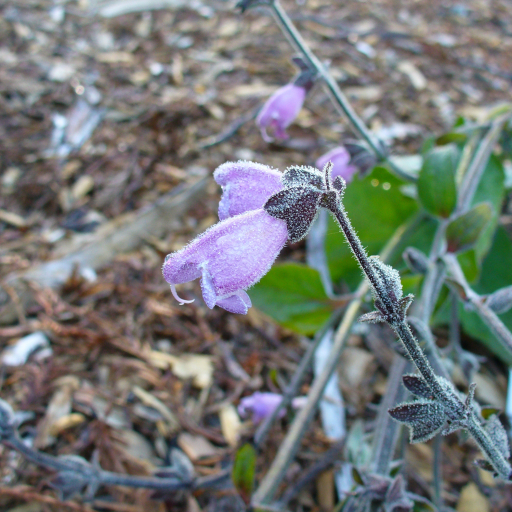
Plant Overview
Often called the Himalayan Sage or the "Gaping Sage," this hardy perennial is a mountain-dwelling beauty that brings a touch of the high peaks to your backyard. Its Latin name, hians, translates to "gaping" or "yawning," referring to its large, open-mouthed flowers that look like they are ready to swallow a bumblebee whole. Known for its resilience and striking color contrast, it is a favorite for those seeking an "English Garden" look with a wild, alpine twist.
🔍 How to Identify
- 👄 The "Gaping" Bloom: Distinctive bicolored flowers featuring a deep violet-purple upper hood and a wide, creamy-white lower lip that creates a stark, beautiful contrast.
- 🍃 Textured Foliage: Large, arrow-shaped leaves that are slightly hairy and rough to the touch, forming a lush, green mound at the base of the plant.
- 📏 Sturdy Stems: Tall, square-shaped flowering stems that rise well above the foliage, often reaching 2 to 3 feet in height during peak summer.
🏡 In Your Garden
- 🏔️ Mountain Roots: Because it originates from high altitudes (up to 13,000 feet!), this Salvia prefers "cool feet." It thrives in soil that stays moist and well-drained, rather than baking in hot, dry sand.
- 🌤️ Sun vs. Shade: While it loves the sun, it is prone to wilting in extreme afternoon heat. In warmer climates, it appreciates a spot with dappled afternoon shade to keep its velvety leaves from scorching.
- 🦋 Pollinator Magnet: The unique shape of the "gaping" flower is perfectly evolved for heavy-bodied bees, making it a bustling hub for local pollinators throughout the mid-to-late summer.
⚠️ Safety & Toxicity
- ✅ Safe Status: Salvia hians is generally considered non-toxic to humans and common household pets like cats and dogs.
- 🐾 Mild Irritant: While not poisonous, the aromatic oils in the leaves and the hairy texture can occasionally cause very mild stomach upset if a curious pet decides to chew on them.
✨ Fun Fact
In its native Himalayan habitat, Salvia hians is a true survivor, often found growing on rocky slopes and alpine meadows where few other garden-style flowers could handle the thin air and cold nights!

Detailed Care Instructions
To grow Salvia hians, also known as the Himalayan sage, you can follow these steps:
- Climate and soil: Salvia hians prefers a mild to cool climate with plenty of sunlight. It thrives in well-drained soil with a pH ranging from slightly acidic to neutral.
- Propagation: Salvia hians can be propagated from seeds or cuttings. If starting from seeds, sow them in a seed tray or small pots filled with seed-starting mix. Keep the soil consistently moist until the seeds germinate. If using cuttings, take a 4-6 inch stem cutting from a healthy plant, remove the lower leaves, and place it in a pot filled with growing medium. Keep the soil moist until the cutting roots.
- Planting: Once the seedlings have grown a few sets of true leaves or the cuttings have rooted, transplant them into larger pots or directly into the garden. Space plants about 12-18 inches apart to allow room for growth. If planting in the garden, make sure to choose a spot with good drainage and plenty of sunlight.
- Watering: Salvia hians prefers moderate watering. Water the plants regularly, but allow the soil to dry out slightly between watering sessions. Overwatering can lead to root rot, so ensure the soil is well-drained.
- Fertilization: Apply a balanced organic fertilizer once a month during the growing season to promote healthy growth. Follow the instructions on the fertilizer packaging for proper dosage.
- Pruning: To encourage bushier growth, pinch back the tips of the young plants when they reach a height of 6-8 inches. This will promote branching and result in a fuller plant. Trim off any dead or damaged branches as needed throughout the growing season.
- Pests and diseases: Salvia hians is generally pest and disease resistant. However, keep an eye out for common garden pests like aphids, spider mites, or snails. If an infestation occurs, treat with an appropriate insecticide or remove the pests manually.
- Harvesting: Salvia hians produces beautiful deep blue flowers in late summer to early fall. You can harvest the leaves just before or during flowering for their essential oil or for use in herbal teas.
Remember to check your local regulations regarding the cultivation and use of Salvia hians as certain jurisdictions may have restrictions.

Place in a bright room that is sun drenched almost all day. Or directly in a south-facing window.

The best way to water this plant is to first check the soil moisture level with your fingers. If it feels dry to the touch, then it is time to water. Use a watering can or hose with a gentle spray nozzle to water the soil around the base of the plant. Avoid getting water on the leaves or flowers. Water deeply, but avoid overwatering as this can lead to root rot. During the growing season, water regularly, at least once or twice a week. In the winter months, reduce watering frequency as the plant becomes dormant.
- Choose a balanced fertilizer with equal parts nitrogen, phosphorus, and potassium.
- Apply the fertilizer at a rate of 1/2 to 1 teaspoon per 1 gallon of water.
- Water the soil thoroughly before fertilizing to avoid fertilizer burn.
- Apply the fertilizer once every 2-3 weeks during the growing season (spring to fall).
- Be careful not to over-fertilize, as this can stunt growth and damage the plant.
- If the soil is naturally rich in nutrients, it may not need additional fertilizer.
- Always follow the manufacturer's instructions when applying fertilizer.
When it comes to planting and growing Salvia Hians, it is important to choose the right type of soil to ensure optimal growth and health of the plant. The ideal soil for Salvia Hians is a well-draining, slightly acidic soil with a pH range of 6.0-7.0. This soil should be rich in organic matter, such as compost, to provide the necessary nutrients for the plant to thrive. It is important to avoid soils that are too heavy or compacted, as they can impede drainage and lead to root rot. Additionally, adding a layer of mulch around the base of the plant can help to retain moisture and regulate soil temperature, further promoting healthy growth.
To propagate this plant, take a stem cutting from a mature and healthy plant using a sharp, clean instrument. The cutting should be about 4-6 inches long and should be taken from the tip of the stem. Remove any leaves from the bottom half of the cutting and dip the cut end into rooting hormone powder.
Make a hole in a well-draining potting mix, and plant the cutting in the hole with the hormone powder at the bottom. Water the cutting and place the pot in a location where it will receive bright, indirect sunlight. Keep the soil moist but not waterlogged.
After a few weeks, roots should begin to develop. You can gently tug on the cutting to see if it has rooted. Once roots have formed, you can transplant the cutting into a bigger pot or directly into the ground in a sunny location.








