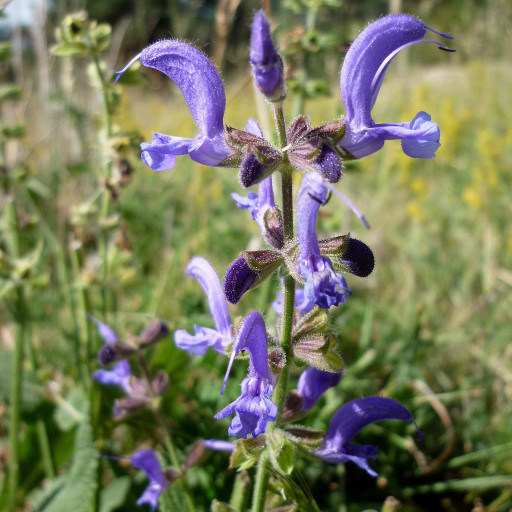
Plant Overview
Known as "Meadow Clary" or "Meadow Sage," this resilient beauty has been a staple of European grasslands for centuries. Its name "Clary" hints at a mystical past where its seeds were used to "clear" the eyes of dust. Today, it is beloved by gardeners for its dramatic spikes of deep indigo that dance in the summer breeze, signaling the peak of the pollinator season.
🔍 How to Identify
- 🌿 The Foliage: It features basal rosettes of heart-shaped, wrinkled, and slightly fuzzy leaves that stay close to the ground, forming a lush green mat.
- 🟦 The Blooms: Look for architectural spikes of hooded, two-lipped flowers. While usually a rich violet-blue, you may occasionally find rare pink or white variants.
- 📐 Square Stems: Like most members of the Mint family, its upright flower stalks are noticeably four-sided, sturdy, and covered in fine hairs.
🏡 In Your Garden
- ☀️ Sun Seeker: This sage thrives in full sun. If it's tucked into too much shade, the flower spikes tend to "flop" or stretch awkwardly as they hunt for the light.
- 🦋 The Pollinator Pub: It is a high-octane nectar source for bumblebees and butterflies. It has evolved a specific "lever" mechanism that dabs pollen onto a bee's back as it reaches for nectar.
- ✂️ The Second Act: To keep it looking tidy, cut the flower spikes back once they fade. This often "tricks" the plant into producing a second, smaller flush of flowers in late summer.
⚠️ Safety & Toxicity
- ✅ Pet & Child Safe: Salvia pratensis is generally considered non-toxic to cats, dogs, and humans. It is a much safer ornamental choice than many other garden perennials.
- 🍃 Mild Irritation: While not poisonous, the textured, hairy leaves may feel slightly rough. Those with very sensitive skin might experience minor mechanical irritation if handling the plant extensively without gloves.
✨ Fun Fact
The "Meadow Clary" has a clever engineering trick: its flowers are spring-loaded! When a bee lands on the lower lip and probes for nectar, it hits a "trigger" that swings the pollen-bearing stalks down to "stamp" the bee’s back with yellow dust to be carried to the next plant.

Detailed Care Instructions
| Color | Dark Purple-Blue |
| Soil Ph | 7 |
| Lighting | Full Sun |
| Toxicity | Poisonous |
| Soil Type | Well-Draining |
| Bloom Time | May-June (Unless Flowers Are Deadheaded, Then They Can Bloom All Summer) |
| Plant Type | Herbaceous Perennial |
| Mature Size | Height Of 3' |
| Native Area | Europe, Asia |
| Sun Exposure | Full Sun |
| Hardiness Zones | 3-9 |
To grow Salvia Pratensis (meadow sage), you can follow these steps:
- Planting location: Choose a location that receives full sun to partial shade. Meadow sage prefers well-draining soil.
- Soil preparation: Prepare the soil by removing any weeds or grass from the area. Loosen the soil by digging it up and add organic matter such as compost to improve drainage and fertility.
- Sowing seeds: Salvia Pratensis can be grown from seeds. Sow the seeds in the spring or fall directly into the prepared soil. They should be lightly pressed into the soil, but not covered completely as they require light to germinate.
- Watering: Keep the soil moist until the seeds germinate, which usually takes about 2-3 weeks. Once the plants are established, they are tolerant of mild drought conditions.
- Thinning: If the crowded seedlings are too close together, thin them out to give each plant enough space to grow. Space them about 12-18 inches apart.
- Mulching: Apply a layer of organic mulch around the plants to suppress weeds and conserve moisture.
- Maintenance: Meadow sage is a low-maintenance plant, but you can deadhead the spent flowers to encourage additional blooms. Cut back the plants after they finish flowering to promote bushier growth.
- Pests and diseases: Meadow sage is relatively resistant to pests and diseases. However, keep an eye out for common garden pests like aphids or spider mites. In case of infestation, you can use organic insecticidal soaps or other appropriate methods.
- Division: Every few years, you can divide the plants in early spring or fall to prevent overcrowding and maintain their vigor.
Remember to check your local climate and hardiness zone to ensure Salvia Pratensis is suitable for your area.

Place in a bright room that is sun drenched almost all day. Or directly in a south-facing window.

Salvia Pratensis is a plant that requires regular watering to thrive. To properly water this plant, it is important to first determine the moisture requirements of the soil. The best way to do this is by observing the soil's moisture level, either by visually inspecting the soil or by inserting your finger into the soil up to the first knuckle.
If the soil is dry to the touch, it is time to water the Salvia Pratensis plant. When watering, do so slowly to ensure that the water penetrates the soil and reaches the plant's roots. Avoid overwatering as this can lead to root rot and other problems.
One way to ensure that the soil is properly moistened is by using a soaker hose or drip irrigation system. These systems deliver water directly to the soil without causing any damage to the plant's leaves or stems. Another option is to water in the early morning or late evening when temperatures are cooler and the water has time to soak into the soil without evaporating too quickly.
Overall, it is important to monitor the Salvia Pratensis plant's moisture levels and adjust watering accordingly to ensure its health and growth.
To optimize the growth and health of this plant, it is recommended to fertilize it in the early spring with a balanced fertilizer. You can also apply a slow-release fertilizer at the beginning of the growing season. Additionally, it's important to ensure that the soil is moist before applying any fertilizer. Avoid over-fertilizing as this can lead to excessive growth and weak stems. A well-fed plant will produce more flowers and stay healthy throughout the growing season.
The ideal soil for Salvia Pratensis plant should have a pH level of 6.0 to 7.5 and be well-draining. It should be a fertile soil mix that is rich in organic matter, such as compost or aged manure. Avoid using heavy clay soils or soils that are too sandy, as they may not provide adequate drainage and nutrients. The plant requires full sun for optimal growth and should be planted in an area with good air circulation to prevent fungal disease. Ensure that the soil is kept moist but not waterlogged, as this may also lead to fungal disease. Adding a layer of mulch around the base of the plant can help to retain moisture and regulate soil temperatures.
To propagate this plant, start by taking cuttings from healthy stems that are about six inches long, making sure to remove all the leaves except for the top few. Dip the base of the cutting in rooting hormone and plant it in a pot filled with a mixture of peat moss and perlite. Keep the soil moist and put the pot in a bright, but not direct, sunlight. Within a few weeks, the cutting should start to develop roots and new growth. Once the plant has established a healthy root system, it can be transplanted into a larger pot or into the garden. It is important to keep the soil consistently moist while the plant is establishing itself.
Common pests of the meadow sage include Spider mites, aphids, whiteflies. Make a habit of checking your meadow sage frequently for pests so that any infestations can be caught and managed early.








