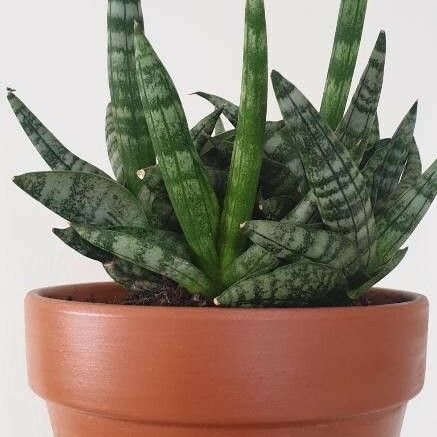
Plant Overview
Commonly known as the Dwarf Sansevieria, this tiny powerhouse is a favorite among succulent collectors for its architectural charm. Unlike its towering cousins that look like upright swords, Sansevieria ballyi forms adorable, compact rosettes that stay miniature. It is famous for its unique "walking" habit, where it sends out long, spindly runners to establish new babies away from the mother plant, making it look like it is taking tiny steps across your bookshelf.
🔍 How to Identify
- 🍃 Leaf Shape: Thick, cylindrical leaves that taper to a sharp reddish-brown point, typically only growing 2 to 4 inches long.
- 🎨 Coloring: Deep green skin decorated with light, silvery-green transverse bands that create a subtle, striped texture.
- 🚶 The "Walking" Stolons: Noticeable long, thin stems (runners) that grow out from the base, arching over the edge of the pot to grow new rosettes at their tips.
🏡 In Your Garden
- 🏺 Potting Preference: Because of its "walking" habit, this plant is best suited for wide, shallow bowls or hanging baskets. This allows the runners to arch and "tumble" over the sides, creating a beautiful cascading effect.
- 💧 Drought Nuance: This species has a relatively shallow root system. It is incredibly drought-tolerant but very sensitive to "wet feet." It is better to forget to water it for a month than to water it twice in one week.
- ☀️ Light & Patterns: While it can survive in dim corners, bright indirect light is necessary to keep its growth compact and ensure the leaf patterns remain vibrant and distinct.
⚠️ Safety & Toxicity
- 🐾 Pet Status: Toxic. Like most members of the Sansevieria family, it contains saponins which act as a natural insecticide but can cause nausea, vomiting, and diarrhea in cats and dogs.
- 👶 Child Safety: The tips of the leaves are quite stiff and sharp. It should be placed on high shelves away from areas where children might bump into it or grab the dangling runners.
✨ Fun Fact
Despite its tiny size, a happy Sansevieria ballyi can produce a flower spike that is actually taller than the plant itself! The blossoms are greenish-white and release a sweet, honey-like fragrance that is most intense after the sun goes down.

Detailed Care Instructions
To grow Sansevieria ballyi, also known as the dwarf sansevieria or the dwarf mother-in-law's tongue, you can follow these steps:
- Choose the right soil: Sansevieria ballyi prefers a well-draining potting mix. You can mix equal parts of standard potting soil, sand, and perlite to create a suitable potting mix.
- Pick an appropriate pot: Select a pot with drainage holes to prevent waterlogging. A small to medium-sized pot is generally sufficient for Sansevieria ballyi.
- Place in a bright location: Sansevieria ballyi thrives in bright, indirect light. Place it near a window where it can receive ample light for several hours a day.
- Watering: Allow the soil to dry out between waterings. Overwatering can lead to root rot. It's better to underwater than to overwater this plant. Stick your finger about an inch into the soil, and if it feels dry, it's time to water. Aim to water about once every 2-3 weeks, adjusting according to the environment and humidity level.
- Temperature and humidity: Sansevieria ballyi prefers temperatures between 60-85°F (15-29°C). It is tolerant of lower temperatures but should be protected from frost. It thrives in average room humidity levels.
- Fertilizing: Use a balanced, diluted houseplant fertilizer once a month during the growing season (spring and summer). Follow the instructions on the fertilizer packaging for proper dilution ratios.
- Pruning: Sansevieria ballyi generally doesn't require much pruning. However, you can trim yellow or dead leaves near the base of the plant using clean, sterilized pruning shears.
- Propagation: Sansevieria ballyi can be propagated through leaf cuttings or division. To propagate through leaf cuttings, cut a healthy leaf into several pieces and plant them in moist soil or water until roots develop. To propagate through division, carefully separate the plant into smaller sections, ensuring each division has roots attached.
- Pest control: Sansevieria ballyi is generally resistant to pests, but occasionally, it can be affected by mealybugs or spider mites. Regularly inspect your plant for signs of pests, and if detected, treat accordingly with appropriate organic or chemical methods.
Remember to regularly monitor the plant's growth, check for signs of pests, and adjust the care routine as needed. With proper care and attention, Sansevieria ballyi can be a stunning addition to your indoor plant collection.
To water this plant, you should first check the soil to make sure it has completely dried out before proceeding. Next, fill a watering can or glass with room temperature water and slowly pour it onto the soil around the base of the plant until the water begins to seep out of the drainage holes. Avoid getting water on the leaves as this can lead to rot and damage. Wait until the soil has dried out completely again before watering to prevent over-watering and root rot. It is also important to not let this plant sit in standing water for extended periods of time.
To fertilize this plant, you should use a balanced, water-soluble fertilizer that contains equal portions of nitrogen, phosphorus, and potassium. Mix this fertilizer with water according to the package instructions, and apply it to the soil around the base of the plant during the growing season. Be careful not to over-fertilize, as this can cause damage to the plant. It is also important to water the plant thoroughly before and after fertilizing to help prevent fertilizer burn and ensure that the nutrients are properly absorbed by the roots.
For the Sansevieria Ballyi plant, it is recommended to use well-draining soil with good aeration. The soil should be composed of a mixture of sandy soil, perlite, and peat moss. This type of soil will prevent water from accumulating around the roots and will provide adequate nutrients for the plant. However, it is important to ensure that the plant is not over-watered as it can lead to root rot. The Sansevieria Ballyi plant prefers slightly dry conditions, so it is good to let the soil dry out between watering. The plant can tolerate a wide range of soil pH levels, but a slightly acidic to neutral soil is ideal. Overall, the soil should be light, loose, and well-draining to promote healthy growth.
- Select a mature Sansevieria Ballyi plant with healthy leaves and roots
- Gently remove the plant from its pot and inspect the roots to make sure they are healthy and not damaged
- Cut the plant into sections using a clean and sharp knife or shears
- Make sure each section has at least one healthy and intact leaf and root
- Allow the cut sections to dry in a shaded area for a few days to prevent them from rotting
- Pot each section in a well-draining soil mix, making sure the root is covered and stabilized
- Water the newly potted sections and place them in a bright and warm spot with indirect sunlight
- Monitor the newly propagated plants and water only when the soil is dry
- After a few months, the newly propagated sections should start producing new leaves and roots.








