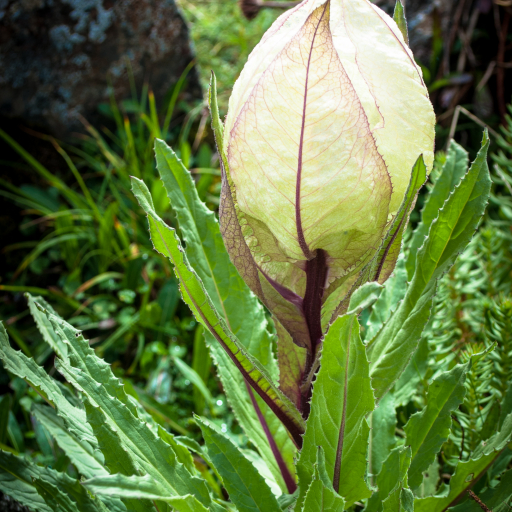
Plant Overview
Known as the "Brahma Kamal" or the "King of Himalayan Flowers," Saussurea obvallata is a mystical bloom found only in the high-altitude reaches of the Himalayas. It is deeply revered in Hindu mythology, often associated with the god of creation, Brahma, and is said to bring immense fortune to anyone lucky enough to see it bloom under the moonlight. This rare beauty is the state flower of Uttarakhand and thrives where most other life struggles to survive.
🔍 How to Identify
- 🌸 Ghostly Bracts: The most striking feature is the collection of large, papery, pale-yellow or cream-colored bracts. These translucent leaves wrap around the flower heads like a protective, glowing lantern.
- 💜 Hidden Core: If you peek inside the papery bracts, you will find several small, dark purple or near-black flower heads huddled together for warmth.
- 🍃 Toothed Foliage: The leaves are oblong and sharply toothed, forming a sturdy rosette at the base of the plant to hug the cold, rocky mountain ground.
🏔️ Habitat & Ecology
- ❄️ Extreme Specialist: This is not a typical garden plant; it thrives in the harsh, rocky scree slopes and alpine meadows of the Himalayas at altitudes between 3,700 and 4,600 meters.
- ☔ Monsoon Bloomer: It has evolved to bloom during the height of the monsoon (July to September). Its unique "lantern" bracts act as a mini-greenhouse, trapping heat and protecting the delicate pollen from freezing mountain rains.
⚠️ Safety & Toxicity
- 🌿 Safe Status: Saussurea obvallata is generally considered non-toxic to humans and pets. It has been used for centuries in traditional Tibetan and Ayurvedic medicine.
- 🛑 Conservation Warning: While safe to touch, it is an endangered and sacred species. In many regions, it is strictly illegal to pick or uproot this plant from the wild. It is best admired through a camera lens to ensure its survival.
✨ Fun Fact
Local folklore suggests that the Brahma Kamal blooms only once a year, specifically at night. It is believed that the flower does not just bloom; it "prays," and witnessing the unfolding of its petals is a rare spiritual blessing that happens only for the virtuous.

Detailed Care Instructions
| Humidity | Normal |
| Lighting | Part Sun |
| Difficulty | Medium |

Place in a window with dappled sun or a spot in the middle of a room. Or directly in a window facing west or east.

The presence of a dry surface layer of soil does not indicate that the plant requires water. Instead, stick your finger 1-2" (3-5 cm) deep in the soil to feel dampness or moisture content. If the soil seems dry, it's time to water your greens. If the soil is still moist, however, it is better not to water your plant and instead wait a day or two. Overwatering or waterlogging raises the risk of root rot. So if the soil takes longer than a week to dry, check the light conditions because it's likely that the plant isn't getting enough light. It's fine if the upper layer of soil is dry between waterings, but the deeper soil layer should always have some moisture.
These plant needs regular fertilizing during growing seasons. Fertilizing your plants in dormant state during the winter, might result in scorching or browning of the leaf tips. If mature plants display signs of nutrient insufficiency, fertilizer administration is necessary to restore the plant to its previous state.
You may use All Purpose Plant Food or Flower Fertilizer for your Brahma Kamal
Common pests of the brahma kamal include Spider mites, thrips. Make a habit of checking your brahma kamal frequently for pests so that any infestations can be caught and managed early.








