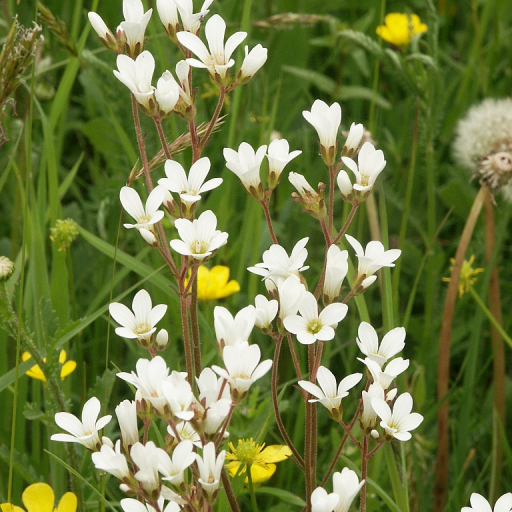
Plant Overview
Known affectionately as the "Meadow Saxifrage" or sometimes "Fair Maids of France," this delicate wildflower is a classic sight in ancient European grasslands. It is best known for its "granulated" roots—tiny, pearl-like bulbils—which once led ancient herbalists to believe the plant held the secret to curing "stones" in the body. It brings a sense of airy, ethereal beauty to any rock garden or meadow setting.
🔍 How to Identify
- 🌸 The Flowers: Clusters of bell-shaped, pure white flowers sit atop slender, hairy stems. Each flower typically has five petals with subtle, translucent veins.
- 🍃 Basal Rosette: At the ground level, it forms a neat mound of kidney-shaped leaves with distinctively scalloped or "toothed" edges.
- 🦪 The Bulbils: The defining feature is hidden at the base; small, pinkish-brown grain-like tubers (bulbils) cling to the stem just below the soil line.
🏡 In Your Garden
- 💤 Summer Dormancy: This plant is a "spring ephemeral." After it finishes flowering in late spring, the foliage often dies back completely to survive the summer heat. Don't mistake this for a dead plant! It is simply retreating into its underground bulbils until the next spring.
- 🌍 Soil & Drainage: It is highly sensitive to "wet feet" during the winter. To keep it happy, ensure it is planted in well-drained, gritty soil. It performs beautifully in rockeries or crevices where water can drain away from the crown quickly.
⚠️ Safety & Toxicity
- 🟢 Generally Safe: Saxifraga granulata is not known to be toxic to humans, dogs, or cats. It is a safe choice for family-friendly gardens and curious pets.
- 👐 Mild Irritation: As with many wild plants, the tiny hairs on the stems can occasionally cause very mild skin tingling for those with highly sensitive skin, though this is rare.
✨ Fun Fact
The "Doctrine of Signatures"—an ancient medical philosophy—suggested that plants were "signed" by nature to show their use. Because the roots of this plant look like tiny stones (granules), it was historically used in teas and tinctures intended to dissolve kidney stones.

Detailed Care Instructions
Saxifraga granulata, also known as Meadow saxifrage, is a pretty and delicate perennial plant that is easy to grow in the garden. Here are some tips on how you can successfully grow Saxifraga granulata:
- Soil: Meadow saxifrage prefers well-draining soil that is slightly acidic to neutral. Make sure the soil is rich in organic matter to provide nutrients for the plant.
- Light: Meadow saxifrage thrives in partial shade to full sun. Make sure to plant it in a location where it receives at least 4-6 hours of sunlight per day.
- Watering: Keep the soil of Saxifraga granulata consistently moist but not waterlogged. Water the plant regularly, especially during dry periods.
- Fertilization: Meadow saxifrage does not require heavy fertilization. You can apply a balanced fertilizer in spring to encourage growth.
- Propagation: You can propagate Meadow saxifrage by dividing the clumps in early spring or by collecting and planting the seeds in the fall.
- Maintenance: Deadhead the spent flowers to encourage continuous blooming. Trim back any dead or damaged foliage to keep the plant looking tidy.
- Pests and diseases: Meadow saxifrage is relatively pest and disease-resistant. However, keep an eye out for snails and slugs, as they may feed on the plant.
Overall, Saxifraga granulata is a low-maintenance plant that adds beauty to any garden. With proper care and attention, you can enjoy its delicate flowers and lush foliage for many years.

Place in a window with dappled sun or a spot in the middle of a room. Or directly in a window facing west or east.

Saxifraga granulata is a plant that requires adequate watering to maintain good health and growth. When watering this plant, it is essential to ensure that the soil is moist but not waterlogged. This can be achieved by watering the plant thoroughly but carefully, ensuring that water reaches the roots without splashing on the leaves.
The best way to water Saxifraga granulata is to use a watering can or a hose with a gentle spray nozzle. Care should be taken not to overwater the plant, as excess water can lead to root rot and other fungal diseases.
It is also important to note that this plant prefers well-draining soils, which allow water to pass through easily. If the soil is heavy and clay-like, it may be necessary to amend it by adding organic matter or perlite to improve drainage.
In addition to watering, Saxifraga granulata benefits from regular fertilization, particularly during the growing season. A balanced fertilizer can be applied every four to six weeks to promote healthy growth and blooms.
Overall, Saxifraga granulata is a low-maintenance plant that requires minimal care. By providing it with adequate watering and fertilization, it can thrive in a variety of conditions and add beauty to any garden or landscape.
To fertilize Saxifraga Granulata, use a balanced, water-soluble fertilizer in spring or early summer. Dilute the fertilizer according to the manufacturer's instructions and apply it to the soil around the base of the plant. Be sure to water the plant thoroughly after fertilizing to help the nutrients penetrate the soil. Repeat this process every 4-6 weeks during the growing season for optimal growth and bloom. Avoid over-fertilizing as this can cause harm to the plant.
The ideal soil for the Saxifraga Granulata plant should be well-draining and rich in organic matter. It should have a slightly acidic to neutral pH level and be able to retain some moisture but not become waterlogged. A mixture of sand, loam, and peat moss in equal parts would be a good option. It is important to avoid using heavy clay soils as they can prevent adequate drainage and cause root rot. Additionally, adding perlite or coarse sand to the soil mix can improve aeration and prevent compaction.
Saxifraga granulata can be propagated through division or from seed. To propagate via division, carefully dig up the plant and separate the rootball into smaller sections, making sure each section has roots attached. Replant these divisions in well-draining soil and water thoroughly.
To propagate from seed, collect mature seed pods from the plant and allow them to dry out. Once the pods are dry, remove the seeds and sow them in a seed tray filled with well-draining soil. Keep the soil moist and place the tray in a warm, sunny location. The seeds should germinate within a few weeks.
Regardless of the method used, it is important to provide the newly propagated plants with adequate water, sunlight, and nutrients to ensure their healthy growth and development.








