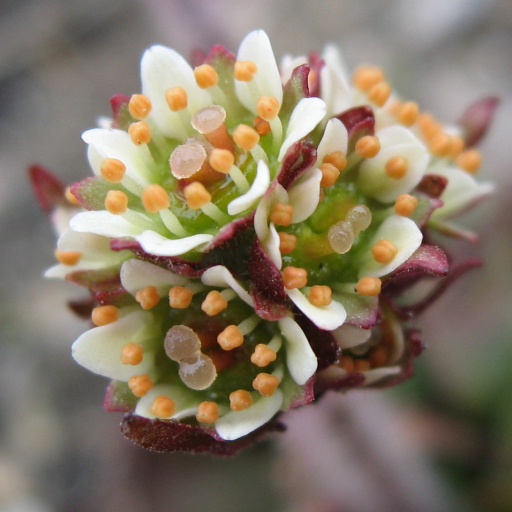
Plant Overview
Known as the Snow Saxifrage, this resilient little mountain dweller thrives where few others dare to grow. Found clinging to rocky ledges in the Arctic and high alpine zones, it is a true symbol of endurance against the elements. Its name, Saxifraga, literally translates from Latin as "stone-breaker," a nod to the ancient belief that these plants could crack solid rock with their determined roots.
🔍 How to Identify
- 🍃 The Rosette: The plant grows in a tight, ground-hugging circle of leathery leaves. These leaves are spoon-shaped with "toothed" edges and often sport a deep purple or reddish hue on their undersides to help absorb heat from the cold ground.
- 茎 The Stalk: A single, leafless stem rises from the center of the rosette. It is covered in fine, sticky hairs (glandular) which help protect the plant from crawling insects and extreme cold.
- 🌸 The Blooms: Tiny white or pale pink flowers gather in a dense, almost flat-topped cluster. Each flower features five delicate petals and ten stamens, usually appearing just as the mountain snow begins to melt.
🏡 In Your Garden
- 🏔️ Mountain Mimicry: If you are attempting to grow this in a rock garden or alpine trough, it requires a "scree" environment. This means plenty of grit, gravel, and sharp drainage. It hates "wet feet" and will quickly rot if water sits in the center of the rosette.
- ❄️ The Chill Factor: This is not a plant for the tropics. It is an "obligate" cold-dweller, meaning it requires a significant period of freezing temperatures in the winter to remain healthy. It struggles significantly in high humidity or sweltering summer nights.
⚠️ Safety & Toxicity
- ✅ Non-Toxic: Saxifraga nivalis is generally considered safe and non-toxic to humans, dogs, and cats.
- 🧤 Delicate Nature: While it isn't poisonous, it is an incredibly slow grower. In its natural habitat, a plant just a few inches wide might be decades old. If you find one in the wild, avoid touching or stepping on it, as it lacks the "rebound" strength of lowland weeds.
✨ Fun Fact
The Snow Saxifrage is a true "extremophile." It has been documented growing on some of the northernmost pieces of land on Earth, surviving temperatures as low as -40°C by producing special "anti-freeze" proteins in its cells!

Detailed Care Instructions
To water this particular plant, it is important to keep the soil consistently moist but not waterlogged. Always ensure the soil has proper drainage to avoid water accumulation which can lead to root rot. It is recommended to water this plant thoroughly once a week and allow the soil to dry out slightly between watering intervals. Use room temperature water to avoid shocking the plant’s roots. Finally, avoid getting water on the plant’s foliage to prevent fungal and bacterial diseases.
Saxifraga Nivalis is a type of plant that requires well-draining soil with sufficient nutrients. The soil should be slightly acidic to slightly alkaline, with a pH range of 6.0 to 7.5. It is recommended to use a mix of sand and loam soil, with added peat moss or perlite to improve drainage. The soil should be moist but not overly saturated, as the plant does not like to sit in water. Additionally, the plant should be grown in a location with full to partial sunlight and protected from strong winds.







