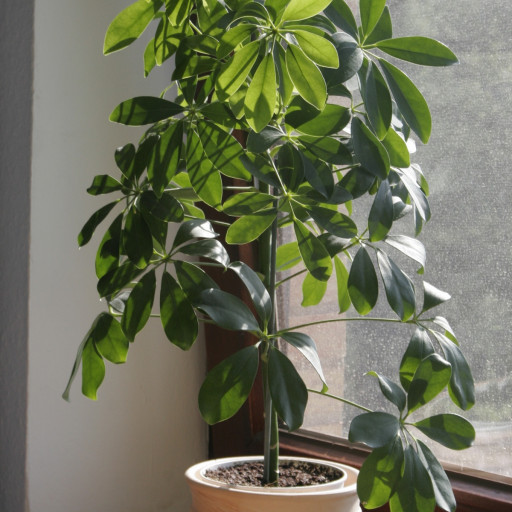
Plant Overview
Often called the "Umbrella Tree" because of its whimsical, spoke-like foliage, the Schefflera is a classic staple of indoor jungles. Originally hailing from the tropical rainforests of Taiwan and Australia, it has earned a reputation for being a resilient "survivor" plant that adds a dramatic, lush canopy feel to any room. Whether it is the towering S. actinophylla or its more compact "dwarf" cousin, this plant is a master of filtering indoor air while looking effortlessly stylish.
🔍 How to Identify
- ☂️ Leaf Arrangement: The most striking feature is its "palmate" leaf structure, where multiple leaflets radiate from a central point like the ribs of an umbrella.
- ✨ Leaf Texture: The leaves are typically thick, leathery, and possess a high-gloss finish that reflects light beautifully.
- 🪵 Growth Habit: While it starts as a bushy shrub, it eventually develops a sturdy, woody trunk and can reach the ceiling if given the space to climb.
🏡 In Your Garden
- ✂️ The Pruning Paradox: Schefflera is incredibly forgiving of "haircuts." If it becomes too leggy or sparse, pinching off the growing tips or cutting the main stem encourages it to branch out, resulting in a much fuller, bushier appearance.
- 🚿 The Drainage Dance: While it loves a tropical vibe, its roots are highly sensitive to "wet feet." It prefers a "soak and dry" method, mimicking the heavy rainfall of its native habitat followed by a period of drainage.
- 🌞 Light Sensitivity: It is a flexible roommate; while it craves bright, indirect light to stay vibrant, it can adapt to lower-light corners, though its growth will slow down and variegated varieties may turn solid green.
⚠️ Safety & Toxicity
- 🚫 Toxic to Pets: Schefflera contains insoluble calcium oxalate crystals. If chewed by cats or dogs, it causes intense oral irritation, drooling, and swelling of the mouth.
- 🧴 Skin Irritant: The sap can cause mild skin irritation or a "prickly" rash in sensitive individuals. It is best to wear gloves when pruning or cleaning up fallen leaves.
✨ Fun Fact
- 🧧 In the practice of Feng Shui, the Schefflera is often used as a "wealth" plant. The way the leaves fan out like a hand is said to "capture" positive energy and good fortune, holding it within the home.

Detailed Care Instructions
| Color | White, Pink, Or Red |
| Soil Ph | Acidic To Slightly Alkaline |
| Humidity | High |
| Lighting | Part Sun |
| Toxicity | Poisonous |
| Soil Type | Rich And Moist |
| Bloom Time | Summer |
| Difficulty | Medium |
| Plant Type | Evergreen Shrub |
| Hibernation | Cold Period |
| Mature Size | 12 To 15 Feet Tall |
| Native Area | Taiwan |
| Temperature | 18°C - 25°C |
| Sun Exposure | Bright, Indirect Light |
| Hardiness Zones | 10, 11 |
To grow a Schefflera plant, follow these guidelines:
- Choose the right location: Schefflera plants prefer bright, indirect light. Avoid placing them in direct sunlight as it can scorch the leaves. They can tolerate some shade, but their growth may be slower.
- Plant it in well-draining soil: Use a well-draining potting mix that retains some moisture but doesn't become waterlogged. Ensure the pot has drainage holes to prevent waterlogging.
- Water it properly: Schefflera plants like to be evenly moist but not waterlogged. Allow the top inch of soil to dry out before watering again. Overwatering can lead to root rot, while underwatering can cause leaf drop.
- Fertilize regularly: Feed the Schefflera plant with a balanced, water-soluble fertilizer every two to four weeks during spring and summer. Reduce the frequency to once a month during fall and winter. Follow the fertilizer packaging instructions for proper dosage.
- Prune it occasionally: Pruning helps maintain the plant's shape and encourages bushier growth. Remove any dead or yellowing leaves, as well as overcrowded branches. Prune in spring or early summer for best results.
- Provide humidity: Schefflera plants thrive in slightly higher humidity levels. Mist the leaves with water every few days to increase humidity. Placing a tray of water near the plant can also help create a humid microclimate.
- Monitor for pests: Keep an eye out for common pests like spider mites, scale insects, and mealybugs. Regularly inspect the plant's leaves and stems for any signs of infestation, and treat with insecticidal soap or neem oil if required.
- Propagate if desired: Schefflera plants can be propagated through stem cuttings. Take a 4-6 inch cutting from a healthy, mature plant and remove the bottom leaves. Place the cutting in a container with moistened potting mix, and keep it warm and humid until roots develop.
By following these care instructions, you can successfully grow and maintain a Schefflera plant.

Place in a window with dappled sun or a spot in the middle of a room. Or directly in a window facing west or east.

To properly water this plant, you should first wait until the top inch of soil feels dry to the touch. When it is time to water, slowly pour water into the soil until it begins to drain out of the bottom of the pot. Be sure not to let the plant sit in any standing water, as this can lead to root rot. During the winter months, you may need to water less frequently, as the plant's growth slows down.
First, select a water-soluble fertilizer with a balanced N-P-K ratio. Mix the fertilizer according to the package directions, and allow the solution to cool to room temperature. Water the soil around the plant evenly with the fertilizer solution, taking care not to splash the fertilizer on the foliage. Repeat this process every two weeks during the growing season, and reduce fertilization during the winter months. Avoid over-fertilizing, as this can harm the plant. Monitor the plant’s overall health and adjust the fertilization schedule as necessary.
The ideal soil for this plant is a well-draining, slightly acidic soil that is rich in organic matter. A mix of peat moss, perlite, and sand can create a suitable growing medium. It is important that the soil does not retain too much moisture, as this can lead to root rot. The pH level of the soil should be around 6.0 to 6.5. The soil must be able to hold moisture, but not too much, because over-fertilization occurs when the soil is oversaturated with water, which can be detrimental to the plant's health.
To propagate this plant, you will need to take a cutting from the stem. Use a clean sharp knife or scissors to make a diagonal cut at the base of a healthy stem. The cutting should be at least 4-6 inches long and have a few leaves attached to it.
Remove the bottom leaves from the stem, leaving only 2-3 leaves at the top. This will help reduce water loss and allow the cutting to focus its energy on root growth.
Prepare a well-draining potting mixture by mixing equal parts sand, perlite, and peat moss. Moisten the potting mixture with water until it is slightly damp but not soaking wet.
Dip the base of the cutting into rooting hormone powder and gently tap off excess powder. Make a small hole in the potting mixture using a pencil or your finger and insert the cutting into the hole.
Cover the pot with a plastic bag or clear plastic wrap to create a warm and humid environment for the cutting. Place the pot in indirect light and keep the potting mixture moist but not waterlogged.
In a few weeks, you should start to see new growth on the cutting, which is an indication that root growth has begun. After a few more weeks, gently tug on the cutting to see if it has rooted. If you feel resistance, then the cutting has rooted and can be carefully transplanted into its own pot with well-draining potting soil.
Continue to care for the new plant as you would with a mature Schefflera plant, making sure it has plenty of bright indirect light and watering when the soil feels dry to the touch.







