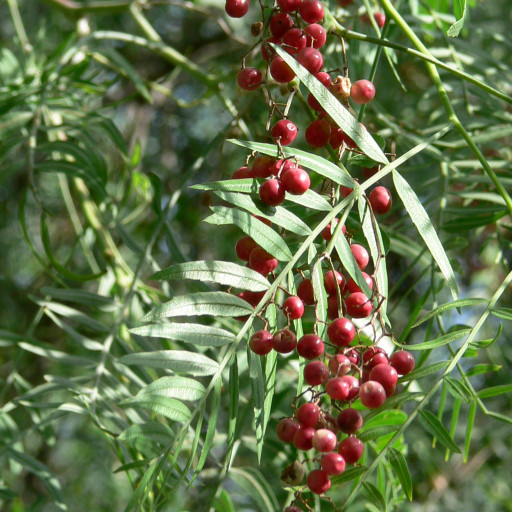
Plant Overview
Known as the "Peruvian Pepper Tree" or the "California Pepper," Schinus molle is a graceful evergreen that seems to dance in the wind. While its pink berries look like common peppercorns, it actually belongs to the Cashew and Sumac family. In its native Andes, it has been revered for centuries as a "tree of life" due to its medicinal versatility and its role in ancient rituals.
🔍 How to Identify
- 🌿 Feathery Foliage: Its leaves are long, drooping, and pinnately compound, creating a delicate, fern-like appearance that casts soft, dappled shade.
- 🪵 Gnarled Trunk: Mature trees develop a rugged, twisted trunk with greyish-brown bark that peels away in plates, revealing a reddish inner layer.
- 🍒 Rosy Berries: Female trees produce heavy, cascading clusters of tiny, round fruits that transition from a pale green to a vibrant, papery rose-pink.
🏡 In Your Garden
- 🏗️ Root Management: While it is a stunning shade tree, be mindful of its shallow, aggressive root system; it can easily lift sidewalks or interfere with underground pipes if planted too close to home structures.
- ☀️ Drought Champion: These trees are masters of the heat and thrive in full sun. They prefer well-draining soil and need very little supplemental water once their roots are established, making them ideal for low-maintenance landscapes.
⚠️ Safety & Toxicity
- 🐾 Moderate Risk: While the berries are sold commercially as "pink peppercorns," they can cause digestive upset in children and pets if consumed raw in large quantities.
- 🦢 Avian Warning: The berries are known to be toxic to certain birds and poultry; it is best to avoid planting this tree near chicken coops or aviaries.
- 🧴 Sap Sensitivity: Some individuals may experience mild skin irritation (dermatitis) when pruning the tree, as the sap contains volatile oils similar to those in its cousin, poison ivy.
✨ Fun Fact
In the Incan Empire, the resin of the Schinus molle was used as a powerful antiseptic and for embalming the dead, while the sweet outer pulp of the berries was fermented into a traditional alcoholic drink called chicha de molle.

Detailed Care Instructions
| Lighting | Full Sun |
| Hardiness Zones | 8A - 11 |
To grow Schinus molle, also known as the Peruvian pepper tree, you can follow these steps:
- Find a suitable location: Schinus molle prefers full sun but can tolerate partial shade. It is also important to ensure that the soil is well-draining.
- Prepare the soil: Before planting, amend the soil with organic matter such as compost to improve its fertility and drainage. The pH should ideally be slightly acidic to neutral (pH 6.0-7.0).
- Obtain seeds or plant: You can propagate Schinus molle from seeds or purchase a young plant from a nursery. Seeds can be collected from the tree if available or obtained from seed suppliers.
- Sow the seeds or transplant the seedling: If using seeds, sow them in seed trays or pots filled with seed-starting mix. Cover the seeds lightly with soil, keeping them moist but not waterlogged. Once the seedlings are around 15-20 cm tall, gently transplant them into a larger container or directly into the ground.
- Watering: While establishing, water the plant regularly to keep the soil consistently moist. Once the plant matures, it becomes quite drought-tolerant and will not require frequent watering.
- Pruning and maintenance: Schinus molle has a rapid growth rate, so occasional pruning may be required to shape the tree and remove any dead or damaged branches. This plant is usually low-maintenance and doesn't require extensive care.
- Mulching: Apply a layer of organic mulch around the base of the tree to help retain soil moisture, suppress weed growth, and regulate soil temperature.
- Fertilization: Schinus molle generally does not require heavy fertilization unless the soil is poor. If needed, you can apply a balanced, slow-release fertilizer once a year in spring.
- Pest and disease control: Schinus molle is generally resistant to pests and diseases. However, occasional infestations of aphids, scale insects, or caterpillars may occur. Monitor your plant regularly, and if necessary, use organic insecticidal sprays or insecticidal soap to control pests.
- Harvesting: Schinus molle produces small red berries known as "pepper berries." These berries can be harvested when ripe and used as a spice or seasoning. However, note that the berries on female trees are the ones commonly harvested, while male trees do not produce fruit.
Remember to consult local gardening resources or experts for specific cultivation guidelines to ensure success in your specific gardening zone.

Place in a bright room that is sun drenched almost all day. Or directly in a south-facing window.

To properly water this plant, it is important to first understand its watering needs and preferences. Schinus Molle plants usually thrive in well-draining soils that are kept consistently moist, but never waterlogged.
To water the plant, use a watering can or hose with a gentle flow. Slowly pour the water onto the soil around the base of the plant, making sure to distribute the water evenly. Avoid getting water on the leaves or foliage, as this can promote fungal growth or cause damage to the plant.
During periods of hot weather or drought, it may be necessary to water the plant more frequently to prevent it from drying out. However, be careful not to overwater the plant, as this can also lead to root rot or other issues.
To check if the plant needs water, stick your finger into the soil up to the first knuckle. If the soil feels dry, it's time to water. If the soil is still moist, wait a few more days before watering again.
Overall, it's important to be attentive to the plant's individual watering needs and adjust the watering schedule accordingly.
To fertilize this plant, apply a complete fertilizer with equal amounts of nitrogen, phosphorus, and potassium once a month during the growing season, from spring to autumn. Use a slow-release fertilizer or a liquid fertilizer diluted to half-strength. Water the plant well before and after fertilizing to prevent root burn. Avoid fertilizing during the dormant period, in winter.
The recommended soil for Schinus Molle plants is a well-draining, nutrient-rich loamy soil that is slightly acidic to neutral in pH. The soil should be loose and friable to allow for root development and water infiltration, and should not be too heavy or compacted. It is also important to ensure that the soil is not waterlogged, as this can lead to root rot and other problems. In addition to soil, it is recommended to add organic matter such as compost or well-rotted manure, to improve soil structure and fertility. It is advisable to conduct a soil test to determine the specific nutrient needs of the plant, and to adjust soil fertility accordingly.
Schinus Molle is a plant that can be propagated through various methods such as seeds, stem cuttings, and layering. Here are the steps on how to propagate Schinus Molle using stem cuttings:
- Choose a healthy parent plant with a mature stem. Make sure that the plant is disease-free and has no signs of pests or damage.
- Cut a stem from the parent plant using a sharp and sterilized cutting tool, such as a pair of pruning shears or scissors. The stem should be at least 6 inches long and have several leaves attached to it.
- Remove the lower leaves from the stem, leaving only a few leaves at the top.
- Dip the cut end of the stem into a rooting hormone powder or liquid. This will encourage root growth.
- Fill a small pot with a well-draining potting mix and make a hole in the center of the soil using a pencil or skewer.
- Insert the prepared stem into the hole and gently press the soil around it to secure the cutting in place.
- Water the cutting thoroughly and cover it with a clear plastic bag or a propagator lid to create a humid environment. This will help to prevent moisture loss and promote rooting.
- Place the pot in a warm and bright location but away from direct sunlight. Keep the soil moist but not waterlogged, and mist the leaves occasionally to maintain humidity.
- After about four to six weeks, check if the cutting has rooted by gently tugging on it. If there is resistance, then roots have formed. You can now remove the plastic bag or propagator lid and move the new plant to a larger pot or the garden.
By following these steps, you can successfully propagate Schinus Molle plant from stem cuttings and enjoy its beauty in your home or garden.
Common pests of the peruvian peppertree include Scale insect, mealybugs, spider mites. Make a habit of checking your peruvian peppertree frequently for pests so that any infestations can be caught and managed early.








