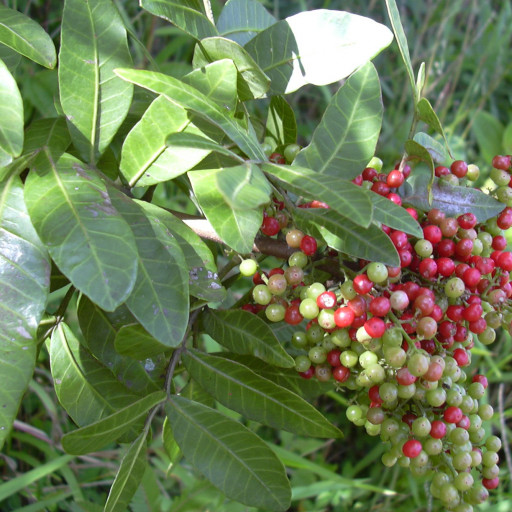
Plant Overview
Often called the "Christmasberry" or "Florida Holly," the Brazilian Peppertree is a master of disguise. Once imported as a charming ornamental for its festive red berries, it has since become a formidable ecological invader across the southern United States and other tropical regions. Its ability to grow almost anywhere makes it a fascinating, if stubborn, resident of the landscape.
🔍 How to Identify
- 🌿 Leaf Structure: It features compound leaves usually made up of 7 to 9 leaflets. Look for a reddish tint on the central leaf stem (rachis), which is often slightly "winged" or flattened.
- 🔴 The Berries: In late autumn and winter, the tree produces dense, heavy clusters of small, glossy red fruits. These berries are the plant's primary way of spreading via birds.
- 👃 Scent: If you crush a leaf, it releases a sharp, spicy aroma that smells like a mix of turpentine and cracked black pepper.
🏡 In Your Garden
- 🌳 The Opportunist: This plant is legendary for its resilience. It thrives in almost any soil, from swampy wetlands to dry, sandy hillsides. Because it grows so aggressively, it often shades out and "chokes" neighboring plants.
- ✂️ Difficult to Deter: Simply cutting it down rarely works; the stump is known to send up dozens of new "suckers" or shoots almost immediately. In many regions, it is classified as a noxious weed, and homeowners are encouraged to remove it entirely to protect local biodiversity.
⚠️ Safety & Toxicity
- 🧴 Skin Sensitivity: As a member of the Anacardiaceae (Cashew) family, it is a cousin to Poison Ivy. The sap contains resins that can cause itchy skin rashes or respiratory irritation, especially when the tree is in bloom.
- 🐾 Animal Warning: While birds frequently eat the berries, they can have a "narcotic" or intoxicating effect on them. The berries and leaves are toxic to horses and can cause significant digestive upset in dogs and cats.
✨ Fun Fact
Despite its name, the "peppers" from this tree aren't the same as the black pepper on your table. While a close relative (Schinus molle) produces the "Pink Peppercorns" found in gourmet shops, the Brazilian Peppertree's berries are generally avoided for consumption because they can be toxic in large quantities!

Detailed Care Instructions
| Humidity | Normal |
| Lighting | Part Sun |
| Toxicity | Poisonous |
| Difficulty | Medium |
| Hardiness Zones | 9 - 11 |
To grow Schinus terebinthifolia, also known as Brazilian peppertree, follow these steps:
- Obtain seeds or a young sapling: You can find seeds or young saplings at local nurseries or through online plant sellers.
- Choose the right location: The Brazilian peppertree thrives in full sun but can tolerate partial shade. Select a spot that receives at least six hours of direct sunlight daily.
- Prepare the soil: The plant prefers well-draining soil, so make sure the soil has good drainage. If the soil is heavy or clay-like, amend it with compost or other organic matter to improve drainage.
- Plant the seeds or sapling: If starting from seeds, sow them directly into the ground at a depth of about 1/4 inch and lightly cover with soil. If planting a sapling, dig a hole slightly larger than the root ball and place the sapling in, backfilling with soil and firming it gently around the base.
- Water regularly: Keep the soil consistently moist but avoid overwatering, as excessive water can lead to root rot. Water the plant deeply once or twice a week, depending on rainfall and the moisture needs of the plant.
- Mulch the area: Apply a layer of mulch around the base of the plant to help retain moisture, suppress weed growth, and insulate the roots from extreme temperatures.
- Prune if needed: Brazilian peppertree is a fast-growing plant that can become large and unruly. Periodically prune to shape the tree and control its size. Pruning also helps to remove dead, damaged, or diseased branches.
- Fertilize sparingly: Brazilian peppertree does not require heavy fertilization. Apply a balanced, slow-release fertilizer once a year in the spring to supply essential nutrients.
- Protect from frost: Brazilian peppertree is sensitive to frost, so if you live in a cold climate, consider wrapping the tree in burlap or covering it with a frost cloth during winter months.
- Monitor for pests and diseases: Brazilian peppertree is generally resistant to pests and diseases; however, occasional problems may occur. Keep an eye out for aphids, scale insects, or leaf spot diseases. Treat as needed using appropriate organic or chemical controls.
With proper care and suitable growing conditions, your Schinus terebinthifolia plant should thrive and grow into a healthy specimen.

Place in a bright room that is sun drenched almost all day. Or directly in a south-facing window.

To water this plant, it is important to first assess the moisture level of the soil by inserting a finger or a moisture meter into the soil. If the soil feels dry to the touch, it is time to water the plant. Using a watering can or hose with a nozzle that can adjust the water flow to a gentle stream, water the soil around the base of the plant until the water begins to seep out from the bottom of the container. It is important to avoid overwatering, as this can lead to root rot and other issues. Allow the soil to dry out slightly between waterings, and adjust the frequency according to the plant's specific needs, as well as the environmental conditions in which it is grown.
To fertilize this plant, use a slow-release fertilizer with a balanced N-P-K ratio, such as a 10-10-10 or 15-15-15. Apply the fertilizer during the growing season, typically in the spring and summer, following the manufacturer’s instructions for the appropriate amount and frequency of application. Avoid over-fertilizing, as this can cause leaf burns and other damage to the plant. Additionally, always water the plant well after fertilization to help the nutrients penetrate down to the roots.
The ideal soil for Schinus Terebinthifolia plant should have good drainage ability and should be rich in nutrients, with adequate levels of organic matter. The soil should have a slightly acidic to a neutral pH range, between 5.5 to 7.0. The plant prefers a soil that is well-aerated and allows for air circulation around the root system, as this helps to prevent root rot and other fungal diseases. A sandy loam soil is generally recommended, as it provides excellent drainage while retaining moisture and nutrients. To ensure optimal growth and health of the plant, it is advisable to use high-quality soil mixtures that are specifically designed for tropical plants, which will provide the right balance of nutrients and minerals needed for growth. It is also important to ensure that the soil is adequately fertilized and that the pH level is regularly monitored and adjusted as needed.
To propagate this plant, you will need to take stem cuttings. Choose a healthy stem from the parent plant that is at least 4-6 inches long. Cut the stem at a 45-degree angle using a sharp, clean knife or pruning shears. Remove any leaves from the bottom two-thirds of the stem.
Prepare a pot with a well-draining soil mixture. Dip the cut end of the stem into rooting hormone powder and then plant the stem into the soil, burying the bottom two-thirds of the stem.
Water the cutting and cover the pot with a clear plastic bag to create a humid environment. Place the pot in a bright, indirect light location, but avoid direct sunlight.
Keep the soil moist by misting the cutting with a spray bottle or watering lightly as needed. In around 2-3 weeks, the cutting should start to root and new growth will appear. Once the plant is established, you can transfer it to a larger pot or into your garden.








