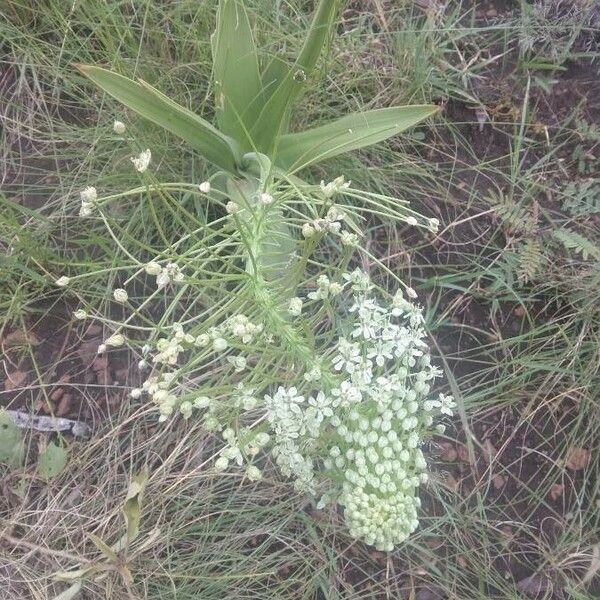
Plant Overview
Often referred to as the White Scilla or the White Paintbrush, Schizocarphus nervosus is a resilient and charming bulbous plant native to the vast grasslands of Southern Africa. Emerging with the first rains, it sends up elegant, wand-like flower spikes that look like clusters of tiny, sparkling pearls against the wild grass. In its native habitat, it is a sign of shifting seasons and the rebirth of the veld.
🔍 How to Identify
- ☁️ Flower Spike: A dense, upright raceme packed with dozens of small, star-shaped white flowers that bloom from the bottom upward.
- 📏 Nervous Leaves: Long, strap-like leaves characterized by very prominent longitudinal veins or "nerves," which give the plant its specific name, nervosus.
- 🧅 The Bulb: A sturdy, pear-shaped bulb covered in dark, papery tunics, often sitting just below the soil surface or slightly exposed in rocky terrain.
🏡 In Your Garden
- 🌱 Seasonal Rhythm: This plant follows a strict seasonal clock. It thrives during wet summers but requires a completely dry "rest" period in the winter. If kept in a pot, you must stop watering when the leaves yellow to prevent the bulb from rotting.
- ☀️ Sun Seeker: To prevent the flower stalks from becoming "leggy" or flopping over, it needs bright, direct light. It is perfectly adapted to rock gardens or containers where the soil can drain rapidly after a downpour.
⚠️ Safety & Toxicity
- 🚫 Status: TOXIC to humans and animals.
- 🐾 Details: Like many members of the Hyacinth family, it contains cardiac glycosides. If ingested, it can cause severe stomach upset, drooling, and in high quantities, heart rhythm issues. Keep it out of reach of curious pets and toddlers.
✨ Fun Fact
The genus name Schizocarphus comes from the Greek words for "split" and "chaff," referring to the way the small bracts (the leaf-like structures under the flowers) appear divided or torn. In traditional Southern African medicine, despite its toxicity, the bulb has been historically used in very specific, small-scale preparations to treat everything from rheumatic fever to infections.

Detailed Care Instructions

Place in a window with dappled sun or a spot in the middle of a room. Or directly in a window facing west or east.

Some plants require more regular watering than others, which should be done every few days. It's critical to maintain the soil moist all of the time. The water requirements of the same plant placed in pots with varying sizes will differ. Because the water in the smaller pot evaporates faster than the water in the larger pot, it will require more watering. Regardless of pot size, the surface should constantly be maintained moist.








