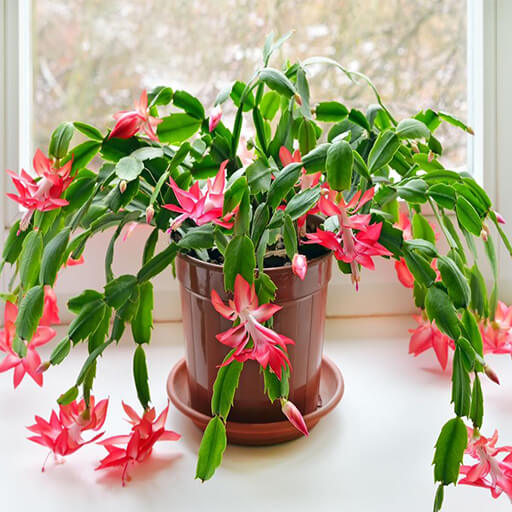
Plant Overview
Known as the quintessential holiday plant, the Christmas Cactus is a living heirloom often passed down through generations. Unlike its prickly desert cousins, this "jungle cactus" hails from the humid coastal mountains of Brazil, where it grows nestled in the nooks of trees rather than in the sand. It is beloved for its dramatic, pendulous blooms that arrive exactly when the winter landscape looks its bleakest.
🔍 How to Identify
- 🌿 Stem Segments: The "leaves" are actually flattened stem segments called phylloclades. They are smooth, fleshy, and lack true spines.
- 🍃 Rounded Margins: You can tell this apart from the "Thanksgiving Cactus" by its edges; the Christmas variety has scalloped, rounded margins rather than sharp, saw-like teeth.
- 🌸 Pendulous Flowers: The blooms are tubular and multi-tiered, hanging gracefully downward from the tips of the stems in vibrant shades of magenta, red, or white.
🏡 In Your Garden
- ☁️ Rainforest Roots: Because it is an epiphyte (a plant that grows on other plants), it craves high humidity and bright, indirect light. It will scorch if placed in the direct, harsh sun that a typical desert cactus enjoys.
- 🌑 The "Dark" Secret: To trigger those iconic winter flowers, the plant requires a "dormancy" period. It needs roughly 12 to 14 hours of total darkness and cooler temperatures in the fall to set its buds.
- 💧 Drainage is Key: While it likes more water than a globe cactus, it is highly susceptible to root rot. Use a light, airy potting mix (like an orchid or succulent blend) and never let it sit in a saucer of water.
⚠️ Safety & Toxicity
- ✅ Non-Toxic: Good news for pet owners—the Christmas Cactus is considered non-toxic to cats, dogs, and horses by the ASPCA.
- 🤢 Mild Sensitivity: Even though it isn't poisonous, the fibrous stems can cause mild stomach upset or vomiting if a curious pet decides to snack on a large portion.
✨ Fun Fact
These plants are incredibly long-lived and resilient. There are documented cases of Christmas Cactuses being kept alive and blooming within the same family for over 100 years, making them a true botanical legacy!

Detailed Care Instructions
To grow Schlumbergera Bridgesii, also known as the Christmas cactus or Thanksgiving cactus, you can follow these steps:
- Choose a suitable location: The Schlumbergera Bridgesii plant prefers bright indirect light. It should be placed in a well-lit area of your home without direct sunlight. A north or east-facing window is often a good location.
- Temperature and humidity: These plants prefer cooler temperatures between 60-70°F (15-21°C). Avoid placing them in areas with extreme temperatures, such as near heating vents or cold drafts. Maintain a moderate level of humidity by placing the pot on a tray filled with water and pebbles.
- Watering: Water the plant thoroughly when the top inch of the soil feels dry. Overwatering can lead to root rot, so make sure the pot has proper drainage. Schlumbergera Bridgesii is a tropical plant, so it’s important to provide consistent moisture, but do not let the plant sit in water.
- Fertilizer: During the growing season (spring and summer), feed the plant with a balanced liquid fertilizer once a month. Dilute the fertilizer to half-strength to avoid over-fertilization.
- Repotting: As the plant grows, you may need to repot it every 2-3 years. Use a well-draining potting mix specifically formulated for cacti or succulents. Repot in the spring, after the blooming period.
- Pruning: After the blooming period, you can prune the plant to encourage branching and fuller growth. Remove any dead or damaged stems, and lightly shape the plant to your desired form.
- Blooming: Schlumbergera Bridgesii typically blooms around Thanksgiving or Christmas. To promote blooming, provide the plant with 12-14 hours of uninterrupted darkness for about 6 weeks before the desired blooming time. This can be achieved by covering the plant with a box or moving it to a dark location during the evening hours.
By following these care instructions, you can help your Schlumbergera Bridgesii plant thrive and enjoy its beautiful blooms during the holiday season.

Place in a window with dappled sun or a spot in the middle of a room. Or directly in a window facing west or east.

To water this plant, thoroughly moisten the soil until water begins to drain out of the bottom of the pot. Allow the soil to dry slightly before watering again, typically once a week. Be sure not to allow the plant to sit in standing water as this can lead to root rot. It is also important to avoid getting water on the foliage as this can lead to disease and damage. To maintain proper moisture levels, consider using a well-draining potting mix and placing a layer of rocks or gravel in the bottom of the pot to aid in drainage.
To provide proper nutrients for this plant, use a balanced fertilizer with equal amounts of nitrogen, phosphorus, and potassium. Dilute the fertilizer to half strength and apply it once a month during the growing season (spring and summer). Water the plant lightly before applying the fertilizer to avoid burning the roots. Avoid fertilizing during the dormant season (fall and winter) as it can lead to over-fertilization and damage to the plant.
The ideal soil for the plant in question is a well-draining mix that provides adequate moisture retention without causing the roots to become waterlogged. This can typically be achieved by combining coarse sand or perlite with a high-quality potting mix, and adding in organic material such as peat moss or coconut coir to help improve soil structure and fertility. Additionally, it is recommended to avoid using heavy clay or other compacted soils, as these can limit the plant's ability to access necessary nutrients and water.
To propagate this plant, take a cutting of a stem that has healthy, mature leaves and no signs of disease or damage. Allow the cutting to dry for a few days before planting it in a well-draining potting mix. Keep the soil consistently moist but not waterlogged, and place the cutting in a warm, brightly lit area but avoid direct sunlight. Over time, the cutting will begin to develop roots and new growth, at which point it can be transplanted into a larger pot or into the ground if conditions are right. Regular care, including fertilization and pruning as needed, can help ensure successful growth and propagation of this plant.








