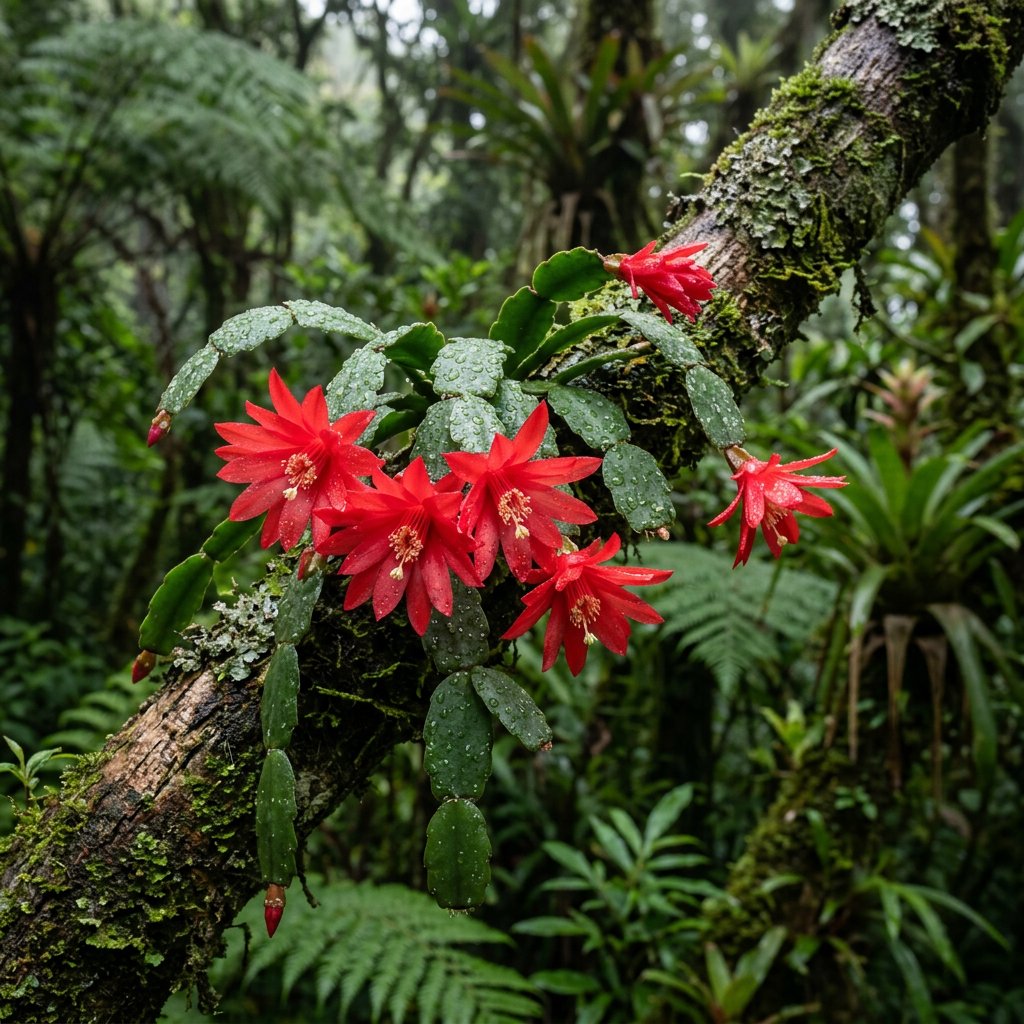
Plant Overview
Known affectionately as the Easter Cactus, Schlumbergera gaertneri is a festive favorite that brings a burst of joy just as spring begins to wake up. Unlike its desert-dwelling cousins, this plant is a tropical "jungle cactus" hailing from the humid rainforests of Brazil. It has traded sand and spines for lush, cascading segments and vibrant, star-burst flowers that traditionally bloom around the Easter holiday.
🔍 How to Identify
- 🌸 The Bloom Shape: Unlike the elongated, asymmetrical tubes of the Christmas cactus, the Easter cactus produces perfectly symmetrical, star-shaped flowers with pointed petals.
- 🍃 Leaf Segments: The flattened stems (cladodes) are oblong with small, rounded notches or "scallops" along the edges, often tinged with a subtle reddish-purple border when exposed to bright light.
- 🧶 Bristly Areoles: At the tips of the segments, you will find tiny, brownish bristles or "hairs" from which the flower buds emerge, a distinct feature that sets it apart from its winter-blooming relatives.
🏡 In Your Garden
- ☁️ Humidity is Key: Because it is an epiphyte (a plant that grows on trees), it craves moisture in the air rather than soggy soil. It thrives in a bathroom or kitchen where steam is common, but it absolutely hates "wet feet," which can lead to root rot.
- 🌡️ Temperature Triggers: To get those famous blooms, this plant needs a "resting period" during the winter with cooler temperatures and long, uninterrupted nights. If your house is too warm or bright at night in January, it may refuse to flower in the spring.
- 🪴 Pot Bound Preference: This cactus actually prefers its roots to be a bit snug. Avoid frequent repotting, as disturbing the sensitive root system can cause the plant to drop its segments or skip a blooming season.
⚠️ Safety & Toxicity
- ✅ Pet Friendly: The Easter Cactus is considered non-toxic to both cats and dogs, making it a wonderful choice for pet-filled households.
- 🐾 Mild Caution: While not poisonous, if a curious pet chews on the fibrous stems, it could cause minor stomach upset or mechanical irritation to the mouth. It’s always best to keep it on a high shelf where the cascading stems can hang freely.
✨ Fun Fact
The Easter Cactus has undergone a major "identity crisis" in the botanical world! For a long time, it was known as Hatiora gaertneri, but recent DNA testing moved it back into the Schlumbergera family alongside the Thanksgiving and Christmas cacti, finally reuniting the holiday trio under one genus.

Detailed Care Instructions
To grow Schlumbergera Gaertneri, also known as Christmas cactus or Thanksgiving cactus, follow these steps:
- Choose a suitable container: Select a pot with drainage holes that is about one size larger than the current size of your plant. The container should be filled with well-draining potting soil.
- Light requirements: Place your Christmas cactus in a location where it receives bright but indirect light. Avoid direct sunlight, as it can burn the leaves.
- Temperature: Maintain a temperature of around 60-70°F (15-21°C). Avoid exposing the plant to extreme temperature fluctuations.
- Watering: Water your Christmas cactus thoroughly when the top inch of soil feels dry. Allow excess water to drain out of the pot, ensuring that the roots do not sit in water. During winter, reduce watering frequency slightly.
- Humidity: Create a humid environment by placing a tray filled with water near the plant, or mist the leaves occasionally. This mimics its natural habitat.
- Fertilization: Feed the Christmas cactus with a balanced, water-soluble fertilizer every 4-6 weeks during spring and summer. Reduce or stop fertilizing during fall and winter.
- Pruning: Prune your plant in early spring to remove leggy or damaged stems, which helps stimulate new growth and improves its shape.
- Repotting: Repot the Christmas cactus every 2-3 years, preferably in spring, into a slightly larger pot using fresh potting soil.
- Flowering: To encourage blooming, expose the plant to 12-14 hours of darkness daily for about 6-8 weeks before the desired flowering period. This can be achieved by placing the plant in a dark room or covering it with a cloth or box.
- Propagation: Schlumbergera Gaertneri can be propagated easily by taking stem cuttings. Let the cuttings dry for a few days, then insert them into a well-drained potting mix. Keep the soil moist until new growth appears.
By following these guidelines, you should be able to successfully grow your Schlumbergera Gaertneri plant.

Place in a window with dappled sun or a spot in the middle of a room. Or directly in a window facing west or east.

The plant should be watered when the soil is dry to the touch. Watering should be done evenly around the plant and should be allowed to drain out of the pot. The plant should not be allowed to sit in water as it can lead to root rot. It is recommended to use room temperature water that has been allowed to sit and dechlorinate for at least 24 hours. Over-watering can cause the plant to wilt, so it is important to monitor the soil moisture levels and adjust the watering schedule accordingly.
To fertilize this plant, make sure to use a balanced fertilizer with equal amounts of nitrogen, phosphorus, and potassium. Apply the fertilizer every two weeks during the growing season, which begins in early spring and ends in late summer. During the winter months, reduce fertilization to once a month. Always follow the package instructions for the recommended amount of fertilizer to use for your plant size. Over-fertilization can damage this plant, so be careful not to use too much.
When planting Schlumbergera Gaertneri, it is recommended to use a well-draining soil that is slightly acidic with a pH between 5.5-6.0. The soil should be rich in organic matter and nutrient-dense, containing plenty of nitrogen, phosphorus, and potassium. A mix of peat moss, perlite, and sand can be a good option for this plant. The soil should not be too compacted but should have a loose texture that allows for proper drainage and aeration. It is also essential to water the plant regularly and avoid overwatering to prevent soil saturation and root rot.
There are several different methods that can be used to propagate this plant. One common method is by taking stem cuttings. To do this, select a healthy stem from the plant and cut a section from it that is at least 4-6 inches long with several leaves attached. Make sure to use a clean, sharp pair of scissors or pruning shears to make the cut.
Once you have your cutting, remove the bottom few leaves to create a bare stem. Dip the cut end of the stem into rooting hormone powder to encourage rooting and insert it into a pot filled with a well-draining potting mix. Water the soil thoroughly and place the pot in a warm, bright location out of direct sunlight.
Another method is by dividing the plant. This can be done if the plant has multiple stems growing from the base. Carefully dig up the plant and separate the stems at the root. Repot each individual stem in a separate pot with fresh potting soil and water thoroughly.
Schlumbergera Gaertneri can also be propagated by seed, although this method requires more time and patience. Collect seeds from the plant when the flowers have faded and the seed pods have dried. Sow the seeds in a pot filled with well-draining potting soil, covering them lightly with soil. Keep the soil moist and warm and wait for the seeds to germinate, which can take several weeks to months.
Regardless of the propagation method, make sure to keep the new plants well-watered and in a warm, bright location. With proper care, Schlumbergera Gaertneri can quickly grow into healthy, mature plants.
Common pests of the easter cactus include Mealybugs, spider mites, thrips. Make a habit of checking your easter cactus frequently for pests so that any infestations can be caught and managed early.








