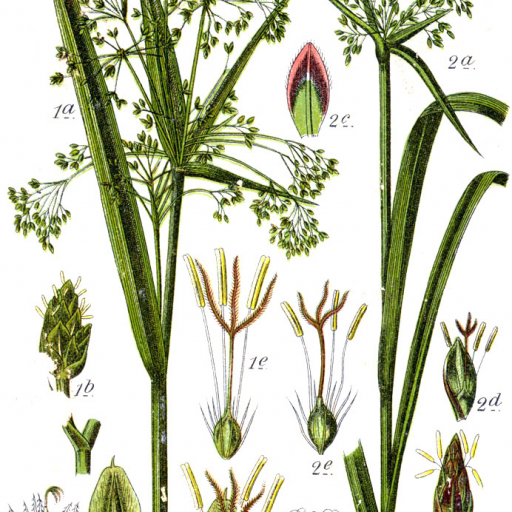
Plant Overview
Known as the Rooting Club-rush, this elegant, grass-like perennial is a master of the "slow-motion stroll." Found across Eurasia, it is famous among botanists for its peculiar way of spreading: its long, arching stems curve down to touch the mud, where they take root and sprout a brand-new plant. It’s a favorite for naturalistic pond edges and bog gardens where it can "walk" freely along the shoreline.
🔍 How to Identify
- 🌿 The "Walking" Stems: Look for long, sterile stems that arch gracefully toward the ground; if the tip touches moist soil, it will likely have small roots forming.
- 🌾 The Seed Clusters: The flowering tops feature a delicate, branched umbrella (umbel) of small, reddish-brown, egg-shaped spikelets.
- 📐 Triangular Culms: Like many members of the sedge family, the stems are somewhat triangular in cross-section, though they feel smooth and sturdy to the touch.
🏡 In Your Garden
- 💧 The Mud Factor: This plant isn't just a water lover; it’s a "wet feet" specialist. It performs best in heavy, silty clay or rich mud at the very edge of a pond or in a consistently soggy marsh.
- 🏃 Space to Wander: Because of its rooting stems, it can bridge gaps and colonize empty patches of mud quickly. If you have a small water feature, consider planting it in a submerged container to keep its "walking" habit under control.
⚠️ Safety & Toxicity
- ✅ Safe Status: Scirpus radicans is generally considered non-toxic to humans, dogs, and cats.
- ✂️ Mechanical Irritation: While not poisonous, the leaf edges can be quite coarse and sharp. Handling the plant without gloves might result in small "grass cuts," so use caution when thinning out a dense patch.
✨ Fun Fact
The species name radicans literally translates from Latin to "rooting." It describes the plant's unique survival strategy: while most plants rely only on seeds or underground runners, this bulrush uses its own height to "leapfrog" across the mud!

Detailed Care Instructions
To grow Scirpus Radicans (commonly known as Soft Rush), you can follow these steps:
- Choose the right location: Scirpus Radicans needs a sunny spot with moist, well-drained soil. Ensure there is enough space for the plant to grow, as it can reach heights of up to 2 to 3 feet.
- Prepare the soil: Before planting, prepare the soil by removing any weeds or grass from the area. Loosen the soil using a garden fork or tiller and amend it with organic matter like compost or well-rotted manure to improve drainage and fertility.
- Sowing seeds: Scirpus Radicans can be grown from seeds or you can purchase young plants from a local nursery. If using seeds, scatter them on the prepared soil, ensuring they are evenly spaced. Lightly cover the seeds with a thin layer of soil and gently press them down.
- Watering: Keep the soil consistently moist but avoid waterlogging. Water the plants regularly, especially during dry spells, to maintain the required moisture level.
- Mulching: Apply a layer of organic mulch around the base of the plants. This will help retain moisture in the soil, suppress weed growth, and provide some insulation during extreme temperatures.
- Maintenance: Remove weeds as they appear to prevent competition for nutrients and water. Additionally, you can fertilize Scirpus Radicans annually in early spring with a balanced, slow-release fertilizer to promote healthy growth.
- Pruning: Prune the plant in early spring to remove any dead or damaged stems. This will help maintain its shape and promote new growth.
- Overwintering: In colder regions, Scirpus Radicans may require some protection during winter months. Mulch the base of the plant with a layer of straw or leaves to insulate the roots.
With proper care and maintenance, Scirpus Radicans should thrive and grow well in your garden or landscape.
To water this plant, you will want to make sure that the soil is consistently moist, but not waterlogged. Check the soil regularly by sticking your finger into the soil up to your knuckle and feeling for moisture. If the soil feels dry, it's time to water.
When watering, give the plant a good soak rather than just a quick spritz. Water until you see moisture begin to seep out of the bottom of the container. Be careful not to water too much as this can lead to over-watering and root rot.
It's also important to make sure the pot has good drainage to avoid waterlogging. Use a pot with drainage holes, and consider adding a layer of gravel or stones at the bottom of the pot to help with drainage.
To fertilize this plant, use a balanced fertilizer with equal parts nitrogen, phosphorous, and potassium. Apply the fertilizer in early spring and late summer, using a granular or slow-release form for best results. Avoid over-fertilizing and follow the packaging instructions for the specific type of fertilizer being used. Always water the plant thoroughly after fertilizing to help the nutrients penetrate the soil and reach the roots.
The ideal soil for Scirpus Radicans should provide good drainage and moisture retention while remaining rich in nutrients. It should have a slightly acidic to neutral pH level and should be able to hold its structure well, providing support for the plant's roots.
It is recommended to use a potting mix that contains peat moss, perlite, and vermiculite, along with nutrient-rich organic matter such as compost or aged manure. Alternatively, you could mix your own soil using equal parts of sand, loam, and organic matter.
Avoid using soil that is too heavy and compact, as this can lead to waterlogging and root rot. Additionally, be cautious of using soil that is too alkaline, as this can cause nutrient deficiencies and yellowing of the plant's leaves.
Overall, the soil used for Scirpus Radicans should be well-draining, nutrient-rich, and pH-balanced to ensure healthy growth and development of the plant.
Propagation of this plant can be done through several methods such as division, cuttings, and seed propagation.
Division involves separating the plant into two or more sections and planting each section separately. This method is best done in early spring or fall, when the plant is not actively growing. Use a sharp garden knife to cut through the root ball and separate the sections. Then, carefully plant each section in a well-draining soil mix and water thoroughly.
Cuttings can be taken from the stem of the plant and propagated in a soil mix. Take a cutting that is 3-4 inches long, remove the leaves from the bottom half of the stem, and dip the cut end in rooting hormone. Then, plant the cutting in a soil mix, and cover it with a plastic bag to retain moisture. Place the cutting in a bright location but away from direct sunlight. Keep the soil moist and wait for roots to develop before transplanting it into a more permanent container.
Seed propagation is done by collecting the seeds from mature plants in the fall. Sow the seeds in a potting mix that remains moist but not overly saturated. Cover the seeds lightly with soil mix, and place it in a bright location but away from direct sunlight. The seeds should germinate in several weeks. Once the seedlings are big enough, transplant them into a more permanent container or outside in a garden bed.








