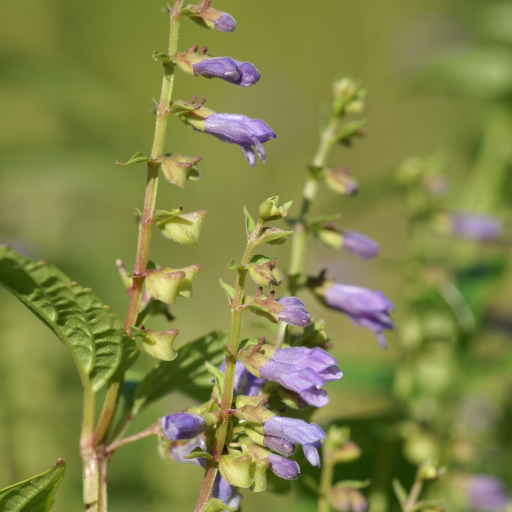
Plant Overview
Known widely as Blue Skullcap, this slender wildflower is a North American native that feels right at home in misty meadows and alongside quiet streams. Its peculiar nickname, "Mad-dog Skullcap," dates back to the 18th century when it was mistakenly believed to be a cure for rabies. While it didn't solve the "mad dog" problem, it has remained a staple in traditional herbalism for centuries as a gentle "nervine" or calming plant.
🔍 How to Identify
- 🟦 The Flowers: Look for tiny, tubular, two-lipped flowers in shades of azure or violet. Unlike many plants, these blooms tend to grow in one-sided clusters from the leaf axils.
- 🪖 The "Skullcap": After the flower falls, the remaining seed pod (calyx) has a distinctive protrusion that resembles a miniature medieval helmet or a small cap.
- 🔳 The Stem: As a member of the Mint family, it features a distinctly square stem. If you roll the stem between your fingers, you will feel four clear edges.
🏡 In Your Garden
- 💧 Wet Feet Welcome: This plant is a "hydrophile," meaning it loves water. It is a perfect choice for rain gardens, pond edges, or those naturally soggy spots in your yard where other plants might struggle with root rot.
- 🌤️ Filtered Sunlight: In the wild, it grows on the edges of marshes and floodplains. To keep it happy at home, give it plenty of light but try to provide some afternoon shade to mimic the protection of a forest canopy.
⚠️ Safety & Toxicity
- 🌿 Safe Assessment: Blue Skullcap is generally considered non-toxic and is widely used in commercial herbal teas.
- 🐾 Pet Caution: While not high on the list of poisonous plants, any medicinal herb can cause digestive upset in cats or dogs if consumed in large quantities. It is best to keep it out of reach of curious chewers.
✨ Fun Fact
- 📜 A Botanical Misunderstanding: The name "Mad-dog" was so widely accepted in the 1700s that the plant was actually sold for high prices as a pharmaceutical miracle. While its rabies-curing days are over, modern science has confirmed it contains compounds that can indeed help soothe the human nervous system!

Detailed Care Instructions
| Humidity | Normal |
| Lighting | Part Sun |
| Difficulty | Medium |
| Hibernation | Cold Period |
| Hardiness Zones | 6 - 9 |
To grow Scutellaria Lateriflora, also known as Skullcap, you can follow these steps:
- Obtain seeds or starter plants: You can find Scutellaria Lateriflora seeds or starter plants from local gardening centers, nurseries, or online seed suppliers.
- Choose the planting location: Skullcap prefers well-drained soil and partial shade. Select a location in your garden or a container that receives morning sunlight but is shaded in the afternoon.
- Prepare the soil: Loosen the soil and remove any weeds or rocks from the planting area. Add organic matter, such as compost or aged manure, to improve soil fertility.
- Plant the seeds or starter plants: If using seeds, sow them directly into the prepared soil according to the recommended planting depth on the seed packet. If using starter plants, dig a hole in the soil slightly larger than the root ball and place the plant in the hole, backfilling with soil.
- Water regularly: Keep the soil consistently moist but not waterlogged. Water the plants regularly, especially during hot and dry periods.
- Mulch the soil: Apply a layer of organic mulch, such as straw or wood chips, around the base of the plants to conserve moisture, suppress weed growth, and insulate the roots.
- Prune and maintain: As the plants grow, you can pinch back the tops to encourage bushier growth. Remove any dead or damaged leaves or stems. Skullcap plants are perennial, so they should come back year after year with proper care.
- Harvesting: Harvest the aerial parts of the plant (leaves, stems, and flowers) when they are in full bloom. Cut the stems just above the lower leaves and allow the plant to continue growing. Dry the harvested material in a well-ventilated area away from direct sunlight until they are crisp.
Note: Always follow proper gardening practices and refer to specific plant care instructions or consult with local gardening experts for best results in your specific climate and conditions.

Place in a bright room that is sun drenched almost all day. Or directly in a south-facing window.

To water this plant, you should first check the soil moisture level by inserting your finger about one inch deep into the soil. If it feels dry, it's time to water. When watering, be sure to pour water slowly and evenly around the base of the plant, avoiding getting water on the leaves. Allow excess water to drain out of the bottom of the pot, and discard any standing water to prevent root rot. This plant prefers evenly moist soil, but be careful not to overwater as this can lead to root rot and other plant diseases. It's essential to monitor the plant's soil moisture level regularly and adjust your watering schedule accordingly.
To fertilize, apply a slow-release general-purpose fertilizer in the early spring, before new growth appears. Follow the package instructions for application rates. Avoid over-fertilizing as this can cause excessive growth and weak stems. Water deeply after fertilizing to help the nutrients penetrate the soil. Reapply fertilizer every six to eight weeks during the growing season to promote healthy growth. Stop fertilizing by mid-summer to allow the plant to prepare for winter dormancy.
Scutellaria Lateriflora is a herbaceous perennial plant that grows best in well-draining, nutrient-rich soil. The ideal soil for this plant should be slightly acidic to neutral with a pH range of 6.0 to 7.5. It prefers a soil that is rich in organic matter and has good moisture retention capacity but is not waterlogged. The soil should be loose and crumbly, allowing for good aeration and drainage. A mixture of compost, peat moss, and well-rotted manure could be added to improve soil quality. It is important to avoid using heavy clay soils or sandy soils, which will not retain enough water or nutrients to support the plant's growth. In summary, the best soil for Scutellaria Lateriflora is a well-draining, nutrient-rich, slightly acidic to neutral soil that is rich in organic matter and has good water retention capacity.
Scutellaria Lateriflora is a plant that can be propagated through stem cuttings. To do this, select a healthy stem with several leaves and cut it at an angle just below a leaf node. Remove the lower leaves from the stem, leaving only a few at the top. Dip the cut end in rooting hormone powder and plant it in a pot filled with moist soil. Keep the soil consistently moist and place the pot in a warm, bright location but out of direct sunlight. In a few weeks, the stem should produce roots and new growth. Once the new plant has grown enough, it can be transferred to a larger pot or planted in the ground.
Common pests of the scullcap include Spider mites, whiteflies. Make a habit of checking your scullcap frequently for pests so that any infestations can be caught and managed early.








