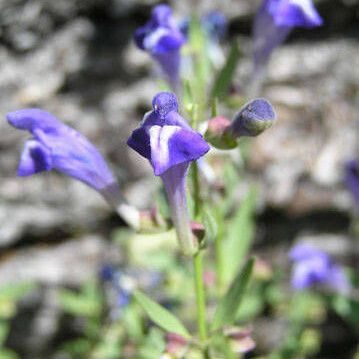
Plant Overview
Often called the Grayleaf Skullcap, this rugged West Coast native is a master of survival in rocky, sun-drenched landscapes. It is a member of the mint family, though it lacks the aggressive spreading habit of its cousins. Its most striking feature is its "helmeted" flowers that look like tiny, blue-violet lanterns hanging from silvery stems.
🔍 How to Identify
- 🟦 The Flowers: Tubular, two-lipped blossoms that range from deep blue to purple, usually featuring a white "landing pad" for bees on the lower lip.
- 🛡️ The "Skullcap": At the base of the flower, the calyx has a distinct protruding ridge that looks like a miniature medieval helmet or a tiny cap.
- 🌿 The Foliage: Narrow, linear leaves with a grayish-green hue, often covered in fine hairs that give the plant a soft, dusty appearance.
- ⬛ Square Stems: Like all members of the Lamiaceae family, if you roll the stem between your fingers, you will feel four distinct flat sides.
🏡 In Your Garden
- ☀️ Sun Seeker: This plant thrives in full sun and rocky, well-draining soil. It is an excellent choice for rock gardens or "crevice" planting where other plants might struggle with the heat.
- 💧 Drought Specialist: It hates "wet feet." Because it is adapted to the dry summers of California and Oregon, it requires very little supplemental water once established and is prone to root rot if overwatered.
- 🐝 Pollinator Hub: It is a vital nectar source for native long-tongued bees and butterflies, making it a "must-have" for biodiversity-focused landscapes.
⚠️ Safety & Toxicity
- 🟢 Status: Generally considered non-toxic, but handle with care.
- 🐾 Details: While some species of Scutellaria are used in traditional herbalism, there is limited data on the specific toxicity of S. siphocampyloides regarding pets. To be safe, discourage dogs or cats from chewing on the foliage, as it may cause minor stomach upset.
✨ Fun Fact
The genus name Scutellaria comes from the Latin word scutella, which means "a small dish" or "saucer." This refers to the shape of the persistent calyx that remains on the plant after the flower falls off, acting like a tiny bowl to hold the developing seeds!

Detailed Care Instructions

Place in a bright room that is sun drenched almost all day. Or directly in a south-facing window.

Some plants require more regular watering than others, which should be done every few days. It's critical to maintain the soil moist all of the time. The water requirements of the same plant placed in pots with varying sizes will differ. Because the water in the smaller pot evaporates faster than the water in the larger pot, it will require more watering. Regardless of pot size, the surface should constantly be maintained moist.








