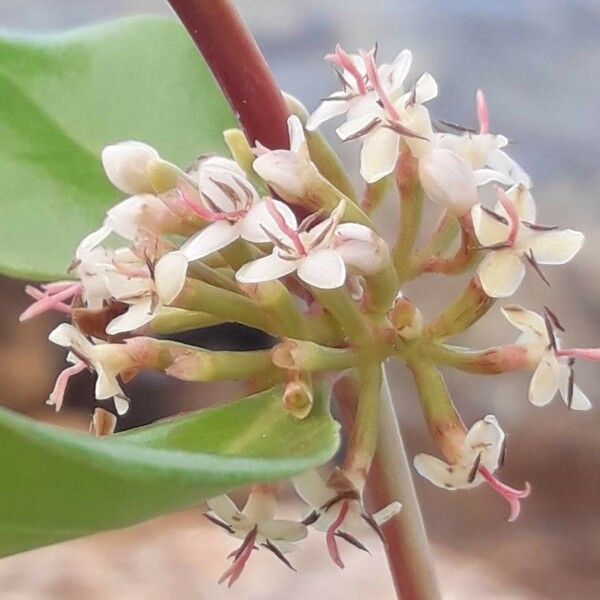
Plant Overview
Known widely as the Chengam or Nilad, this resilient evergreen shrub is a true survivor of the tropical coastlines. While it may look like a standard garden hedge at first glance, it is actually one of the few woody plants in the coffee family (Rubiaceae) that has adapted to live in the harsh, salty environment of mangrove forests. Its thick, waxy leaves and sturdy structure make it a vital part of coastal ecosystems across Southeast Asia and Northern Australia.
🔍 How to Identify
- 🍃 The Foliage: Look for glossy, leathery leaves that are shaped like a teardrop (obovate). They grow in opposite pairs and often have a slightly yellowish-green tint when exposed to heavy sun.
- 🌸 The Flowers: It produces small, delicate clusters of tubular flowers. They start as white and often transition to a soft pink or brown as they age, smelling faintly sweet.
- 🍒 The Fruit: The most distinct feature is the fruit—small, green (turning brown), and oblong with deep longitudinal ribs or "furrows" that make them look like tiny carved lanterns.
🏡 In Your Garden & Habitat
- 🌊 Salt Specialist: In the wild, this plant thrives where others wither. It has a high tolerance for salt spray and occasional tidal flooding, making it an excellent choice for seaside "buffer" gardens to prevent erosion.
- ☀️ Sun & Soil: It demands full tropical sun to maintain its dense, bushy shape. While it can grow in muddy mangrove soil, it is surprisingly adaptable to well-draining sandy or loamy soils if kept consistently hydrated.
- 🌳 Growth Habit: It typically grows as a multi-stemmed shrub but can reach the height of a small tree (up to 3 meters). It is often used by coastal communities as a natural windbreak.
⚠️ Safety & Toxicity
- 🟢 Status: Generally considered non-toxic to humans and common domestic animals.
- 🧂 Salt Accumulation: Because it lives in saline environments, the leaves can sometimes accumulate salt. While not "poisonous," the high tannin content in the bark and leaves means it is not palatable and should not be ingested by pets or children.
✨ Fun Fact
The city of Manila, the capital of the Philippines, is said to derive its name from this plant! The phrase May-nilad translates to "where there are Nilad plants," referring to the abundance of Scyphiphora hydrophylacea that once lined the shores of the Pasig River.

Detailed Care Instructions








