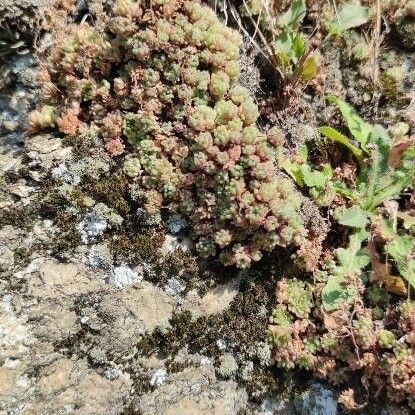
Plant Overview
Known as the Woolly Stonecrop, this charming succulent looks like it’s wearing a tiny, fuzzy sweater. Originally from the sun-drenched rocky terrains of the Iberian Peninsula and France, it is a master of survival that prefers mountain cliffs over manicured lawns. Its distinct "hairy" texture isn't just for show; it's a clever adaptation for life in the elements.
🔍 How to Identify
- 🌿 The Hairy Rosettes: Small, dense clusters of fleshy, spoon-shaped leaves entirely covered in fine, white, glandular hairs.
- 🌸 Starry Blooms: In early summer, it sends up short stalks topped with delicate, star-shaped white flowers, often tinged with a hint of pink or red.
- 🧶 Mat-Forming Habit: It grows in low, spreading carpets, making it an excellent "filler" for rock crevices or a "spiller" for the edges of pots.
🏡 In Your Garden
- 🪨 The Drainage Specialist: This plant evolved in rocky crevices, meaning it absolutely despises "wet feet." If its roots sit in soggy soil for even a few days, it may melt away; always use a gritty, sandy cactus mix.
- ☀️ Sun-Kissed Texture: The more sun it receives, the more compact and "woolly" its rosettes become. In too much shade, the plant will stretch out (etiolate), and the hairs will become sparse.
⚠️ Safety & Toxicity
- 🐾 Pet Friendly: Sedum hirsutum is generally considered non-toxic to cats, dogs, and horses, making it a worry-free addition to a low-level garden or coffee table.
- 🧤 Mild Sensitivity: While not poisonous, the sap of some stonecrops can occasionally cause mild skin irritation for those with very sensitive skin. It is best to wash your hands after pruning.
✨ Fun Fact
Those tiny hairs (trichomes) act as a natural "sunscreen" and windbreak. They trap a thin layer of moisture against the leaf surface, preventing the plant from drying out in the harsh, high-altitude winds of its native home.

Detailed Care Instructions
To grow Sedum hirsutum, also known as hairy stonecrop, you can follow these steps:
- Choose a suitable location: Sedum hirsutum prefers full sun or light shade. Make sure the soil is well-draining and preferably sandy or loamy.
- Prepare the soil: If your soil is heavy or clay-like, amend it with organic matter, such as compost, to improve drainage and fertility. Work the organic matter into the top few inches of soil.
- Planting: You can either sow seeds directly into the prepared soil or start with established plants. If growing from seeds, sprinkle them over the soil and lightly press them in but avoid burying them too deeply. If using established plants, dig a hole slightly larger than the root ball and place the plant in, making sure the crown is level with the soil surface.
- Watering: After planting, water the soil thoroughly to settle it around the roots. For the initial few weeks, keep the soil consistently moist but avoid overwatering. Once established, Sedum hirsutum only requires occasional watering during extended dry periods.
- Mulching: Apply a layer of organic mulch around the base of the plant to conserve moisture, suppress weeds, and regulate soil temperature. However, make sure to leave a small gap between the plant stem and mulch to prevent rotting.
- Fertilizing: Sedum hirsutum generally doesn't require heavy fertilization. If you want to fertilize, use a balanced, slow-release fertilizer in spring or early summer following the package instructions.
- Pruning: Hairy stonecrop is a low-maintenance plant and doesn't require much pruning. However, you can remove any dead or damaged foliage in early spring or reshape the plant to maintain a desirable form.
- Propagation: Sedum hirsutum can be propagated through stem cuttings or division. Stem cuttings should be taken in spring or early summer, and division can be done in the same period by separating clumps and replanting them.
Remember that Sedum hirsutum is a hardy plant and tolerates drought and neglect well. However, if your area experiences harsh winters, providing some protection, such as mulching, can help the plant survive.

Place in a bright room that is sun drenched almost all day. Or directly in a south-facing window.

Sedum Hirsutum is a drought-tolerant plant that requires infrequent watering. When watering, it is important to give it a deep soak but allow the soil to dry out completely before the next watering. Overwatering can lead to root rot and cause damage to the plant. It is also important to water the plant at the base of the stem to avoid getting water on the leaves, which can lead to fungal diseases. Watering in the early morning or evening is ideal to avoid evaporation in the heat of the day.
This plant should be fertilized once a year in the spring or summer with a balanced all-purpose fertilizer. Dilute the fertilizer according to the instructions on the label before applying it to the soil around the plant. Be sure to water the plant before and after fertilizing to prevent root burn. Avoid fertilizing during the fall and winter months when the plant is dormant.
The ideal soil for this plant should be well-draining and sandy, with a pH range of 6.0 to 7.5. It should be able to retain moisture without becoming waterlogged, as this can lead to root rot. The soil should also be nutrient-rich, with a high organic matter content to support growth and development. It is important to avoid heavy or compacted soils, as this can impede the plant's ability to absorb nutrients and water. Additionally, adding a layer of gravel or pebbles to the top of the soil can help to improve drainage and prevent waterlogging.
Propagation of this plant can be done through stem cuttings or leaf cuttings. For stem cuttings, select a healthy stem with leaves, and cut it just below a leaf node. Remove the lower leaves and dip the cut end in rooting hormone powder. Plant the cutting in well-draining soil and water thoroughly. Keep the soil moist and place the cutting in a bright, but indirect light. Rooting should occur in several weeks.
Leaf cuttings can also be taken by selecting a healthy leaf and cutting it close to the stem. Dip the cut end in rooting hormone powder and plant it in well-draining soil. Water the soil thoroughly and keep it moist. Place the cutting in bright, but indirect light. Roots should start to form at the base of the leaf within a few weeks.
It is important to keep in mind that this plant prefers dry conditions and may not tolerate overwatering or high humidity. Therefore, be careful not to water too often and ensure that the soil is well-draining to prevent water from sitting around the roots.
Common pests of the ground grapes (నేల ద్రాక్ష) include Mealybugs, aphids. Make a habit of checking your ground grapes (నేల ద్రాక్ష) frequently for pests so that any infestations can be caught and managed early.








