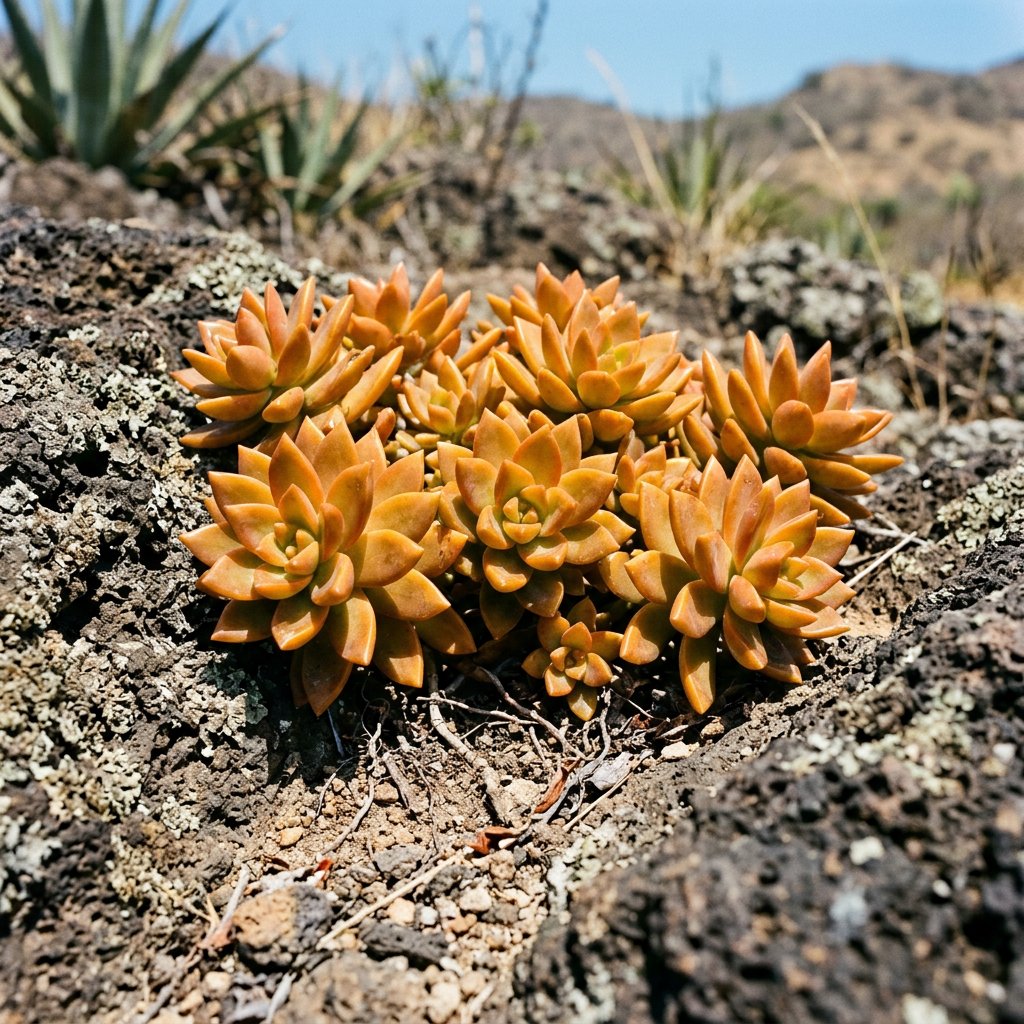
Plant Overview
Commonly called the "Coppertone Stonecrop," this Mexican native is a sun-worshipper that brings fiery hues to any succulent collection. Its ability to transform from a cool lime green to a brilliant, glowing orange makes it a dramatic standout in rock gardens and patio pots. Whether cascading over the edge of a container or tucked into a stony crevice, it adds a warm, metallic sheen that looks as if it’s permanently bathed in the "golden hour" sun.
🔍 How to Identify
- 🍃 Rosette Formation: The plant grows in sprawling, pointed rosettes. Each leaf is thick, boat-shaped, and incredibly fleshy, designed to store moisture for long dry spells.
- 🎨 Color Shifting: While it starts as a pale olive green, intense sunlight triggers a "tan," turning the leaf margins and tips into a vibrant bronze or burnt orange.
- 🌸 Starry Blooms: In late winter to spring, it produces small, white, star-shaped flowers that emerge in rounded clusters, providing a delicate contrast to the chunky foliage.
🏡 In Your Garden
- ☀️ The "Sun Tan" Secret: To keep that signature copper glow, this plant needs as much direct light as possible. In low light, it will "stretch" (become leggy) and revert to a plain, dull green.
- 💧 Drought Resilience: It hates "wet feet." Because it evolved in rocky Mexican canyons, it requires gritty, fast-draining soil. It is much safer to forget to water it for a week than to water it too frequently.
⚠️ Safety & Toxicity
- 🐾 Pet & Child Friendly: This Sedum is generally considered non-toxic to cats, dogs, and humans, making it a safe choice for household surfaces and accessible garden beds.
- 🤲 Fragile Nature: While not dangerous, the leaves are quite brittle and can snap off at the slightest bump. If a leaf falls, don't worry—simply lay it on top of some soil, and it will likely sprout a whole new baby plant!
✨ Fun Fact
The intense orange color isn't just for show—it's a biological defense. The plant produces special carotenoid pigments to act as a natural "sunscreen," protecting its internal tissues from being scorched by high-altitude UV rays!

Detailed Care Instructions
| Color | Bright, Bronzed Orange Hue |
| Soil Ph | Acid, Alkaline, Neutral |
| Humidity | Dry |
| Lighting | Full Sun |
| Toxicity | Non-Toxic |
| Soil Type | Loam, Sand |
| Bloom Time | The Plant Blooms Star Shaped Flowers From Early Summer Through Late Fall |
| Difficulty | Easy |
| Plant Type | Succulent, Perennial Evergreen |
| Hibernation | Cold Period |
| Mature Size | Grows To 8”-9” In Height, Spreads To 2”-3” Wide |
| Native Area | Mexico |
| Temperature | 15°C - 30°C |
| Sun Exposure | Full Sun |
| Hardiness Zones | 9-11 |
To grow Sedum nussbaumerianum (commonly known as Coppertone Stonecrop or Golden Sedum), you can follow these steps:
- Choose a location: Sedum nussbaumerianum thrives in full sunlight, so select a spot that receives at least 6 hours of direct sunlight each day. It can also tolerate partial shade.
- Prepare the soil: The plant prefers well-draining soil. If your soil is heavy or clay-like, amend it with sand or perlite to improve drainage. You can also create a raised bed or container with a well-draining soil mix.
- Planting: Dig a hole in the soil and place the sedum in it, ensuring that the crown (where the stem meets the roots) is level with or slightly above the soil surface. Backfill the hole, gently firming the soil around the plant.
- Watering: Sedum nussbaumerianum is a drought-tolerant plant, and overwatering can be detrimental. Water the plant deeply once every couple of weeks, allowing the soil to dry out between waterings. In hot or dry periods, you may need to water more frequently, but always check the soil moisture before watering.
- Fertilizing: This sedum doesn't require much fertilizer. You can apply a slow-release or diluted, balanced fertilizer during the growing season (spring and summer) if desired, following the package instructions.
- Pruning: Pruning isn't necessary for Sedum nussbaumerianum, but you can trim any leggy or overgrown stems to maintain a compact shape. Trim in spring or early summer before the growing season begins.
- Propagation: Sedum nussbaumerianum can be propagated through stem cuttings. Simply take a cutting from a healthy stem, let it dry for a couple of days to callus, then place it in well-draining soil. Keep the soil slightly moist until the cutting roots and develops new growth.
- Protection: In colder climates, Sedum nussbaumerianum may be susceptible to frost damage. If possible, provide protection by moving containers indoors or covering the plants with a frost cloth or mulch.
By following these care guidelines, your Sedum nussbaumerianum should grow and thrive, adding beauty to your garden or indoor space.

Place in a bright room that is sun drenched almost all day. Or directly in a south-facing window.

To properly water this plant, it is important to ensure that the soil is completely dry before watering. When watering, it is important to do so thoroughly, but infrequently, as the plant is susceptible to root rot. One method for watering is to wait until the leaves begin to show signs of dehydration, such as drooping or wilting, and then give the plant a deep watering. It is best to avoid getting water on the leaves, as this can promote the growth of fungus. Additionally, it is important to not let excess water accumulate at the base of the plant, as this can also contribute to root rot. In general, this plant can tolerate some drought, so it is better to err on the side of underwatering rather than overwatering.
To fertilize this plant, use a balanced liquid fertilizer with equal amounts of nitrogen, phosphorus, and potassium. Dilute the fertilizer to half strength and apply it to the soil once every month during the growing season. Water the plant thoroughly before fertilizing to prevent root burn. Avoid over-fertilizing, as it can lead to stunted growth and leaf drop.
The Sedum Nussbaumerianum plant requires well-draining soil that is rich in nutrients. It prefers a soil mixture that is slightly acidic to neutral in pH. A sandy loam soil, mixed with perlite and peat moss, is ideal for this plant. Avoid using heavy clay soils or soils that retain moisture for extended periods as this can lead to root rot and other fungal diseases. The plant also benefits from occasional top dressing with compost or a slow-release fertilizer to promote healthy growth.
To propagate this plant, you will need to first identify a healthy stem with a few leaves on it. Cut off the stem using a clean, sharp pair of scissors or pruning shears. If there are any leaves on the lower part of the stem, remove them so that there are no more than three or four leaves remaining.
Next, let the stem dry out for a few days until the cut end has calloused over. This will help prevent bacteria or disease from entering the stem when it is planted.
Once the stem has calloused over, prepare a small pot with a well-draining soil mix. You can use a cactus or succulent mix, or make your own by combining equal parts perlite, sand, and peat moss.
Make a small hole in the soil with your finger or a pencil, and gently place the stem into the hole. Carefully backfill the hole with soil and lightly tamp down to ensure the stem is secure.
Water the soil lightly, being careful not to overwater. Keep the soil slightly moist, but not wet, until you see new growth. This should occur within a few weeks.
Once the new plant has developed roots and several new leaves, it can be transplanted to a larger pot or planted in your garden.
Common pests of the coppertone stonecrop include Mealybugs, aphids. Make a habit of checking your coppertone stonecrop frequently for pests so that any infestations can be caught and managed early.








