Plant Overview
Known affectionately as "Dragon’s Blood" or "Two-row Stonecrop," this hardy succulent hails from the rugged, rocky slopes of the Caucasus Mountains. It is the ultimate "rescue plant," famously thriving in cracks and crevices where other greenery would wither. Whether draped over a stone wall or carpeting a sunny patch of earth, its geometric foliage creates a thick, tapestry-like groundcover that changes color with the seasons.
🔍 How to Identify
- 🍃 The "Two-Row" Leaves: Thick, fleshy, wedge-shaped leaves grow in precise, opposing pairs along the stem. This "stacked" arrangement gives the plant its common name.
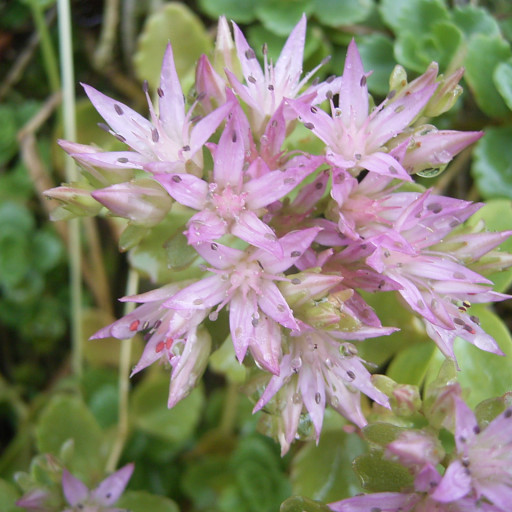
- 🌸 Starry Clusters: In mid-to-late summer, it produces flat-topped clusters of tiny, star-shaped flowers that act as a magnet for local butterflies.
- 🔴 Creeping Stems: The wiry, reddish stems trail along the ground, sending out tiny roots wherever they touch the soil to claim new territory.
🏡 In Your Garden
- ☀️ Sun-Kissed Colors: While it can survive in partial shade, full sun is the secret to unlocking its deep bronze and burgundy hues. In too much shade, the plant often loses its vibrant pigment and turns a simple forest green.
- 🪨 The Drainage Expert: This plant is a specialist in "dry feet." It thrives in gritty, sandy, or poor-quality soil where water drains away quickly. It is an excellent choice for xeriscaping or filling the gaps between garden stepping stones.
⚠️ Safety & Toxicity
- 🐾 Pet Friendly: Sedum spurium is generally considered non-toxic to cats, dogs, and horses. It is a "safe" choice for households with curious furry friends.
- 🤢 Mild Caution: While not poisonous, ingesting large amounts of the fleshy leaves can cause a mild stomach ache or nausea in small children or pets. The sap may also cause very slight skin irritation for those with highly sensitive skin.
✨ Fun Fact
The genus name Sedum comes from the Latin word sedere, meaning "to sit." This is a nod to the plant’s humble habit of "sitting" snugly upon rocks and stone walls throughout the high-altitude regions of Europe and Asia!

Detailed Care Instructions
| Humidity | Dry |
| Lighting | Full Sun |
| Toxicity | Non-Toxic |
| Difficulty | Easy |
| Hibernation | Cold Period |
| Temperature | 20°C - 35°C |
| Hardiness Zones | Min 3A |
To grow Sedum spurium, also known as stonecrop, you can follow these steps:
- Choose a suitable location: Sedum spurium prefers full sun but can tolerate partial shade. Make sure the area has well-draining soil.
- Prepare the soil: Remove any weeds or grass from the planting area and amend the soil with compost or well-rotted manure to improve drainage and fertility.
- Planting: Dig a hole slightly larger than the root ball of the Sedum spurium plant. Place the plant in the hole, ensuring that the crown of the plant (where the stems and roots meet) is just above the soil level. Backfill the hole with soil and gently firm it around the plant, avoiding any air pockets.
- Watering: Water the newly planted Sedum spurium thoroughly after planting to help settle the soil. Water regularly during the first growing season to establish a strong root system. Once established, Sedum spurium is drought-tolerant and requires minimal watering.
- Mulching: Apply a layer of organic mulch, such as wood chips or shredded bark, around the plant to retain moisture, suppress weed growth, and insulate the roots.
- Fertilizing: Sedum spurium is generally a low-maintenance plant and does not require regular fertilization. However, you can use a balanced, slow-release fertilizer in early spring to provide nutrients if desired.
- Pruning: Deadhead any faded flowers to encourage new growth and maintain a tidy appearance. You can also trim back the plant in early spring before new growth emerges to promote bushier growth.
- Propagation: You can propagate Sedum spurium through stem cuttings or division. Stem cuttings should be taken during spring or early summer and rooted in well-draining soil. Division can be done in early spring or fall by gently separating the root clumps and replanting them.
By following these steps, you can successfully grow Sedum spurium and enjoy its attractive foliage and flowers.

Place in a bright room that is sun drenched almost all day. Or directly in a south-facing window.

To water this specific type of plant, it is important to follow a few steps. Firstly, one should ensure that the soil is not too wet or too dry. The best way to check this is to stick one's finger into the soil and check for moisture. If the soil feels dry, it is time to water the plant. Secondly, it is important to water the plant sparingly and avoid getting water on the leaves or stem. One can do this by watering at the base of the plant and using a watering can with a narrow spout. Lastly, it is important to allow the soil to dry out completely before watering again to avoid over-watering.
To fertilize this plant, apply a balanced fertilizer with equal parts nitrogen, phosphorus, and potassium in the spring, just as new growth appears. Use a slow-release type of fertilizer and avoid over-fertilizing as it may cause the plant to become spindly. Water the plant well before and after applying the fertilizer.
When planting the Sedum Spurium plant, it is important to use well-draining soil. It is recommended to use a mixture of sand and gravel along with nutrient-rich soil. The soil should be loose and not compacted. The plant can tolerate various soil types, including sandy, clay, and loamy soil, as long as it is well-draining. The pH level of the soil should be slightly acidic to neutral, with a range of 6.0 to 7.5. The plant prefers full sunlight and can withstand drought conditions, but it needs to be watered regularly until established.
To propagate this plant, start by taking a cutting from a healthy and mature plant. Using a sharp, sterilized pruning shears, cut a stem that is several inches long and has several leaves on it. Remove any lower leaves close to the stem's base.
Before potting the cutting, allow it to dry and callus over for a few days to a week to prevent rotting. After the cutting has calloused, plant it in a well-draining soil mix, such as a cactus/succulent soil, in a small container.
Keep the soil moist but not overly wet, and place the container in a bright but indirect light location. In a few weeks, roots should start to develop and new growth will emerge.
Once the new plant has established roots, you can transplant it into a larger pot or in a garden bed outdoors, depending on your preference.
Common pests of the caucasian stonecrop include Mealybugs, aphids. Make a habit of checking your caucasian stonecrop frequently for pests so that any infestations can be caught and managed early.








