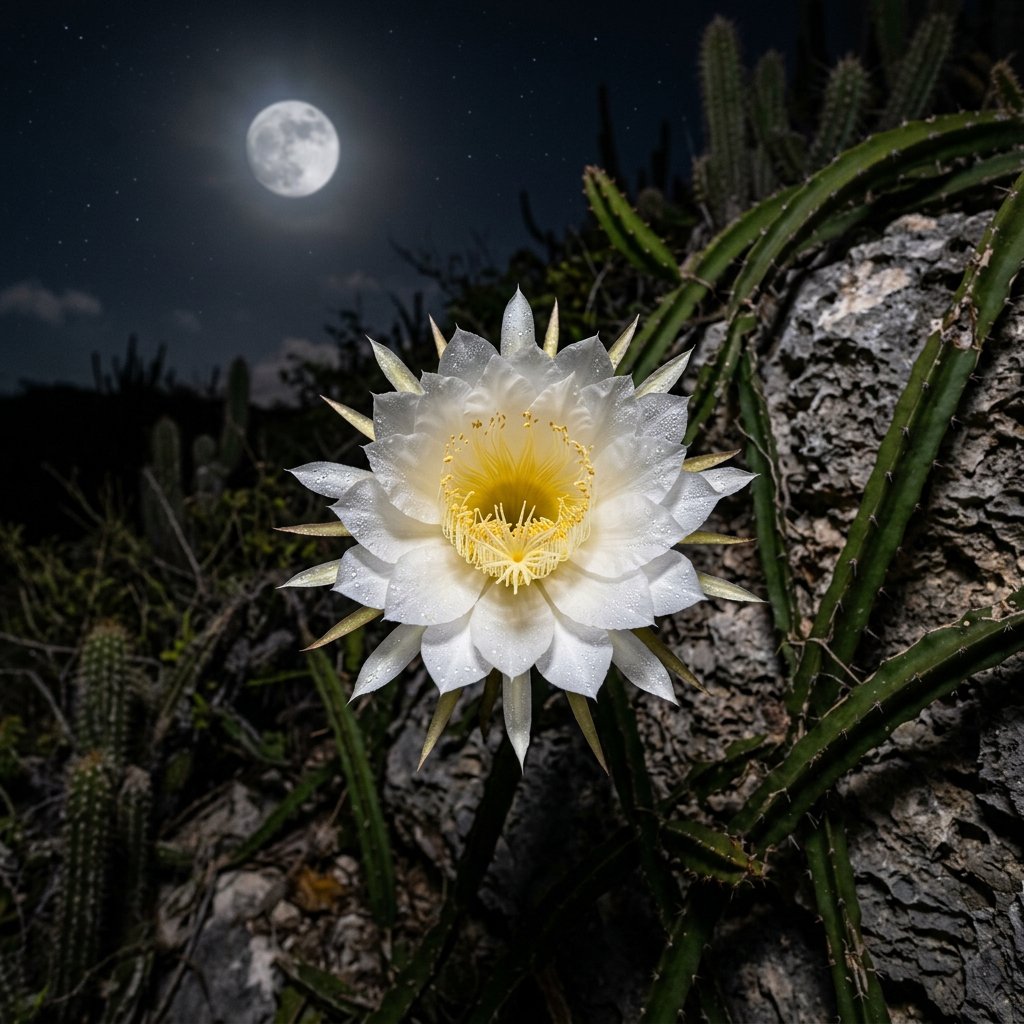
Plant Overview
Commonly known as the Queen of the Night, Selenicereus grandiflorus is a legendary climbing cactus that holds a mystical status among enthusiasts. Native to the Caribbean and Central America, it is famous for its massive, vanilla-scented flowers that wait until the dead of night to unfurl. Historically, Victorian-era socialites would host "bloom parties," staying up until dawn to witness this plant's rare and fleeting performance.
🔍 How to Identify
- 🌵 The Stems: Long, slender, and snake-like green stems that are typically 5 to 7-angled. They often feature aerial roots that help the plant "climb" trees or walls.
- 🌸 The Bloom: Gigantic white flowers that can reach up to 12 inches in diameter. The outer petals are often brownish or golden, creating a halo effect around the pure white inner petals.
- 👃 The Scent: A powerful, intoxicating fragrance that smells like a mixture of heavy vanilla and orange blossoms, designed to attract nocturnal pollinators like hawk moths.
🏡 In Your Garden
- 🧗 Support is Key: Because this is a climbing (epiphytic) cactus, it is happiest when given a sturdy trellis or a moss pole to scramble up. In its natural habitat, it uses its roots to anchor onto large tropical trees.
- 💧 Tropical Humidity: Unlike your typical desert cactus, the Queen of the Night prefers a bit more humidity and "dappled" sunlight. It hates being bone-dry for too long but will suffer from root rot if the soil isn't extremely well-draining.
- 🌕 The Waiting Game: Patience is required. A young plant may take several years to reach maturity before it produces its first spectacular, midnight bloom.
⚠️ Safety & Toxicity
- 🟢 Non-Toxic: This plant is generally considered non-toxic to cats, dogs, and humans if accidentally nibbled.
- 🌵 Hidden Spines: While it looks relatively smooth from a distance, the stems are lined with small, hair-like bristles and spines. These can easily embed themselves in your skin, so it is best to handle the plant with sturdy gardening gloves.
✨ Fun Fact
The Queen of the Night is a true "one-hit wonder." Each individual flower opens only once, usually beginning at dusk and reaching full glory by midnight, only to wilt and die forever by the time the first rays of the morning sun hit the petals.

Detailed Care Instructions
| Color | White |
| Soil Ph | Tolerates A Variety |
| Humidity | Dry |
| Lighting | Full Sun |
| Soil Type | Tolerates A Variety |
| Bloom Time | Summer |
| Difficulty | Medium |
| Plant Type | Perennial Succulent |
| Mature Size | Up To 30 Feet Tall And 12 Inches Wide |
| Native Area | Tropical South America |
| Temperature | 15°C - 30°C |
| Sun Exposure | Full Sun/ Partial Shade |
| Hardiness Zones | 10-11 |
To grow Selenicereus Grandiflorus or "Queen of the Night" cactus, follow these steps:
- Choose a healthy cutting: Get a stem cutting with at least two nodes. Ensure the cutting is mature and has no signs of disease or damage.
- Let the cutting dry: Allow the cutting to dry for a few days to form a callus. This helps prevent the cutting from rotting when planted.
- Prepare the soil: Use a well-draining soil mix that consists of equal parts potting mix, perlite, and sand. This will prevent water logging and root rot.
- Plant the cutting: Gently insert the cutting into the soil, burying at least one node. Keep the soil barely moist until roots start to form.
- Provide the right environment: Place the pot in a bright location with indirect sunlight. Queen of the Night cactus prefers warm temperatures between 70-90°F (21-32°C) during the day and 60-70°F (15-21°C) at night.
- Water and humidity: Water the plant thoroughly once every week during the growing season (spring and summer). Decrease watering frequency during the dormant period (fall and winter). Maintain moderate humidity levels, but avoid excessive moisture.
- Fertilize sparingly: Apply a balanced fertilizer diluted to half strength once every month during the growing season to provide essential nutrients.
- Support the plant: As the cactus grows, ensure it has proper support. You can use stakes or a trellis system to ensure the plant climbs and grows upright.
- Prune and maintain: Remove any dead or damaged parts and occasionally trim back leggy growth to maintain shape and encourage bushiness.
- Watch for pests and diseases: Monitor for common cactus pests like mealybugs and scale insects. If detected, use an organic insecticide or wipe off the pests with a cotton swab dipped in rubbing alcohol.
With proper care and attention, your Selenicereus Grandiflorus plant should grow and flourish, eventually producing beautiful white flowers.

Place in a window with dappled sun or a spot in the middle of a room. Or directly in a window facing west or east.

The best way to water this plant is to wait until the topsoil has completely dried out before watering it. This can be tested by inserting a finger or a wooden stick into the soil to see if it feels moist. When watering, make sure to soak the soil thoroughly, allowing the water to drain out completely before returning the plant to its normal location. It is important not to overwater this plant, as this can lead to root rot and other issues. This plant prefers to be kept on the drier side, so it is advisable to err on the side of caution when watering it.
To fertilize this plant, use a balanced fertilizer with equal proportions of nitrogen, phosphorus, and potassium. Fertilize once a month during the growing season, which is typically from spring to fall. Dilute the fertilizer in water according to the instructions on the package and apply it to the soil around the plant. Be sure to water the plant thoroughly before and after fertilizing to prevent fertilizer burn. Avoid applying fertilizer during the dormant period in the winter.
The best soil for this plant should be well-draining and porous, with good nutrient content. A mixture of peat moss, perlite, and coarse sand or gravel is recommended, with a slightly acidic pH range of 5.5-6.5. Adding organic matter such as compost or leaf litter can also improve soil structure and fertility. It is important to avoid heavy or compacted soils that can cause waterlogging and root rot, as well as sandy or nutrient-poor soils that may not support healthy growth. Regular watering and fertilization can also help maintain soil health and support the long-term growth and flowering of this plant.
To propagate this plant, first gather healthy and mature stem cuttings from the parent plant during the growing season. Cuttings should be around 6-8 inches long and have at least one or two nodes. Remove any leaves or offsets from the lower one-third of the cutting.
Allow the cuttings to dry for a few days to form a callus, and then dip the cut end in rooting hormone powder. Plant the cutting in a well-draining potting mix and water it thoroughly.
Keep the cutting in a warm and bright location, but out of direct sunlight. Mist the cutting regularly and ensure the soil remains moist but not too wet. After a few weeks, the cutting should start to produce roots and new growth.
Once the cutting has established roots, it can be gradually acclimated to more sunlight and fertilized with a balanced fertilizer every few weeks. It may take several months for the new plant to reach maturity and start flowering.
Common pests of the queen of the night include Scale insect, mealybugs, spider mites, thrips. Make a habit of checking your queen of the night frequently for pests so that any infestations can be caught and managed early.








