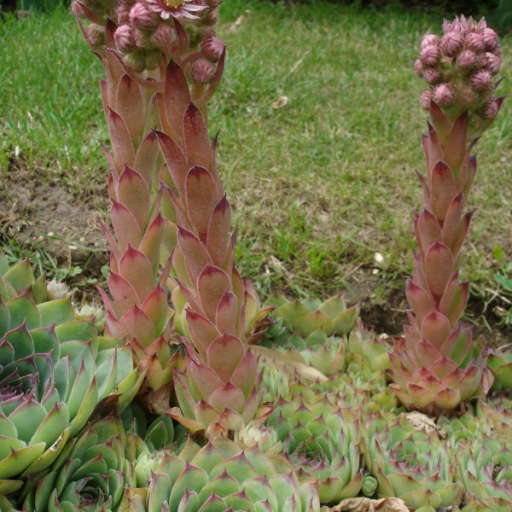
Plant Overview
Known as the "Mountain Houseleek," this hardy survivor hails from the rocky, wind-swept peaks of the Alps, Pyrenees, and Carpathians. Its genus name, Sempervivum, literally translates to "always living," a testament to its incredible ability to withstand freezing temperatures and blistering mountain sun. For centuries, these rosettes were planted on thatched roofs across Europe to ward off lightning and fire, earning them a place in folklore as protective botanical charms.
🔍 How to Identify
- 🌵 The Rosette: Grows in tight, symmetrical rosettes of fleshy, lance-shaped leaves that rarely exceed 2 inches in diameter.
- 🪶 Velvety Texture: Unlike its smoother cousins, the leaves are covered in fine, glandular hairs (cilia) that give the plant a slightly sticky or fuzzy appearance.
- 🌸 Starry Blooms: In mid-summer, mature rosettes send up a thick, hairy stalk topped with striking, star-shaped flowers in shades of reddish-purple or deep pink.
🏡 In Your Garden
- ⛰️ Alpine Aspirations: Because it evolved in rocky crevices, this plant demands exceptional drainage. It thrives in "gritty" soil or rock gardens where water can't pool around its roots, which prevents the dreaded "crown rot."
- 🐣 The "Hen and Chicks" Habit: The plant spreads by sending out tiny "pups" on short runners. Once the mother plant (the Hen) flowers, she will die, but her many offsets (the Chicks) will quickly fill the space she left behind.
- ❄️ Cold Warrior: This is one of the most cold-hardy succulents in existence. It actually benefits from a winter "chill" and can survive being buried under a blanket of snow without any fuss.
⚠️ Safety & Toxicity
- ✅ Safe for All: Sempervivum montanum is considered non-toxic to humans, cats, and dogs.
- 👶 Kid Friendly: Its lack of sharp spines or irritating sap makes it an excellent "starter plant" for children interested in gardening. While not intended for eating, accidental ingestion is generally not a cause for medical alarm.
✨ Fun Fact
In the 8th century, the Emperor Charlemagne issued a royal decree (the Capitulare de villis) ordering all his subjects to plant Houseleeks on their roofs. He believed the plants were associated with the god Jupiter and would protect the home from being struck by lightning!

Detailed Care Instructions
| Lighting | Full Sun |
| Hardiness Zones | Min 4A |
To grow Sempervivum Montanum, also known as mountain houseleek or hens and chicks, you can follow these steps:
- Choose a suitable location: Sempervivum Montanum prefers full sun but can tolerate partial shade. Ensure the location has well-draining soil as these plants don't like to sit in wet conditions.
- Prepare the soil: If the soil is heavy and compacted, amend it with sand or perlite to improve drainage. Loosen the soil to a depth of about 6-8 inches.
- Planting: You can either sow the seeds or propagate from offsets (baby plants). If planting from seeds, scatter them on the soil surface and lightly press them into the soil. If propagating from offsets, gently separate the baby plants from the parent plant and plant them in the desired location.
- Watering: After planting, water the soil lightly to settle it around the plant roots. Once established, Sempervivum Montanum is drought-tolerant and does not require regular watering. Water sparingly, allowing the soil to dry out between waterings.
- Mulching: Apply a layer of organic mulch around the plants to conserve moisture and suppress weed growth. Avoid covering the center rosettes of the plants with mulch, as this can cause rotting.
- Maintenance: Sempervivum Montanum is a relatively low-maintenance plant. Remove any weeds that emerge around the plants to prevent competition for nutrients. Monitor for any signs of disease or pest infestation and take appropriate action if needed.
- Propagation: Over time, Sempervivum Montanum will produce offsets or "chicks" around the parent plant. These can be gently separated and replanted in new areas to expand your collection or share with others.
- Winter care: Sempervivum Montanum is a cold-hardy plant and can survive freezing temperatures. However, extremely wet or cold conditions can cause rotting. If you live in an area with harsh winters, provide some protection by covering the plants with a layer of mulch or moving potted plants indoors.
By following these guidelines, you should be able to successfully grow Sempervivum Montanum and enjoy its unique and attractive rosettes.

Place in a bright room that is sun drenched almost all day. Or directly in a south-facing window.

The best way to water this plant is to allow the soil to dry completely between watering. This plant is drought-tolerant and too much water can cause root rot. When watering, make sure to thoroughly soak the soil until water drains out of the pot or root zone. It is also important to avoid getting water on the leaves as this can cause fungal diseases.
To fertilize this plant, you should use a balanced fertilizer with a ratio of 10-10-10. Apply the fertilizer once every two weeks during the growing season, which is typically spring and summer. You should dilute the fertilizer according to the instructions on the label and apply it directly to the soil around the base of the plant. Be sure not to get any fertilizer on the leaves as it could cause damage. Finally, water the plant thoroughly after fertilizing.
Sempervivum Montanum plant prefers a well-draining soil mix with good aeration. The soil should be a sandy loam or a gritty soil blend. It is important that the soil has excellent drainage to prevent root rot. The pH levels of the soil should be neutral to slightly alkaline. It is recommended to add perlite or coarse sand to improve drainage and aeration. It is also important to avoid overwatering and to allow the soil to dry out completely between waterings.
To propagate this plant, you can take stem cuttings or remove offsets from the mother plant. For stem cuttings, use a sharp, sterilized blade to make a clean cut just below a leaf node. Remove the lower leaves to expose the stem and dip the cut end in rooting hormone. Plant the cutting in well-draining soil and keep it moist until it roots.
For offsets, gently separate them from the mother plant using a sterile tool. Plant them in their own pots or in a well-draining soil in a new location in the garden. Keep the soil moist but not waterlogged and avoid direct sunlight until they establish roots.
Alternatively, you can sow seeds in a well-draining potting mix and keep them moist until they germinate. Thin out the seedlings once they have grown a few sets of leaves and transplant them into their own pots or into the garden.
Common pests of the mountain houseleek include Scale insect, mealybugs, thrips. Make a habit of checking your mountain houseleek frequently for pests so that any infestations can be caught and managed early.








