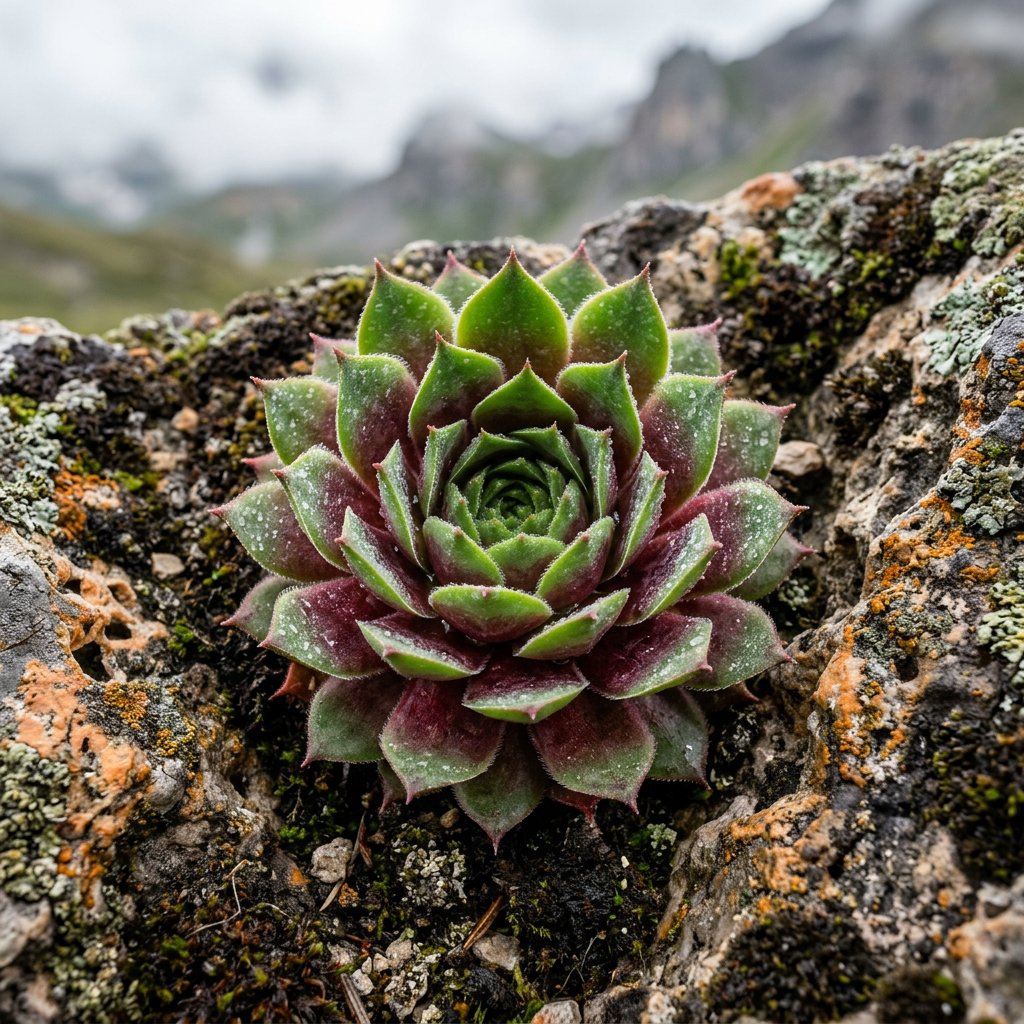
Plant Overview
Known widely as "Hens and Chicks," Sempervivum tectorum is a rugged survivor that lives up to its Latin name, which translates to "Always Living on Roofs." Historically, these hardy succulents were planted on thatched roofs across Europe because people believed they warded off lightning strikes and fire. Today, they are beloved by hobbyists for their geometric perfection and their uncanny ability to thrive in the harshest, rockiest crevices.
🔍 How to Identify
- 🍃 Rosette Form: Grows in tight, symmetrical circles of fleshy, wedge-shaped leaves that resemble a lotus flower sculpted from stone.
- 🎨 Leaf Color: Typically a soft grayish-green, but the tips often blush with a dramatic deep red or purple, especially when exposed to bright sunlight or cold temperatures.
- 🧶 Leaf Margins: If you look closely at the edges of the leaves, you will see tiny, fine white hairs (cilia) that give the plant a slightly frosted appearance.
🏡 In Your Garden
- ⛰️ Alpine Hardiness: Because they originate from the high mountains of Europe, these plants are incredibly frost-tolerant. They prefer "tough love"—gritty, sandy soil and very little water.
- 🐣 The "Hens & Chicks" Habit: The plant reproduces by sending out small runners from the mother plant (the Hen) which develop into tiny clones (the Chicks). This creates a beautiful, mounded carpet of rosettes over time.
- 🌸 Monocarpic Bloom: When a "Hen" reaches maturity, it may shoot up a tall, starry-flowered stalk. This is its "swan song"; once the rosette flowers and sets seed, that specific rosette will die, leaving the space to be filled by its many offspring.
⚠️ Safety & Toxicity
- 🐾 Pet Friendly: Sempervivum tectorum is non-toxic to cats, dogs, and horses, making it an excellent choice for households with curious furry friends.
- 🌿 Skin & Stomach: While the sap has been used in folk medicine similarly to Aloe Vera to treat stings, it is generally not meant to be eaten. Large amounts could cause mild digestive upset in humans or pets.
✨ Fun Fact
⚡ The Lightning Rod: In medieval Europe, Charlemagne (the King of the Franks) reportedly issued a decree that every villager must plant Sempervivum on their roof. He believed the plant’s association with the God of Thunder would protect the buildings from being struck by lightning during storms.

Detailed Care Instructions
As a drought-tolerant succulent, hens and chicks is one of the better perennials for rock-gardens—they also grow well in cracks, whether in stone walls or between garden stepping stones.If you're looking for a ground cover, you can replace your lawn with a combination of hens and chicks plus creeping sedum. Hens and chicks also makes a good potted plant, both outdoors and indoors.
How long does this plant live?
These plants are known as monocarpic plants. The individual rosettes die out soon after they send up flower shoots. But flowering doesn't always occur, and even when some rosettes die out, the offshoot "chicks" will continue the colony. An established colony will live for decades with this constant replacement of rosettes.
Are there other Sempervivum species I should consider?
There are more than 40 species in the Sempervivum genus, and several are popular garden and houseplant species. In addition to S. tectorum, you can look for Sempervivum arachnoideum (cobweb house leek), Sempervivum calcareum, and Sempervivum ciliosum (Teneriffe houseleek). All species have the characteristic rosette shape.
Where did the name "house leek" come from?
The common name "houseleek" comes from an Anglo Saxon word “leac,” meaning plant. These plants are literally known to grow on houses, especially those with slate or stone shingles. In fact, they were sometimes deliberately planted on roofs in order to hold roof shingles in place.
Is this plant edible?
The leaves of hens and chicks are completely edible and can be used in salads and other dishes. The taste is slightly sour, like an unripe apple.
| Color | Light Pink To Reddish Purple |
| Soil Ph | 6.6 To 7.5 |
| Lighting | Full Sun |
| Soil Type | Sandy |
| Bloom Time | Summer |
| Plant Type | Succulent Evergreen Perennials |
| Mature Size | 4 Inches Tall |
| Native Area | Mountainous And Stony Areas Of Southern And Central Europe And North Africa |
| Sun Exposure | Full Sun To Part Shade |
| Hardiness Zones | 3-11 |
To grow Sempervivum tectorum, also known as Hens and Chicks or houseleek, follow these steps:
- Select a suitable location: Sempervivum tectorum prefers full sun to partial shade. Choose an area with well-draining soil, as the plant does not tolerate excessively wet conditions.
- Prepare the soil: If your soil is heavy or compacted, amend it with some organic matter like compost or peat moss to improve drainage.
- Planting: Sempervivum can be grown from seeds, offsets (babies), or mature plants. If using offsets, detach a few from the main plant and plant them at a depth of 1 to 2 inches (2.5 to 5 cm). Space them about 4 to 6 inches (10 to 15 cm) apart to allow for their growth. If using seeds or mature plants, follow the instructions on the seed packet or plant tag.
- Watering: After planting, water the Hens and Chicks thoroughly and keep the soil slightly moist until they establish roots. Once established, Sempervivum is drought-tolerant and requires minimal watering. Only water when the soil feels dry to the touch.
- Fertilizing: Sempervivum does not require much fertilization. If you choose to fertilize, use a balanced, slow-release fertilizer once or twice during the growing season, following the package instructions.
- Maintenance: Remove any weeds that may come up around the plants. Sempervivum is a low-maintenance plant that doesn't require much attention. Deadhead any spent flower stalks to maintain a tidy appearance.
- Propagation: Sempervivum is known for its ability to produce offsets or "chicks." These can be carefully detached from the main plant once they reach a sufficient size and replanted elsewhere. This method is a common way to propagate and expand your Sempervivum collection.
- Winter care: Sempervivum tectorum is a hardy perennial that can withstand freezing temperatures. However, in cold climates, it's a good idea to provide some protection, especially for newly planted or potted plants. Consider mulching around the plants with a layer of straw or leaves to help insulate the soil and roots.
By following these steps, you can successfully grow your Sempervivum tectorum plant and enjoy its unique rosette-shaped foliage.

Place in a bright room that is sun drenched almost all day. Or directly in a south-facing window.

Watering for this particular plant is crucial for its growth and survival. To water the plant, use a watering can or spray bottle to gently moisten the soil or compost. It is important to avoid spraying the leaves as this can lead to rotting or fungal diseases. Always ensure that the soil is well-draining, as waterlogged soil can harm the roots and cause the plant to rot. In general, this plant prefers to be kept on the drier side, so avoid overwatering and allow the top layer of soil to dry out before watering again. In hot and dry conditions, the plant may require more frequent watering.
To fertilize this plant, use a general purpose fertilizer. Dilute the fertilizer to half strength and apply it directly to the soil, avoiding direct contact with the plant's leaves. Fertilize the plant once a month during the growing season, which is typically from spring to fall. It is important to not over-fertilize the plant, as this can lead to root burn and damage. Always follow the manufacturer's instructions for the specific fertilizer being used.
The plant requires a specific type of soil that is well-draining and rich in minerals. This type of soil should have a slightly acidic pH balance and be able to retain moisture without becoming waterlogged. It is recommended to use a soil mix that consists of equal parts of sand, perlite, and peat moss to provide the appropriate growing conditions for the plant. Additionally, adding small amounts of compost or organic matter can help to improve the overall health and vitality of the plant. It is important to avoid using heavy soils or those that contain large amounts of clay, as this can lead to soil compaction and poor drainage. With the right soil, your Sempervivum Tectorum plant can thrive and grow to its full potential.
Sempervivum Tectorum is a plant that can be easily propagated through a simple process. To propagate this plant, you will need to follow the steps mentioned below:
- Take a healthy Sempervivum Tectorum plant and carefully remove some of its offsets or baby plants from the edges.
- Make sure that each offset has its own set of roots. You can gently pull the offset to check if it has roots. If it doesn't, you can cut it using a sharp and clean knife.
- Allow the offsets to dry out for a day or two so that the cut ends of the roots can heal.
- Get a well-draining pot that has a mixture of soil and sand. Make sure that the soil mixture is moist but not too wet.
- Place the offsets in the pot, burying the roots in the soil mixture. You can keep two or three offsets in one pot.
- Water the pot gently and make sure that the soil mixture is moist but not waterlogged.
- Keep the pot in a well-lit area that receives indirect sunlight. You can also keep it under a grow light if you have one.
- Within a few weeks, you will notice that the offsets have started to grow and form their own rosettes.
- Once the new plants have grown to a reasonable size, you can transplant them into separate pots or plant them directly into the ground.
By following these simple steps, you can easily propagate Sempervivum Tectorum and enjoy its beautiful rosettes in your garden.
Common pests of the hen-and-chickens include Scale insect, mealybugs, thrips. Make a habit of checking your hen-and-chickens frequently for pests so that any infestations can be caught and managed early.








