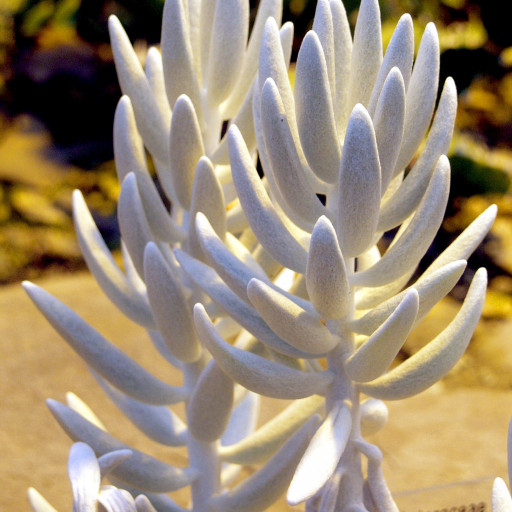
Plant Overview
Often called the "Cocoon Plant" or "Woolly Senecio," Senecio haworthii looks like a collection of silk-spun moth cocoons standing upright in a pot. Hailing from the arid Karoo region of South Africa, this succulent is a master of survival, sporting a thick, snowy-white coating that makes it look almost otherworldly in any succulent collection.
🔍 How to Identify
- ☁️ The "Wool": The most striking feature is a dense, brilliant white, felt-like layer (tomentum) that covers every inch of the leaves.
- 🐛 Cylindrical Leaves: The leaves are thick, fleshy, and shaped like fat cigars or cocoons, tapering slightly at both ends.
- 🏗️ Upright Habit: It grows as a small, branching shrub, with stems that become slightly woody over time to support the heavy, water-filled leaves.
🏡 In Your Garden
- ☀️ Sunlight Armor: That white fuzz isn’t just for looks—it acts as a natural sunscreen and reduces moisture loss. To keep it bright white and compact, it needs a very sunny spot; otherwise, it may turn "baldy" and green.
- 💧 Drought Specialist: Because of its protective coat and fleshy interior, it holds onto moisture extremely well. It is highly susceptible to root rot, so it thrives best when ignored—only water when the soil is bone-dry all the way through.
- 🚫 Hands Off: Try to avoid touching the leaves frequently. The white felt can rub off under your fingertips, leaving "bald" green patches that do not easily grow back, which can ruin its pristine aesthetic.
⚠️ Safety & Toxicity
- 🐾 Toxic to Pets: Like most members of the Senecio genus, this plant contains pyrrolizidine alkaloids. If ingested by cats or dogs, it can cause liver distress or vomiting.
- 👶 Human Safety: It is considered toxic if eaten. Keep it on higher shelves out of reach of curious children who might be tempted by its soft, "pet-able" texture.
✨ Fun Fact
The thick white "hair" on the leaves is so dense and flammable when dry that, in its native South African habitat, it has historically been used as a natural tinder for starting fires!

Detailed Care Instructions
To grow a Senecio Haworthii plant, also known as Cocoon Plant or Woolly Senecio, you can follow these steps:
- Choose the right location: Senecio Haworthii plants prefer bright, indirect sunlight. Place them near a window that receives indirect light or in a spot with filtered sunlight.
- Use well-draining soil: The plant requires well-draining soil to prevent root rot. A cactus or succulent soil mix is an ideal choice.
- Planting the Senecio Haworthii: Select a pot with drainage holes to ensure excess water can escape. Fill the pot with the well-draining soil mixture and gently plant the senecio at the same depth as its previous pot. Avoid burying the leaves or stem.
- Watering: Water the plant thoroughly whenever the top inch of soil feels dry, but be cautious not to overwater. Senecio Haworthii plants are drought-tolerant and can survive longer periods without water. During the winter months, reduce watering frequency.
- Temperature and humidity: Senecio Haworthii prefers warmer temperatures between 65-80°F (18-27°C). They can tolerate slightly cooler temperatures during winter but should be protected from frost. Average household humidity is generally sufficient for the plant.
- Fertilizing: Feed the plant with a balanced fertilizer diluted to half strength once a month during the growing season (spring and summer). Avoid fertilizing during winter.
- Pruning: Trim off any dead or yellowed leaves to maintain the plant's appearance and health. You can also pinch back the tips to encourage bushier growth.
- Propagation: Senecio Haworthii can be propagated through stem cuttings. Take a cutting and allow it to dry for a few days. Plant it in well-draining soil and keep it slightly moist until roots form.
- Pests and diseases: These plants are generally pest-resistant, but occasionally they may encounter mealybugs or spider mites. Regularly inspect the plant for any signs of infestation and treat accordingly.
Remember to research the specific care needs of your Senecio Haworthii to ensure optimal growth and health for your specific variety.

Place in a window with dappled sun or a spot in the middle of a room. Or directly in a window facing west or east.

To water this plant, it is important to wait until the top inch of soil is completely dry. Then, slowly pour water into the soil, making sure to avoid getting water on the leaves or stem. It is also important to ensure that the pot has drainage holes, allowing excess water to escape and prevent root rot. Additionally, during the winter months, it is important to reduce watering and only water when the soil is completely dry to prevent overwatering.
To fertilize this plant, you should use a balanced, water-soluble fertilizer during the growing season. Dilute the fertilizer to half strength and apply it to the soil every two weeks. Make sure not to over-fertilize as this can damage the plant's roots and cause burn on its leaves. During the winter months, stop fertilizing and let the plant rest.
For optimal growth of this plant, it is recommended to use a well-draining soil mix that is specifically formulated for succulent plants. The mix should contain a combination of coarse sand, perlite, and peat moss, with very little organic matter. This will provide the plant with the necessary drainage and aeration while preventing the soil from becoming too compacted. Additionally, it is important to ensure that the soil mix is pH balanced, as this plant requires a slightly acidic soil environment to thrive. Finally, it is important to avoid overwatering this plant, as it is susceptible to root rot, so ensure that the soil is allowed to dry out between waterings.
To propagate this plant, take a stem cutting from the parent plant. Choose a healthy stem that is at least 3-4 inches long and has a few leaves attached. Cut the stem just below a node (the part where the leaf attaches to the stem). Remove the lower leaves, leaving only the top two or three. Dip the cut end of the stem into rooting hormone, if desired. Place the stem in a pot filled with well-draining soil, and water it lightly. Cover the pot with a plastic bag to create a humid atmosphere, and place it in bright, indirect light. Keep the soil moist but not waterlogged, and remove the plastic bag once the cutting has rooted and new growth appears.
Common pests of the woolly senecio include Scale insect, mealybugs, spider mites, thrips. Make a habit of checking your woolly senecio frequently for pests so that any infestations can be caught and managed early.








