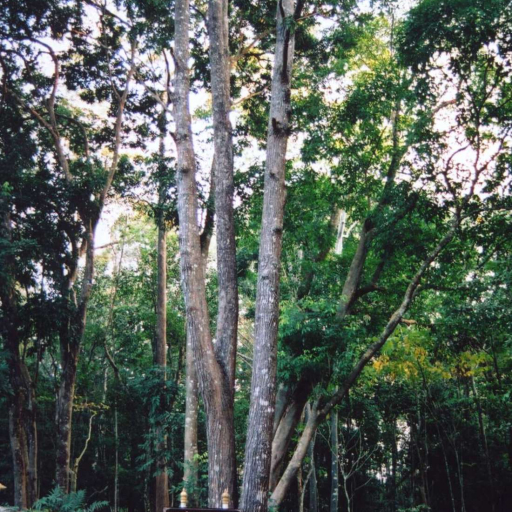
Plant Overview
Known as the Burmese Sal or Talura, Shorea roxburghii is a majestic forest giant that reigns over the dry deciduous landscapes of Southeast Asia and India. While its timber is legendary for its strength, it is most celebrated for its ethereal, honey-scented blossoms that turn entire forest canopies into snowy clouds during the blooming season. In its native lands, it is a symbol of endurance, often found standing tall in regions where other trees struggle with seasonal droughts.
🔍 How to Identify
- 🪵 The Bark: Mature trees feature thick, greyish-brown bark with deep, irregular vertical fissures that give it a rugged, ancient appearance.
- 🍃 The Foliage: Its leaves are leathery, oblong, and a deep glossy green, providing dense shade throughout the year.
- 🌸 The Flowers: It produces clusters of creamy-white, star-shaped flowers that emit a powerful, sweet fragrance reminiscent of jasmine and honey.
- 🚁 The Fruit: The most distinct feature is its winged seed; three to five long, papery "wings" surround the nut, allowing it to spin like a helicopter when it falls.
🏡 In Your Garden
- 🌳 Space is Essential: Because this is a large-canopy timber tree, it is not suitable for small backyard gardens or containers. It requires significant "elbow room" and is best suited for large estates, parks, or reforestation projects.
- 🌱 Deep Taproot: The Burmese Sal develops a massive taproot early in life to find water deep underground. Because of this, it hates being transplanted; once you choose a spot, it should remain there for its entire life.
- 🌞 Drought Specialist: Unlike many tropical giants, this tree is incredibly resilient to dry spells. It prefers well-draining sandy or loamy soil and actually benefits from a distinct dry season to trigger its spectacular flowering.
⚠️ Safety & Toxicity
- ✅ Status: Generally non-toxic and safe.
- 🐾 Details: There are no known toxic effects for dogs, cats, or horses. In fact, various parts of the tree, including its resin (often called 'dammar'), have been used in traditional medicine for centuries. The primary "safety" concern is its size—ensure it is planted far from power lines or home foundations.
✨ Fun Fact
The seeds of Shorea roxburghii are master flyers! Their aerodynamic wings are perfectly weighted so that as the seed drops, it enters a rapid "auto-rotation" (like a helicopter blade). This allows the wind to carry the baby tree far away from the shade of its parent, ensuring it finds its own patch of sunlight to grow.

Detailed Care Instructions
To grow Shorea Roxburghii, also known as the Sal tree or Sakhua, you can follow these steps:
- Obtaining seeds or seedlings: You can either collect seeds from mature trees or purchase them from a nursery. Alternatively, you can acquire young seedlings from a trusted source.
- Soil preparation: Shorea Roxburghii prefers well-draining soil. Prepare a mix of equal parts garden soil, compost and sand. This will ensure good drainage and provide adequate nutrients.
- Planting seeds or seedlings: If planting seeds, soak them in water overnight to enhance germination. Sow the seeds about 1 inch deep in small pots or directly in the ground during spring or early summer. If using seedlings, gently transplant them into larger pots or directly into the ground.
- Sunlight and watering: Sal trees thrive in full sunlight, so choose a spot with plenty of direct sunlight. Keep the soil evenly moist, but avoid overwatering, as this can cause root rot. Water the plants deeply once or twice a week, depending on the weather conditions.
- Mulching and fertilizing: Apply a layer of organic mulch around the base of the plant to retain soil moisture and suppress weed growth. Additionally, feed the plant with a balanced organic fertilizer during the growing season to promote healthy growth.
- Pruning and shaping: As the tree grows, you may need to prune and shape it to encourage a desired form. Remove any dead or damaged branches and trim back excessive growth to maintain a manageable size.
- Pest and disease control: Monitor the plant regularly for any signs of pests or diseases. Common pests that may affect Shorea Roxburghii include aphids and caterpillars. Use appropriate organic pest control methods to address these issues.
- Patience and care: Shorea Roxburghii is a slow-growing tree, so be patient with its growth. Provide regular care and attention by watering, fertilizing, and protecting it from extreme weather conditions. With time, it will grow into a beautiful Sal tree.
Remember to check if growing Shorea Roxburghii is suitable for your specific climate and geographical location, as it is native to the Indian subcontinent and may have specific requirements.
To water this particular plant species, you should first check the soil moisture level using a moisture meter or by touching the soil with your finger. If the soil is dry to the touch, give the plant a deep watering, saturating the root zone and allowing any excess water to drain out of the pot. Avoid overwatering, which can lead to root rot and other issues. During the growing season, check the soil moisture regularly and adjust your watering schedule as needed based on the plant's needs and the environmental conditions. It is also important to ensure proper drainage, either by using a well-draining potting mix or adding drainage holes to the pot. Finally, consider using room-temperature or tepid water to avoid shocking the plant's roots.
To fertilize this plant, apply a slow-release granular fertilizer or a water-soluble fertilizer at half strength once every two months during the growing season. Make sure to water the plant thoroughly before and after fertilizing to avoid burning the roots. Avoid over-fertilizing as it can cause excessive growth and weaken the plant.
The ideal soil for Shorea Roxburghii plants is loamy soil with good drainage and a pH level ranging from slightly acidic to neutral. The soil should also be rich in organic matter and nutrients to support healthy growth. It is recommended to mix in compost and peat moss to provide some additional nutrients and improve soil structure. Avoid using heavy clay soils or soils that are too sandy, as they may not provide adequate drainage or nutrients for the plant to thrive. Additionally, it's important to water the plant regularly but not too frequently, as over-watering can lead to root rot.
There are a few methods of propagating this plant, but one common way is to collect seeds from mature fruits. Seeds should be extracted carefully and planted immediately in well-draining soil mix. Keep the soil moist and warm, but not too wet or soggy, as this can lead to root rot. Germination can take several weeks to a few months.
Another method is to take cuttings from healthy stems during the growing season. Make sure the cutting is taken from the base of the stem and is at least 6 inches long. Remove leaves from the lower half of the cutting and dip the cut end in rooting hormone. Plant the cutting in a well-draining soil mix and keep it moist. The cutting should develop roots in a few weeks.
Grafting is another way to propagate this plant, but it requires some expertise and experience. It involves attaching a scion (a piece of the desired plant) onto the rootstock (the plant with an established root system). This method is used to create hybrids or to propagate varieties that are difficult to root from cuttings or germinate from seeds.
Regardless of the method you choose, it's important to provide the right growing conditions for the propagated plant, including proper soil, light, water, and nutrients. With proper care, the plant can grow into a healthy and mature specimen.








