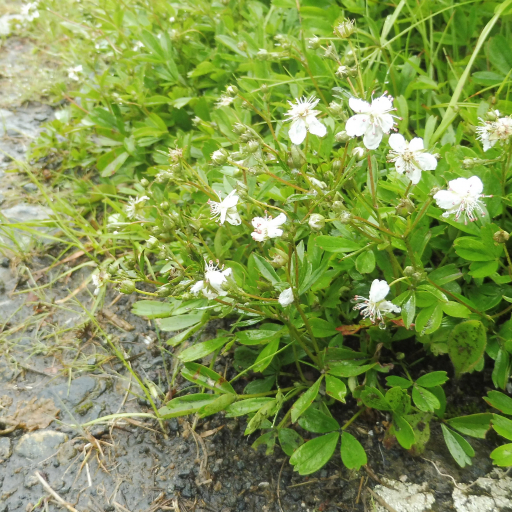
Plant Overview
Often called the Three-toothed Cinquefoil or Mountain White Cinquefoil, this resilient little powerhouse is a star of rugged northern landscapes. While it looks like a delicate wildflower, it is actually a woody subshrub that can withstand freezing mountain winds and poor, rocky soils. Its most enchanting secret is its autumn wardrobe, when its deep green leaves transition into a brilliant, fiery crimson.
🔍 How to Identify
- 🍃 The Signature Leaves: Each leaf is divided into three distinct leaflets. True to its name (tridentata), each leathery leaflet has exactly three sharp, prominent teeth at its very tip.
- 🌸 Starry Blooms: From late spring to mid-summer, the plant produces clusters of small, five-petaled white flowers with yellow centers that look like tiny stars scattered across a green carpet.
- 🪵 Growth Habit: It forms a low, dense mat that hugs the ground. Unlike true herbaceous perennials, the base of this plant is tough and woody, helping it anchor into rocky crevices.
🏡 In Your Garden
- ⛰️ The "Tough Love" Rule: This plant thrives on neglect in the right conditions. It craves acidic, well-drained, and even nutrient-poor soil. It is an ideal choice for rock gardens, stone walls, or coastal landscapes where salt spray and wind are common.
- ❄️ Cold Warrior: Because it is native to alpine and arctic regions, it is incredibly cold-hardy. It actually requires a significant winter chill to thrive and may struggle or become "leggy" in hot, humid southern climates.
⚠️ Safety & Toxicity
- ✅ Safe Status: Sibbaldiopsis tridentata is generally considered non-toxic to humans, dogs, and cats.
- 🐾 Pet Note: While it won't cause poisoning if a curious pet nibbles it, the leaves are quite tough and leathery, which might cause minor stomach upset if ingested in large quantities. It is best used as a visual groundcover rather than a forage plant.
✨ Fun Fact
Despite its delicate appearance, this plant is a master of camouflage and survival. It is one of the few plants that can survive on the high-altitude "balds" of the Appalachian Mountains, where the weather conditions are often compared to the harsh tundra of the Arctic!

Detailed Care Instructions








