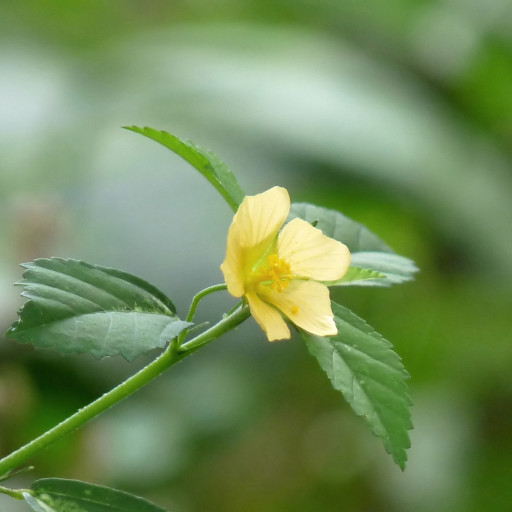
Plant Overview
Often called Arrowleaf Sida or Jelly Leaf, this resilient wildflower is a globe-trotter found everywhere from tropical roadsides to backyard lawns. While many gardeners treat it as a stubborn weed, it has a rich history as "Cuban Jute," once prized globally for its incredibly tough stems used to make cordage and heavy-duty brooms.
🔍 How to Identify
- 🍃 The Diamond Leaf: Look for the signature "rhombic" or diamond-shaped leaves. They are usually bright green with serrated (saw-toothed) edges on the top half, while the base remains smooth.
- 🌼 Sun-Kissed Blooms: It produces delicate, five-petaled flowers in shades of creamy yellow or pale orange. These blooms are "early birds," often opening in the morning sun and closing by mid-afternoon.
- 🪵 The Iron Stem: Even as a small plant, the stem is remarkably woody and flexible. If you try to pull it up, you’ll find it resists snapping far better than typical garden weeds.
🏡 In Your Garden
- ⛏️ The Taproot Anchor: This plant is a master of survival because of its deep, vertical taproot. It thrives in compacted, poor soil where other plants struggle. This makes it a "bio-indicator"—if you see it thriving, your soil might be overly compressed or lacking aeration.
- ☀️ Heat Warrior: Arrowleaf Sida loves the heat. It is exceptionally drought-tolerant and will remain green and vibrant even during a scorching mid-summer dry spell without any extra watering.
⚠️ Safety & Toxicity
- 🐾 Pet & Child Safety: Sida rhombifolia is generally considered non-toxic to humans and pets in small amounts. It has a long history of use in traditional medicine (Ayurveda).
- ⚠️ The "Munching" Rule: Despite its medicinal history, it contains trace amounts of alkaloids like ephedrine. It is best to prevent pets or curious children from grazing on it, as consuming large quantities could lead to digestive upset or mild stimulation.
✨ Fun Fact
In many tropical cultures, the stems are dried, bundled together, and tied to a stick to create durable, natural sweeping brooms. This has earned the plant the common nickname "Broomweed."

Detailed Care Instructions
To grow Sida Rhombifolia, also known as Cuban Jute or Arrowleaf Sida, follow these steps:
- Obtaining seeds: You can purchase Sida Rhombifolia seeds from a local nursery or online seed stores. Make sure the seeds are fresh and viable.
- Choosing a location: Sida Rhombifolia prefers full sun but can tolerate partial shade. It grows well in a warm climate, so choose a location where the plant will receive ample sunlight.
- Soil preparation: Prepare the soil by removing weeds and rocks. Sida Rhombifolia prefers well-draining soil, so consider adding organic matter like compost to enhance soil fertility and drainage.
- Planting: Sow the Sida Rhombifolia seeds directly into the prepared soil. Make sure the soil is moist, but not overly wet. Plant the seeds at a depth of about 1/4 to 1/2 inch and space them about 12 inches apart.
- Watering: Keep the soil consistently moist but not waterlogged. Water the plants regularly, especially during dry periods, but avoid over-watering. Sida Rhombifolia can tolerate dry conditions but prefers moderate moisture.
- Fertilization: You can apply a balanced, slow-release fertilizer once or twice a year to provide essential nutrients to the plants. Follow the fertilizer package instructions for appropriate dosage. Be careful not to over-fertilize as it can harm the plants.
- Mulching: Apply a layer of mulch around the base of the plant to retain soil moisture, suppress weed growth, and protect the roots from extreme temperatures.
- Pruning: Sida Rhombifolia may require occasional pruning to remove dead or damaged branches and to maintain an attractive shape. Prune the plant after the flowering season or as needed to control its size and promote bushier growth.
- Pest and disease control: Sida Rhombifolia is relatively resistant to pests and diseases. However, keep an eye out for signs of common garden pests such as aphids or whiteflies. If necessary, you can use organic pest control methods like insecticidal soaps or neem oil to address any issues.
- Support: As the plant grows, it may benefit from staking or a trellis for support, especially if you want it to grow vertically.
Remember to be patient, as it may take some time for the Sida Rhombifolia plant to establish and reach its full potential. Regular care, including watering, fertilizing, and occasional pruning, will help ensure its health and growth.

Place in a bright room that is sun drenched almost all day. Or directly in a south-facing window.

The ideal way to water the plant is to give it a thorough soaking and then allow the soil to dry out slightly before watering again. It is important not to overwater the plant as this can lead to root rot, so ensure that the soil is completely dry before watering again. When watering, aim to water the base of the plant rather than the leaves to avoid any damage. Additionally, it is recommended to water in the morning or evening when the temperatures are cooler to prevent the water from evaporating before it can be absorbed by the plant.
The Sida Rhombifolia plant prefers a nutrient-rich soil with a pH level between 6.5 and 7.5. Fertilizing the plant with a balanced fertilizer that contains equal amounts of nitrogen, phosphorus, and potassium is recommended. It is also important to avoid over-fertilizing, as this can lead to excessive growth and decreased plant health. A slow-release fertilizer can be applied once every three months during the active growing season. Alternatively, a liquid fertilizer can be applied every two weeks, following the manufacturer's instructions for dilution and application. Always water thoroughly after fertilizing to ensure the nutrients are evenly distributed.
The soil that should be used with the plant species known as Sida Rhombifolia should be well-draining and fertile. It should have a pH level that ranges between 6.0 and 7.5. The soil should also be moist, but not waterlogged, as overly wet conditions can lead to root rot and other diseases. It is recommended to use a mix of peat moss, vermiculite, and perlite to create the optimal soil for this plant. Additionally, adding organic matter such as compost and aged manure can help improve the soil structure and provide nutrients for the plant's growth.
To propagate this plant, take cuttings from healthy, mature stems. Use a clean, sharp tool to make a diagonal cut at a 45-degree angle. The cutting should be approximately 4-6 inches in length and have at least 2-3 nodes.
Remove the lower leaves from the cutting, leaving only the top 2-3 leaves intact. Dip the cut end of the stem into a rooting hormone powder. Tap off any excess powder.
Prepare a potting mix consisting of equal parts of peat moss, perlite, and vermiculite. Moisten the mixture with water until it is damp but not soaking wet.
Make a small hole in the potting mix and insert the cutting, making sure that the bottom nodes of the stem are in contact with the soil. Firmly press the soil around the cutting to ensure good contact. Water the cutting until the soil is moist.
Cover the cutting with a clear plastic bag or a plastic dome to maintain humidity. Place the cutting in a bright, indirect light location but avoid direct sunlight. Ensure that the soil remains moist but not waterlogged. Check the cutting regularly for any signs of wilting or drying out.
After 3-4 weeks, check for root growth by gently tugging on the stem. If there is resistance, roots have developed. After rooting, gradually remove the plastic cover and increase the amount of light exposure. Transplant the rooted cutting into a larger container or outdoors in a well-draining soil mixture with adequate sunlight.








