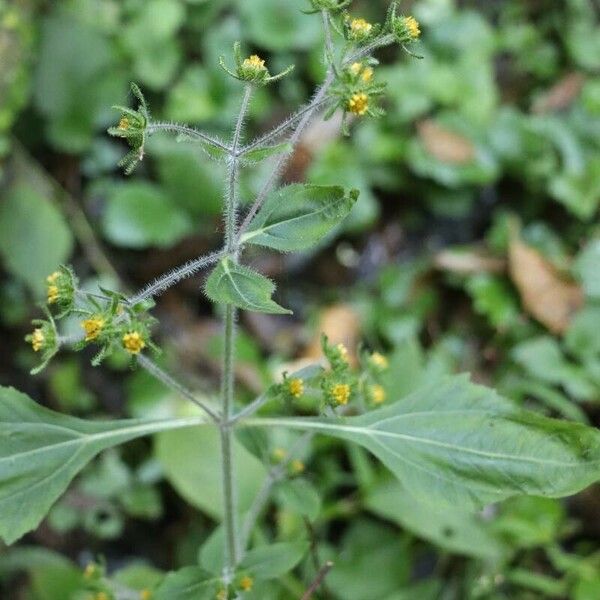
Plant Overview
Often called "St. Paul’s Wort" or "Sticky Sigesbeckia," this hardy herb is a staple in traditional East Asian medicine. While it may look like a humble roadside weed at first glance, it carries a fascinating history of healing and a unique "tacky" defense mechanism. It is best known for its ability to "hitchhike" by sticking to the fur of animals or the clothes of passing hikers to spread its seeds.
🔍 How to Identify
- 🌼 The Blooms: Small, daisy-like yellow flowers that appear in loose clusters. They lack the large, showy petals of a sunflower, appearing more like tiny golden buttons.
- 🍯 Sticky Bracts: The flower heads are surrounded by five long, green, leaf-like bracts. These are covered in dense, glandular hairs that produce a sticky resin, making them feel like natural Velcro to the touch.
- 🍃 Toothed Leaves: The leaves are relatively large, triangular or arrowhead-shaped, and have noticeably serrated (toothed) edges. They grow in opposite pairs along a hairy, upright stem.
🏡 In Your Garden
- 🌱 Opportunistic Growth: You will likely find this plant appearing as a "volunteer" in moist, shaded corners or near forest edges. It thrives in nitrogen-rich soil and loves humidity, making it a common sight near compost piles or damp drainage areas.
- 🦋 Ecosystem Role: While some gardeners view it as a weed due to its vigorous growth, it is a nectar source for small native bees and hoverflies. Its sticky nature also serves as a "bug trap" for tiny pests, acting as a natural form of pest control.
⚠️ Safety & Toxicity
- 🐾 Low Risk: Sigesbeckia pubescens is generally considered non-toxic to humans and common household pets if touched.
- 🧤 Skin Sensitivity: The sticky resin on the flower heads can occasionally cause mild skin irritation or a "clogged" feeling on the skin for those with sensitivities. It is also notorious for getting stuck in the long fur of dogs, which may require a bath or careful brushing to remove.
- 🌿 Medicinal Note: Although used in Traditional Chinese Medicine (known as Xi Xian), it should never be ingested without professional guidance, as improper preparation can lead to stomach upset.
✨ Fun Fact
🎓 A Botanical Insult: The genus was named by the famous botanist Carl Linnaeus after his rival, Johann Georg Siegesbeck. Siegesbeck had criticized Linnaeus's work, so Linnaeus retaliated by naming this "small, sticky, and somewhat unpleasant weed" after him, ensuring his rival's name was forever associated with a plant that people try to pull out of their gardens!

Detailed Care Instructions

Place in a bright room that is sun drenched almost all day. Or directly in a south-facing window.

Water-loving plants flourish in wet or sloppy soil and near ponds. The extensive root system enables these plants to absorb plenty of water. The surface of the soil should be kept moist at all times. Place your pot in a container filled with water to guarantee that plants get enough water. If the ground becomes dry, it is recommended that you water it well. Plants in smaller pots will need to be watered more frequently. Water the soil in which the plant is standing thoroughly using a watering can.








