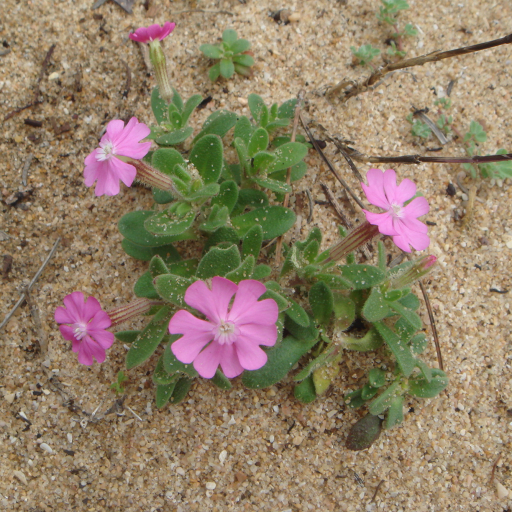
Plant Overview
Often referred to as the Mediterranean Catchfly, Silene littorea is a resilient little pioneer that paints coastal sand dunes in shades of vibrant pink. Thriving where most plants wither, this hardy annual is a master of the shoreline, using its sticky "glue" to protect its nectar from crawling thieves while braving the salty Mediterranean winds.
🔍 How to Identify
- 🌸 The Bloom: Small but striking five-petaled flowers, usually in a vivid candy-pink or deep rose. Each petal has a distinct notch at the tip, giving it a heart-like appearance.
- 🧪 The "Catchfly" Stem: The stems and leaves are covered in fine, glandular hairs that feel sticky to the touch. This "glue" traps small crawling insects that might try to steal nectar without pollinating the plant.
- 🐚 The Striped Base: The calyx (the tube at the base of the flower) is elongated and often marked with ten dark, longitudinal veins, giving it a delicate, pinstriped look.
🏡 In Your Garden
- ☀️ Sun & Sand: This plant is a true sun-worshiper. In a garden setting, it requires excellent drainage—ideally a sandy or gritty soil mix—to mimic its natural dune habitat. It will struggle and likely rot in heavy, clay-rich soil.
- 🌊 Salt Specialist: It is exceptionally tolerant of salt spray, making it an ideal choice for "rockery" style gardens or coastal properties where other flowers might be scorched by the sea air.
- 🌱 Short but Sweet: As an annual, Silene littorea lives fast. It focuses its energy on producing a carpet of flowers and plenty of seeds to ensure its return the following spring.
⚠️ Safety & Toxicity
- 🐾 Pet & Human Safety: Silene littorea is generally considered non-toxic to humans and common household pets. It does not possess the aggressive irritants found in some of its botanical cousins.
- 🧪 Saponin Content: Like many members of the Pink family (Caryophyllaceae), it contains saponins. While these can be toxic if consumed in massive quantities, the plant is generally unpalatable and poses very little risk to curious toddlers or pets.
✨ Fun Fact
The "Catchfly" isn't actually a carnivorous plant! While it traps ants and small flies on its sticky stems, it doesn't digest them for nutrients. Instead, the stickiness acts as a "biological fence" to ensure that only flying insects—who are better at cross-pollination—can reach the pollen at the top.

Detailed Care Instructions

Place in a bright room that is sun drenched almost all day. Or directly in a south-facing window.

Some plants require more regular watering than others, which should be done every few days. It's critical to maintain the soil moist all of the time. The water requirements of the same plant placed in pots with varying sizes will differ. Because the water in the smaller pot evaporates faster than the water in the larger pot, it will require more watering. Regardless of pot size, the surface should constantly be maintained moist.








