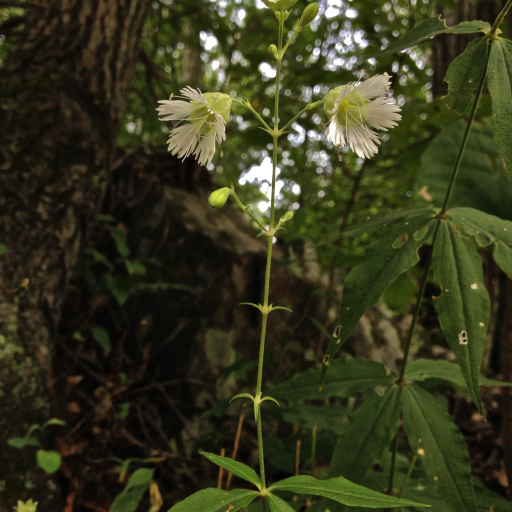
Plant Overview
Often called the Widow's Frill because of its delicate, torn-looking petals, Silene stellata is an ethereal woodland gem native to the North American prairies and oak savannas. Its ghost-white, star-shaped flowers seem to float in the dappled shade, providing a touch of "wild mystery" to any native plant collection. It is a favorite for gardeners looking to support local biodiversity while adding architectural interest.
🔍 How to Identify
- 🌸 Fringed Petals: Each of its five white petals is deeply divided into four or more thin, hair-like lobes, giving the flower a ragged, lace-like appearance.
- 🍃 Whorled Leaves: Look at the stem—unlike many other campions, this species features leaves arranged in distinctive "circles" or whorls of four at each node.
- 🕯️ Bell-shaped Calyx: The base of the flower sits in a pale green, slightly inflated "cup" (the calyx) that looks like a tiny paper lantern.
🏡 In Your Garden
- 🌤️ Dappled Sunlight: This plant thrives in "in-between" spaces. It loves the gentle morning sun but requires protection from harsh afternoon heat to prevent its delicate, thin petals from wilting prematurely.
- 🧱 Stability is Key: Once established, try not to move it. Silene stellata develops a sturdy taproot that makes it impressively drought-tolerant but also very "grumpy" and prone to failure if transplanted.
- 🦉 Moon Garden Potential: Because its flowers are bright white and most fragrant at dusk, it is a perfect candidate for a "Moon Garden" meant to be enjoyed after sunset.
⚠️ Safety & Toxicity
- 🐾 Pet Friendly: This plant is generally considered non-toxic to cats, dogs, and horses, making it a safe choice for family backyards.
- 🧼 Mild Saponins: Like many members of the Pink family, it contains saponins (natural soap-like compounds). While not deadly, they have a bitter taste and can cause mild stomach upset if ingested in large quantities by curious children or pets.
✨ Fun Fact
- 🦋 The Moth's Landing Pad: The "frilled" edges of the petals aren't just for show—they are evolutionarily designed to help nocturnal moths easily locate and grip the flower in the dark, ensuring successful pollination under the cover of night.

Detailed Care Instructions
To grow Silene stellata plants, also known as starry campion or widow's frill, follow these steps:
- Choose a suitable location: Silene stellata prefers well-draining soil and full sun to partial shade. Ensure the chosen location has these conditions.
- Prepare the soil: Before planting, prepare the soil by removing weeds and adding compost or well-rotted manure to improve fertility and drainage.
- Sow the seeds: Silene stellata can be grown from both seeds and seedlings. If starting from seeds, sow them directly into the prepared soil in late spring or early summer. Space the seeds about 12-18 inches apart, as they can grow fairly large.
- Lightly cover the seeds: Cover the seeds with a thin layer of soil, about 1/4 inch deep. Water gently to avoid washing away the seeds.
- Watering and maintenance: Keep the soil consistently moist but not waterlogged until the seeds germinate. Once they sprout, reduce watering and let the soil dry slightly between watering sessions. Ensure the plants receive about 1 inch of water per week, either through rainfall or supplemental watering.
- Provide support if needed: As Silene stellata plants grow, they may benefit from support to prevent them from flopping over. You can use stakes or a trellis to provide support as necessary.
- Fertilize if necessary: Silene stellata doesn't require heavy fertilization, but you can apply a balanced, slow-release fertilizer once or twice during the growing season. Follow the instructions on the fertilizer package for application rates.
- Mulch the soil: Mulching around the plants helps retain moisture, suppress weed growth, and maintain a more consistent temperature for the roots. Apply a layer of organic mulch, such as straw or wood chips, around the base of the plants, being careful not to cover the stems.
- Prune and deadhead: Regularly remove faded flowers (deadhead) to promote continuous blooming and prevent the plant from going to seed too quickly. Optionally, you can also lightly prune the plants to maintain their shape and prevent them from becoming leggy.
- Control pests and diseases: Monitor for common pests like aphids or slugs and take appropriate measures to manage them. Silene stellata is generally resistant to most diseases but may occasionally be susceptible to root rot in poorly drained soils.
By following these steps, you should be able to successfully grow Silene stellata plants in your garden.

Place in a window with dappled sun or a spot in the middle of a room. Or directly in a window facing west or east.

Silene Stellata plant requires frequent watering and requires a moist, well-drained soil. When watering, it is important to avoid getting the leaves wet, as this can promote fungal growth. Instead, water the soil at the base of the plant and allow the water to soak into the soil. To prevent overwatering, wait until the top inch of soil has dried out before watering again. During the winter months, reduce watering to allow the plant to go into a dormant state. It is also important to ensure that the soil is not waterlogged, as this can lead to root rot.
To fertilize this plant, select a balanced fertilizer that contains equal amounts of nitrogen, phosphorus, and potassium. Dilute the fertilizer according to the manufacturer's instructions. Apply the fertilizer to the soil around the base of the plant, taking care not to get any on the leaves or stem. Water the plant thoroughly after fertilizing. Fertilize every 2-3 weeks during the growing season, tapering off as the plant enters dormancy in the winter.
Silene Stellata plant requires well-draining soil that is rich in organic matter. The pH level of the soil should be slightly acidic to neutral, ranging from 6.0 to 7.5. Sandy or loamy soil types are preferable over clayey soil types, as they provide good drainage. Additionally, the soil should be kept moist but not waterlogged, as excessive moisture can lead to root rot. Mulching the soil can help retain moisture and regulate temperature. Providing a balanced fertilizer during the growing season can also promote healthy growth and flowering of the plant.
To propagate this plant, you can take stem cuttings from healthy parent plants. Choose stems that are around 6 inches long and have several sets of leaves. Make a clean, angled cut at the base of the stem with a sterile cutting tool. Remove the lower leaves from the stem, leaving about 2-3 sets of leaves at the top.
Dip the cut end of the stem in rooting hormone powder to encourage root growth. Plant the cutting in a pot filled with moist potting soil, making sure that at least one set of leaves is above the soil line. Cover the pot with a plastic bag or a clear plastic container to create a mini greenhouse and keep the soil moist.
Place the pot in a warm, bright area but out of direct sunlight. After a few weeks, you should start to see new growth, indicating that the cutting has rooted. Gradually remove the plastic cover and move the plant to a slightly larger pot as it grows.








