Plant Overview
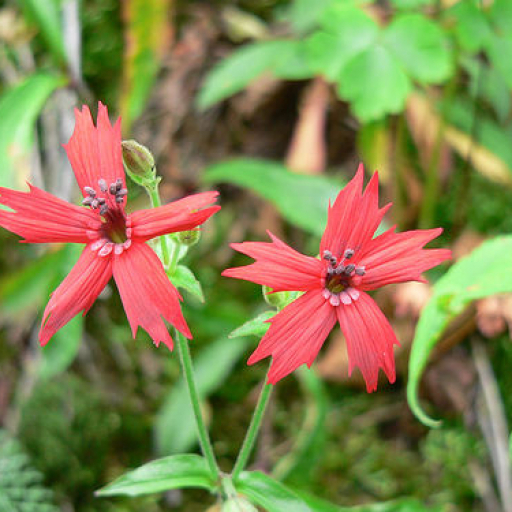
The Fire Pink is a show-stopping wildflower that acts like a biological neon sign for hummingbirds in the dappled light of the forest floor. Despite its name, this plant isn't "pink" in color; it boasts a searing, true scarlet hue that stands out against any green backdrop. Often found clinging to rocky slopes or woodland edges, it is a favorite for native plant enthusiasts looking to add a splash of drama to a shaded garden.
🔍 How to Identify
- 🌸 The "Pinked" Petals: Each flower has five brilliant red petals that are deeply notched at the tips. This gives them a jagged appearance, as if they were trimmed with zigzag "pinking" shears.
- 🧪 The Sticky Stem: The stems and calyx (the base of the flower) are covered in glandular, sticky hairs. This "catchfly" feature prevents small ants from crawling up to steal nectar without pollinating the plant.
- 🍃 Leaf Structure: It features a basal rosette of smooth, lance-shaped leaves, with smaller leaves appearing in pairs along the flowering stem.
🏡 In Your Garden
- ⛰️ The Drainage Dilemma: Fire Pinks naturally thrive on rocky outcrops and steep slopes. In a garden setting, they demand exceptional drainage. If planted in heavy, wet clay, the roots will likely rot during the winter months.
- 🐦 Hummingbird Magnet: Because of its tubular shape and vivid red hue, it is a primary nectar source for the Ruby-throated Hummingbird. It evolved specifically to be pollinated by these birds rather than bees.
- 🚫 Look But Don't Touch: This plant develops a long, sensitive taproot to find moisture deep in rocky crevices. Because of this, it is notoriously difficult to transplant. It is best started from seed or purchased as a young nursery plant and left in its permanent home.
⚠️ Safety & Toxicity
- ✅ Non-Toxic: Silene virginica is generally considered non-toxic to humans, cats, and dogs.
- 🧼 Sticky Residue: While not poisonous, the "catchfly" sap can be quite tacky. If children or pets brush against it, the residue can be a bit messy on fur or skin, though it is easily washed off with soap and water.
✨ Fun Fact
The word "Pink" in its name has nothing to do with the color! In the 17th century, the verb "to pink" meant to decorate an edge with a jagged pattern. This plant family was named for its "pinked" edges long before the color "pink" became a standard English word.

Detailed Care Instructions
| Humidity | Normal |
| Lighting | Full Sun |
| Difficulty | Medium |
| Hardiness Zones | 4 - 8 |
To grow Silene Virginica plants, also known as Fire Pinks, you can follow these steps:
- Choose the right location: Fire Pinks prefer partial shade or full sun with well-draining soil. Make sure the location has good air circulation.
- Prepare the soil: Fire Pinks prefer slightly acidic to neutral soil. Add organic matter such as compost to improve drainage and fertility.
- Planting seeds: Sow the seeds directly into the prepared soil in spring. Lightly cover the seeds with a thin layer of soil and keep them moist until germination occurs.
- Transplanting seedlings: Once the seedlings have grown a few inches tall, you can transplant them to their permanent location. Dig holes slightly larger than the root ball and space the plants about 10-12 inches apart.
- Watering: Water the plants regularly, ensuring that the soil stays evenly moist but not waterlogged. Fire Pinks prefer slightly dry soil, so avoid overwatering.
- Mulching: Applying a layer of organic mulch around the plants will help retain moisture, control weeds, and maintain an even soil temperature.
- Fertilizing: While Fire Pinks can grow well without additional fertilization, you can apply a slow-release, balanced fertilizer in early spring to promote healthy growth.
- Pruning: After the blooming period, you can deadhead the spent flowers to encourage more blooms and maintain a tidy appearance. In late fall, you can cut back the foliage to ground level.
- Pest and disease control: Fire Pinks are relatively resistant to pests and diseases. However, keeping the plants healthy and maintaining good air circulation can help prevent any issues.
- Enjoy the blooms: Fire Pinks produce vibrant red flowers on tall stalks in late spring to early summer. Admire their beauty and enjoy the pollinators they attract to your garden.
Remember to check the specific growing conditions for Silene Virginica in your region, as slight variations may exist.

Place in a window with dappled sun or a spot in the middle of a room. Or directly in a window facing west or east.

To water the plant, first check the soil moisture level by feeling the top inch of soil. If it feels dry, give the plant a deep watering, making sure to water around the base of the plant and not directly onto the leaves. Allow the soil to dry out slightly before watering again, as overwatering can lead to root rot. If the plant is in a container, make sure it has drainage holes to prevent water from pooling at the bottom. Watering frequency may vary depending on the climate and location of the plant.
To fertilize this plant, you will need to apply a balanced, slow-release fertilizer in early spring. Mix the fertilizer into the soil around the base of the plant and water thoroughly. Repeat this process every four to six weeks throughout the growing season. Be careful not to over-fertilize, as this can lead to excessive vegetative growth and reduced flowering. Monitor the plant's growth and adjust the fertilizer application as needed.
Silene Virginica thrives in a soil that is nutrient-rich, loamy, and well-draining. The pH level of the soil should be slightly acidic to neutral, ideally between 6.0 and 7.0. The plant can tolerate different soil textures, including clay, sand, and loam, but prefers a loamy soil. Soil that is too compacted or heavy can be a problem, as it may not allow the roots to spread and grow properly. The addition of organic matter, such as compost or aged manure, to the soil before planting can help provide the necessary nutrients and improve the structure of the soil. It is also important to ensure that the soil is not too wet, as this can cause root rot. Adequate drainage and watering practices can help prevent this.
Propagation of this plant can be achieved through several methods. One way is to collect seeds from the plant and sow them in a suitable soil mix. The seeds should be sown in moist soil and kept in a warm location with sufficient light. Another method is to divide the plant during its dormant period. This involves carefully digging up the plant and separating it into smaller sections, each with their own roots and stems. These sections can then be replanted in a suitable location. The plant can also be propagated through stem cuttings, where a small section of the stem is cut and dipped in rooting hormone before being planted in suitable soil. The new plant should be kept in a cool, shaded location with adequate moisture until roots have established. With proper care, this plant can be propagated successfully through any of these methods.








