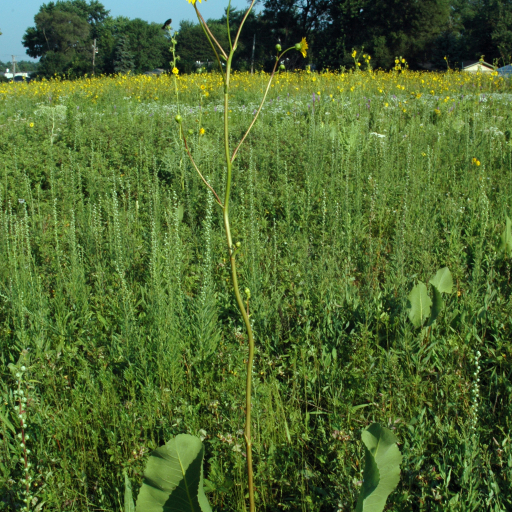
Plant Overview
Often called the "Green Giant" of the tallgrass prairie, the Prairie Dock is a plant of impressive proportions. Known for its massive, sandpaper-textured leaves that can grow larger than a person's head, it spends its early years quietly developing a massive root system before launching towering flower stalks toward the sky. In the mid-19th century, settlers often used its resinous sap as a primitive chewing gum, earning it the nickname "Turpentine Plant."
🔍 How to Identify
- 🍃 Massive Basal Leaves: Most of the plant's foliage stays low to the ground. The leaves are heart-shaped, leathery, and can reach up to 2 feet in length. They feel remarkably like coarse sandpaper to the touch.
- 🌻 Sky-High Blooms: In late summer, smooth, leafless stalks shoot up from the base, often reaching heights of 3 to 10 feet. These are topped with bright yellow, sunflower-like blossoms.
- 💧 Resinous Sap: If a leaf or stem is broken, the plant exudes a thick, aromatic, pine-scented resin that eventually hardens into a translucent "tear."
🏡 In Your Garden
- 🏗️ The Deep Foundation: Prairie Dock is famous for its massive taproot, which can descend up to 14 feet into the earth. Because of this, it is nearly impossible to transplant once established. Choose its "forever home" carefully!
- ⏳ A Lesson in Patience: This plant is a "slow starter." It may spend its first 2-3 years producing only a few leaves while it focuses all its energy on building that deep root system. Once established, however, it is virtually drought-proof.
- ☀️ Sun Worshipper: To see those iconic towering stalks, it needs full, unobstructed sunlight. It thrives in heavy clay soils where other plants might struggle, making it a champion for prairie restoration projects.
⚠️ Safety & Toxicity
- ✅ Generally Safe: Prairie Dock is considered non-toxic to humans, dogs, and cats.
- 🌲 Sticky Resin: While not poisonous, the resinous sap can be very sticky and may cause mild skin irritation for those with sensitive skin or allergies to plant resins.
- 🐄 Forage Value: It is a favorite for livestock and deer, though its sandpaper texture provides a bit of a deterrent once the leaves mature and toughen.
✨ Fun Fact
The Prairie Dock is a "compass plant" relative. To avoid the scorching midday sun, its massive leaves often orient themselves in a north-south direction, presenting only their thin edges to the harshest overhead rays to conserve moisture!

Detailed Care Instructions
To successfully grow Silphium terebinthinaceum, or Prairie Dock, follow these steps:
- Climate and soil requirements: Silphium terebinthinaceum thrives in full sun to partial shade with well-drained, loamy soil. Ensure the climate matches its native habitat, which is typically the central and eastern regions of North America.
- Planting: Choose a suitable location with enough space as it can grow up to 6-8 feet tall with a spread of 2-4 feet. Dig a hole twice as wide as the root ball and deep enough to accommodate the roots. Place the plant in the hole and backfill with soil, firmly pressing it around the roots.
- Watering: Initially, water the plant regularly to help it establish in its new location. Afterward, it can tolerate mild drought but will benefit from occasional watering during dry spells.
- Mulching: Apply a layer of organic mulch, such as wood chips or bark, around the base of the plant. Mulching helps retain soil moisture, suppresses weeds, and regulates soil temperature.
- Pruning: Prune the plant in early spring to remove any dead or damaged stems. This will encourage new growth and maintain its shape. It's a good idea to wear gloves as the plant has rough, hairy leaves.
- Fertilization: Silphium terebinthinaceum typically doesn't require excessive fertilization. However, you can apply a balanced slow-release fertilizer in early spring to promote healthy growth.
- Pest and disease control: Prairie Dock is relatively pest and disease resistant, but occasional inspections for common garden pests like aphids or leaf miners are necessary. If an infestation occurs, treat the plant with appropriate organic insecticides or solutions.
- Division and propagation: Silphium terebinthinaceum can be divided in early spring or fall. Dig up the entire plant and carefully separate the clumps using a sharp, sterile tool. Replant the divided sections in well-prepared soil.
- Support: As the plant grows tall, it may require support in the form of stakes or a plant cage to prevent bending or falling over.
- Observing nature: Silphium terebinthinaceum attracts pollinators like bees and butterflies, so enjoy the beauty of the plant, its flowers, and the wildlife it will bring to your garden.
Remember, growing plants can vary based on climate, region, and individual care requirements. Always observe the specific needs of Silphium terebinthinaceum in your area and adapt your gardening practices accordingly.

Place in a bright room that is sun drenched almost all day. Or directly in a south-facing window.

Silphium Terebinthinaceum is a perennial flowering plant that requires consistent watering throughout the growing season. The plant should be watered deeply, but infrequently to promote healthy root growth and prevent overwatering. It is recommended to water the plant once every week, or as needed, depending on soil moisture.
To water Silphium Terebinthinaceum, you should start by checking the soil moisture level. To do this, insert a finger into the soil to a depth of about two inches. If the soil feels dry, it's time to water the plant.
When watering, it's important to apply water at the base of the plant to ensure that the roots receive enough moisture. Avoid watering the foliage, as this can lead to fungal diseases. Use a hose, watering can, or drip irrigation system to apply water slowly and evenly to the soil.
After watering, allow the soil to dry out slightly before watering again. This will ensure that the plant's roots have access to both water and oxygen, which is essential for healthy growth.
In summary, Silphium Terebinthinaceum should be watered deeply and infrequently, at the base of the plant, and soil moisture should be monitored to prevent overwatering.
To fertilize this plant, begin by selecting a balanced fertilizer with equal parts nitrogen, phosphorus, and potassium. Apply the fertilizer at a rate of one tablespoon per square foot of soil in the plant's root zone. Water the fertilizer into the soil well, being careful not to soak the plant. Repeat this fertilization process every four to six weeks during the growing season. Be sure to follow all instructions on the fertilizer label, and avoid over-fertilizing, which can lead to burned or damaged foliage.
Silphium terebinthinaceum is a species of plant that requires well-draining soil with good fertility. It prefers soil that is moist but not waterlogged and can tolerate a range of soil types, including sandy, loamy, and clay soils. It is recommended to use a mixture of sandy loam soil and organic matter that provides good drainage and adequate nutrition to the plant. The pH level of soil should be slightly acidic to neutral, ranging from 6.0 to 7.5, as Silphium terebinthinaceum does not tolerate highly acidic or alkaline soils. It is important to avoid using heavy soils or soils with high levels of clay, as the plant may struggle to establish roots and may be prone to root rot.
To propagate this plant, you will need to start by collecting seeds from mature specimens. Once you have collected the seeds, you can start the process of germinating them.
To germinate Silphium Terebinthinaceum seeds, you can start by scarifying the seed coat or using stratification. Scarification involves scratching or nicking the surface of the seed to help it absorb moisture and germinate. Stratification involves soaking the seeds in water for a few hours and then storing them in a moist, cool place for several weeks.
After you have prepared the seeds, you can plant them in well-draining soil and keep them watered and in a sunny location. With the right conditions, the seeds should begin to sprout within a few weeks.
Once your seedlings have grown to a suitable size, you can transplant them into their permanent location. It is important to keep the soil moist and well-draining while they establish themselves.
Silphium Terebinthinaceum can also be propagated through division, which involves dividing the root system of a mature plant into smaller sections and planting them separately. This is best done in the spring or fall when the plant is not actively growing.








