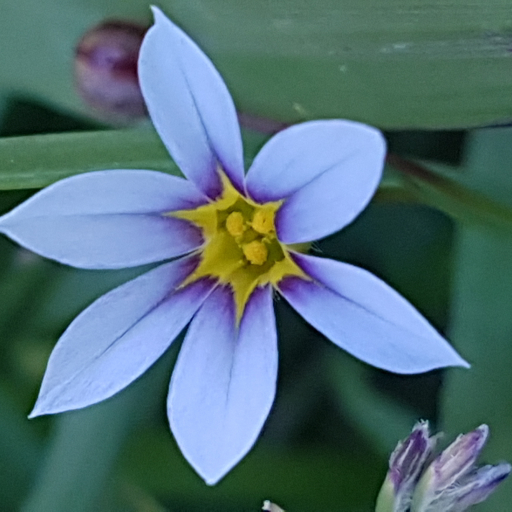
Plant Overview
Commonly known as the Blue Pigroot or Striped Rush-leaf, this dainty member of the Iris family is often mistaken for common lawn grass until its jewel-like flowers emerge. Native to South America but now a global traveler, it earns its nickname "Pigroot" from its tendency to pop up in disturbed soils where livestock might forage. It is the ultimate "hidden gem" of the garden, offering a miniature splash of celestial blue to those who look closely.
🔍 How to Identify
- 🌸 The "Eye" Pattern: Each tiny flower features six pale blue to mauve petals, decorated with distinct darker purple veins and a bright, contrasting yellow center or "eye."
- 🌱 Grass-like Foliage: The leaves are narrow, flat, and sword-shaped, mimicking the look of ornamental grass, which allows the plant to blend in perfectly with lawns.
- 🧶 Clumping Habit: It grows in neat, tufted clumps, rarely reaching more than 15–20 centimeters in height, making it a subtle addition to garden borders.
🏡 In Your Garden
- 💧 Moisture Lover: While it is surprisingly hardy, the Blue Pigroot thrives in damp spots. You’ll often find it "volunteering" near leaky garden taps or in the low-lying, soggy corners of a yard.
- ☀️ The Sun Seekers: The flowers are "diurnal," meaning they usually only open during the brightest parts of the day. If it’s cloudy or late afternoon, the plant may appear to be just a clump of grass as the petals tightly tuck away.
- 🚜 Resilient Pioneer: It loves "disturbed" ground. If you’ve recently tilled a bed or cleared a patch of weeds, don't be surprised if this little iris is the first to move in and claim the territory.
⚠️ Safety & Toxicity
- 🟢 General Safety: Sisyrinchium micranthum is generally considered non-toxic to humans and common household pets like dogs and cats.
- 🐄 Livestock Caution: While not high-risk, it is best kept away from heavy grazing areas for livestock, as many members of the Iris family can cause mild digestive upset if consumed in very large quantities.
✨ Fun Fact
Despite its name and grass-like appearance, the Blue Pigroot is a true Iris! If you look at the flower through a magnifying glass, you can see the same intricate three-fold symmetry found in its much larger, more famous cousins like the Siberian or Dutch Iris.

Detailed Care Instructions
To grow Sisyrinchium Micranthum plants, follow these steps:
- Choose the right location: Sisyrinchium Micranthum prefers full sun but can tolerate partial shade. Select a spot in your garden that receives at least six hours of direct sunlight per day.
- Prepare the soil: Ensure the soil is well-draining with good organic content. Amend heavy clay soil with compost or well-rotted manure to improve drainage. This plant also thrives in sandy or loamy soil.
- Sow the seeds: Sisyrinchium Micranthum can be grown from seeds. Sow the seeds directly into the prepared soil in spring or early summer. Scatter the seeds over the soil surface and gently press them into the soil. Keep the seeds moist until germination occurs.
- Watering: Water the newly planted seeds regularly to keep the soil evenly moist. Once the plants are established, they are relatively drought-tolerant and only require watering during prolonged dry periods.
- Provide good air circulation: Sisyrinchium Micranthum plants prefer good air circulation, which helps prevent fungal diseases. Avoid overcrowding by providing enough space between plants.
- Fertilization: Apply a balanced fertilizer once a month during the growing season to provide essential nutrients to the plants.
- Control weeds: Keep the area around the plants clear of weeds, as weeds can compete for nutrients and space.
- Pruning: Sisyrinchium Micranthum generally does not require extensive pruning. However, you can remove spent flowers to encourage more blooms and maintain the plant's neat appearance.
- Protect the plants in winter: If you live in a colder region, apply a layer of mulch around the plants in late fall to protect them from freezing temperatures.
- Propagation: Sisyrinchium Micranthum can also be propagated by dividing established clumps in early spring. Carefully dig up the clump, separate the individual plants, and replant them in desired areas.
By following these steps, you can successfully grow Sisyrinchium Micranthum plants and enjoy their beautiful blooms.

Place in a bright room that is sun drenched almost all day. Or directly in a south-facing window.

To properly care for this plant, it is important to ensure that it has access to regular watering. The amount and frequency of watering will depend on various factors such as the plant's location, soil type, and weather conditions. However, it is generally recommended to water when the top layer of soil feels dry to the touch. It is important to avoid overwatering, as this can lead to root rot and other negative health effects for the plant. When watering, it is best to aim for direct soil application rather than watering from above, as this can lead to moisture accumulation on the leaves and potential for disease. Overall, monitoring the plant's soil moisture levels and adjusting watering as necessary will help ensure its health and vitality.
To properly fertilize this plant, it is recommended to use a balanced fertilizer with equal amounts of nitrogen, phosphorus, and potassium. Apply the fertilizer in the early spring when new growth appears, and again in early summer. Use only a small amount of fertilizer to avoid overfeeding. Water the plant well after fertilization to ensure the nutrients are absorbed properly. Avoid applying fertilizer to dry soil, as this can cause burns on the roots.
The ideal soil for this plant should be well-draining and light, with a pH level of 6.5 to 7.5. It should also contain a good amount of organic matter, such as compost or well-rotted manure. Avoid using heavy or compacted soils that retain water, as this can cause root rot. Additionally, the soil should be enriched with essential nutrients, such as nitrogen, phosphorus, and potassium, to support healthy growth and development. It is recommended to mix in a slow-release fertilizer at planting time and to supplement with liquid fertilizer during the growing season. Overall, the soil should be loose and friable, allowing for good air circulation and water retention without becoming waterlogged.
To propagate this plant, you will need to first collect its seeds from the mature flower heads. Once the seeds have been harvested, they can be stored in a cool, dry place until you are ready to sow them.
To start the germination process, you will need to plant the seeds in a well-draining soil mixture in a small container or plant tray. Keep the soil moist but not waterlogged and place the container in a warm, sunny location.
As the seedlings begin to grow, you can transplant them into larger containers or into a garden bed. Be sure to space them at least a foot apart to allow for optimal growth and prevent overcrowding.
As the plants mature, they will produce new offsets or runners that can be divided and replanted to create new plants. To do this, carefully dig up the plant and separate the offsets, making sure each one has a healthy root system. Replant the offsets in fresh soil and water them in well.
With proper care and maintenance, your Sisyrinchium Micranthum plants will continue to grow and produce new foliage and flowers year after year.








