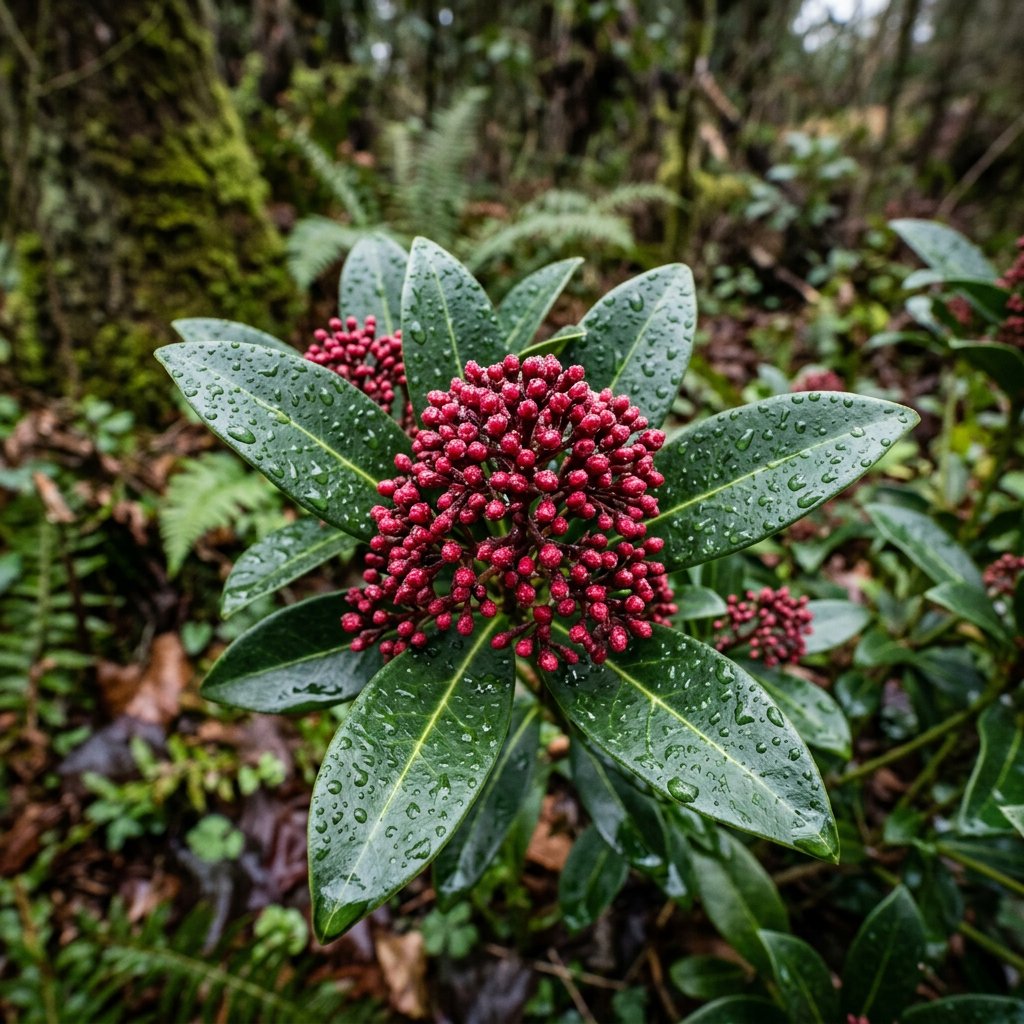
Plant Overview
Often called the "Jewel of the Shade," Skimmia Japonica is a resilient evergreen that provides year-round interest even when the rest of the garden goes dormant. Native to the mountain forests of Japan and China, this shrub is a favorite for its dramatic transition from deep red winter buds to citrus-scented spring blooms. It is the perfect solution for those "difficult" dark corners of a garden where other plants struggle to thrive.
🔍 How to Identify
- 🍃 Leathery Foliage: The leaves are glossy, lance-shaped, and thick. When crushed, they release a distinct, slightly spicy aroma.
- 🌸 Winter Buds: In late autumn, the plant develops dense clusters of tiny, dark red or pinkish buds that remain closed all winter, providing a splash of color against the green.
- 🌼 Starry Blooms: In mid-spring, the buds open into small, creamy-white flowers that are highly fragrant and shaped like tiny stars.
- 🍒 Bright Berries: On female varieties, these flowers turn into clusters of brilliant red berries that can last well into the following winter.
🏡 In Your Garden
- ☁️ The Shade Specialist: Skimmia hates direct, harsh sunlight. If planted in a southern exposure, its leaves will bleach and turn a sickly yellow. It belongs in north-facing borders or under the canopy of larger trees.
- 🧪 Acidic Appetites: This is an "ericaceous" plant, meaning it thrives in acidic soil. If your garden soil is alkaline (chalky), the plant will struggle to take up iron; in these cases, it is much happier living in a large pot with specialized acidic compost.
- 👫 The Mating Game: Most Skimmia are "dioecious," meaning you need both a male and a female plant if you want to see berries. The male plants generally have larger, more fragrant flowers, while the females provide the iconic red fruit.
⚠️ Safety & Toxicity
- 🚫 Status: Toxic to humans, cats, and dogs.
- 🐾 Details: The plant contains alkaloids that can cause cardiac distress if consumed in large quantities, though most cases result in localized irritation, vomiting, or stomach upset. While the berries look tempting to children, they are quite bitter and generally discouraged from being handled or eaten.
✨ Fun Fact
The most popular variety in the world, 'Rubella,' is actually a male clone. Because it doesn't spend energy producing berries, it puts all its effort into its stunning red flower buds, which are considered some of the most beautiful winter features in the botanical world.

Detailed Care Instructions
| Color | Yellow, White |
| Soil Ph | 5.6-6 |
| Humidity | Normal |
| Lighting | Part Sun |
| Toxicity | Toxic |
| Soil Type | Moist, Well-Draining |
| Bloom Time | Spring |
| Difficulty | Medium |
| Plant Type | Shrub |
| Hibernation | Cold Period |
| Mature Size | 3 To 4 Feet Tall |
| Native Area | Japan, China, South-East Asia |
| Temperature | 10°C - 30°C |
| Sun Exposure | Part Shade, Shade |
| Hardiness Zones | 6-8 |
To grow Skimmia Japonica plant, follow these steps:
- Find the right location: Skimmia Japonica prefers partial shade to full shade and thrives in well-drained soil. Avoid direct sunlight or extremely hot and dry conditions.
- Soil preparation: Prepare the soil by adding organic matter such as compost or peat moss to improve drainage and enrich the soil. Skimmia Japonica prefers slightly acidic soil, so if necessary, amend the pH level using sulfur or acidic fertilizers.
- Planting: Dig a hole that is slightly larger than the root ball of the Skimmia Japonica plant. Place the plant in the hole, making sure the top of the root ball is level with the soil surface. Backfill the hole with soil, firming it gently around the plant.
- Watering: Water the plant thoroughly after planting to settle the soil and help the roots establish. Skimmia Japonica prefers consistently moist soil, so water it regularly, especially during dry periods. However, avoid overwatering, as it can lead to root rot.
- Fertilizing: Feed the Skimmia Japonica plant in early spring and late summer with a balanced slow-release fertilizer. Follow the manufacturer's instructions for application rates. Avoid fertilizing during periods of high heat or drought.
- Pruning: Prune the plant in spring after flowering to maintain its shape and remove any dead or damaged branches. Skimmia Japonica blooms on old wood, so avoid heavy pruning if you want to enjoy its flowers.
- Mulching: Apply a layer of organic mulch around the base of the plant to conserve soil moisture, suppress weed growth, and provide insulation during extreme temperatures.
- Protection: Skimmia Japonica is generally hardy, but during periods of severe cold or frost, consider protecting the plant with a frost blanket or horticultural fleece.
- Pest and disease control: Monitor the plant regularly for pests such as aphids, spider mites, and scale insects. Treat any infestations promptly using organic or chemical control methods. Skimmia Japonica is generally resistant to most diseases.
- Propagation: Skimmia Japonica can be propagated through seed, cuttings, or layering. If you want to propagate from cuttings, take semi-ripe cuttings in late summer or early fall, dip them in rooting hormone, and plant them in well-draining soil or a propagation mix. Keep the cuttings moist and in a sheltered spot until roots develop.
By following these steps, you can successfully grow Skimmia Japonica plants in your garden or container.

Place in a window with dappled sun or a spot in the middle of a room. Or directly in a window facing west or east.

To water this particular plant, it is important to make sure the soil is moist but not overly saturated. You can gauge this by sticking your finger about an inch into the soil and feeling for moisture. If the soil feels dry, it is time to water. When watering, be sure to pour the water directly into the soil rather than on the leaves or flowers. It is also important not to allow the plant to sit in standing water, as this can lead to root rot. During hot and dry weather conditions, you may need to water the plant more frequently to prevent it from drying out.
To fertilize this plant, use a balanced fertilizer with equal parts nitrogen, phosphorus, and potassium. Apply the fertilizer in early spring before new growth appears and again in late summer. Use a granular fertilizer and apply it evenly around the base of the plant, avoiding direct contact with the stems or foliage. Water the plant well after fertilizing to help the nutrients reach the roots. Avoid over-fertilizing, as this can lead to excessive growth or damage to the plant.
Skimmia Japonica prefers soil that is well-draining but moist. The soil should be rich in organic matter and have a slightly acid pH level. A soil mix that contains peat moss, perlite, and composted bark would be suitable for this plant. It is important to avoid using heavy clay soils or those that are too sandy, as they may not retain enough moisture or provide enough nutrients for Skimmia Japonica to thrive. Additionally, adding mulch around the base of the plant can help retain moisture and provide additional nutrients over time.
Skimmia Japonica can be propagated through two methods: cutting and layering.
For cutting, select a healthy stem with at least three leaves and cut off the stem at a node. Remove the bottom leaf and dip the stem in rooting hormone. Plant the stem in a pot with well-draining soil and keep it moist. Keep the pot in a shaded area and wait for roots to form, which usually takes around four to six weeks. Once the roots have formed, transplant the cutting into a larger pot or into the ground.
For layering, find a low-hanging branch that touches the ground or can be bent down to the ground without breaking. Scratch the bark on the bottom of the branch and cover it with soil, making sure to leave the top part of the branch exposed. Anchor the branch to the ground with a wire or peg. Keep the soil moist and wait for roots to form, which usually takes around one to two months. Once roots have formed, cut the branch from the parent plant and transplant it into a larger pot or into the ground.
Both methods of propagation should be done in the spring or early summer, when the plant is actively growing.








