Plant Overview
Known as the "Peruvian Ground Apple" or "Strawberry Jicama," the Yacon is a towering Andean perennial that hides its greatest treasure beneath the soil. While it looks like a relative of the sunflower, its crunchy, sweet tubers offer a refreshing flavor reminiscent of a cross between a pear, a watermelon, and a water chestnut. Historically prized by the Incas as a source of hydration for travelers, it has recently gained global fame as a "superfood" for its unique, low-calorie sweetness.
🔍 How to Identify
- 🍃 The Foliage: Large, broad, heart-shaped leaves that feel velvety or fuzzy to the touch, often growing in opposite pairs along a thick, purple-mottled stem.
- 🌼 The Flowers: Surprisingly small, bright yellow daisy-like blooms that appear at the very top of the plant late in the season.
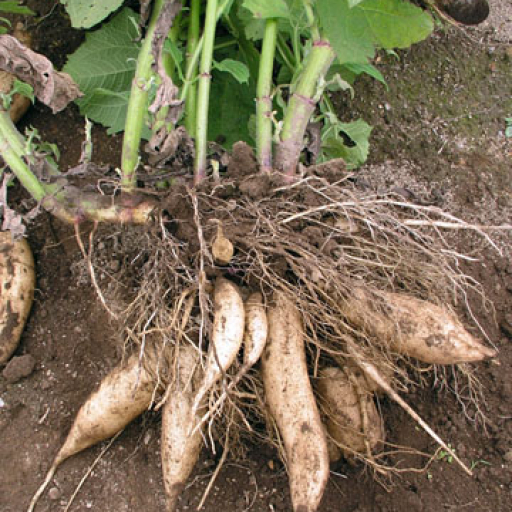
- 🥔 The Root System: A dual-root system consisting of reddish "mother" rhizomes used for propagation and large, tan, potato-like storage tubers that are harvested for eating.
🏡 In Your Garden
- 🌱 Space Requirements: Give this giant room to breathe; it can easily reach 6 to 7 feet in height, making it an excellent temporary summer screen or backdrop for smaller vegetables.
- ⏳ Patience is Key: Unlike potatoes, Yacon needs a very long growing season (6-7 months). The tubers develop their best flavor and size only after the plant begins to flower and the first light frost hits the foliage.
⚠️ Safety & Toxicity
- ✅ Status: Safe and Edible.
- 💨 Digestion Note: The tubers are rich in Fructooligosaccharides (FOS), a prebiotic fiber that the human body cannot fully digest. While very healthy for gut bacteria, eating large amounts suddenly can cause mild bloating or gas in sensitive individuals.
- 🐾 Pets: Yacon is generally considered non-toxic to dogs and cats, though the high fiber content might cause a mild upset stomach if they snack on the tubers.
✨ Fun Fact
Yacon is often called the "diet potato" because its sweetness comes from Inulin, a type of sugar that passes through the human body without being metabolized, providing a sweet taste with almost no calories or blood sugar spikes.

Detailed Care Instructions
To grow Smallanthus Sonchifolius (also known as Yacon), follow these steps:
- Choose a sunny location: Yacon plants require full sun to thrive. Choose a spot in your garden that receives direct sunlight for at least 6-8 hours a day.
- Prepare the soil: Yacon prefers well-draining soil with a pH level between 5.5 and 6.5. Amend the soil with organic matter such as compost or well-rotted manure to improve its fertility and drainage.
- Planting: Yacon is usually propagated from rhizomes or tubers. Plant the rhizomes or tubers about 3-4 inches deep in the soil, with the sprouts facing upwards. Space the plants about 1-2 feet apart to allow for sufficient growth.
- Watering: Keep the soil consistently moist, but not waterlogged. Yacon requires regular watering, especially during dry periods. Avoid overwatering, as it can cause root rot. Mulching around the plants can help retain moisture and suppress weeds.
- Fertilization: Yacon plants benefit from regular feeding. Apply a balanced organic fertilizer every 4-6 weeks during the growing season to support healthy growth. Follow the manufacturer's instructions for application rates.
- Pruning: Yacon plants can grow quite tall, so you may need to provide support or stake them to prevent bending or breaking. Additionally, pinch off any dead or yellowing leaves to maintain plant health and appearance.
- Harvesting: Yacon tubers are typically harvested in late autumn or early winter, once the foliage has died back. Lift the tubers gently from the soil using a garden fork or shovel. Store them in a cool, dry place until ready for use.
- Propagation: Yacon plants can be propagated by dividing the rhizomes during the dormant season in early spring. Separate the rhizomes carefully and plant them in well-prepared soil following the same guidelines as mentioned earlier.
Remember to research specific growing requirements for your particular climate, as Smallanthus Sonchifolius may have regional variations in terms of optimal planting times, watering needs, and soil conditions.

Place in a bright room that is sun drenched almost all day. Or directly in a south-facing window.

Smallanthus Sonchifolius plant is a perennial flowering plant that requires proper care for its healthy growth. When it comes to watering the plant, it is crucial to take into account the environmental conditions, such as temperature, humidity levels, and soil quality.
The best way to provide adequate water to the Smallanthus Sonchifolius plant is to keep the soil consistently moist, but not waterlogged. Overwatering can lead to root rot and fungal growth, so it is crucial to avoid waterlogging the soil.
One way to ensure proper watering is to examine the soil regularly by inserting a finger into the soil. If the top inch of soil is dry, it is time to water the plant. It is advisable to water the plant thoroughly until water starts to drain out from the bottom of the pot or container. This helps to prevent salt buildup and ensures that the root system receives enough water.
In times of high temperatures or low humidity, the plant may require more water than usual. Therefore, it is essential to monitor the moisture level of the soil and adjust accordingly. Additionally, adding organic matter to the soil can help to retain moisture and improve soil quality, resulting in healthy plant growth.
In summary, providing consistent moisture to the Smallanthus Sonchifolius plant is crucial for its healthy growth, and it is crucial to avoid overwatering and waterlogging the soil. Checking the soil regularly and adjusting based on the environmental conditions can help to ensure proper watering.
To fertilize this plant, apply a slow-release, balanced fertilizer with an NPK ratio of 10-10-10 in early spring and midsummer. Alternatively, you can apply organic fertilizers such as compost or well-rotted manure. Be careful not to over-fertilize, as this can cause excessive vegetative growth and reduce flowering. Water the plant well after fertilizing to help nutrients reach the roots.
The ideal soil for this plant should have good drainage to prevent the roots from becoming waterlogged. It should also be rich in nutrients such as nitrogen, phosphorus, and potassium to support healthy growth. Organic matter such as compost or well-rotted manure can be mixed into the soil to improve its fertility. The soil pH should be slightly acidic to neutral, ideally in the range of 6.0 to 7.0. Additionally, the soil should not be compacted, as loose soil helps roots to spread easily and absorb more nutrients.
Smallanthus Sonchifolius is a plant species that belongs to the Asteraceae family. It is easy to propagate this plant using stem cuttings. Here are the steps for propagating Smallanthus Sonchifolius:
- Take a stem cutting from a healthy parent plant with a clean, sharp knife or scissors.
- Choose a stem that is around 4-6 inches long and has at least 2-3 sets of leaves.
- Remove the lower leaves on the stem cutting and dip the cut end in rooting hormone powder or solution.
- Prepare a container with well-draining soil and poke a hole in the soil using a pencil.
- Insert the cutting in the hole and gently press the soil around it.
- Water the cutting lightly and cover the container with a plastic bag to create a mini greenhouse.
- Place the container in a bright spot with indirect sunlight and keep the soil moist but not waterlogged.
- After a few weeks, check for new leaves or roots on the plant cutting.
- Once the new roots and leaves have developed, the plant can be transplanted to a bigger pot or planted outside in the garden.








