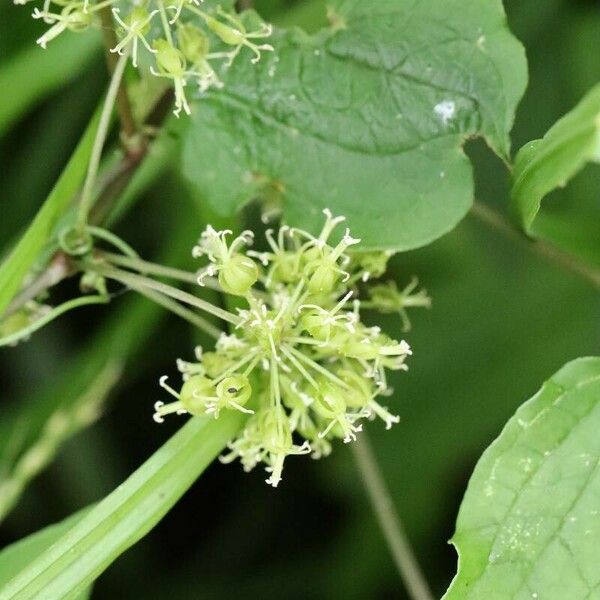
Plant Overview
Often called the Riparian Greenbrier, this elegant climber is a more refined, often thornless relative of the rugged woodland vines you might find in the wild. Found trailing along riverbanks and moist thickets throughout East Asia, it creates a lush, leafy screen that feels both prehistoric and tropical. Unlike its "catbrier" cousins that snag your clothes, Smilax riparia is prized for its graceful habit and soft, verdant foliage.
🔍 How to Identify
- 🍃 The Leaves: Glossy, bright green leaves are shaped like elongated hearts or arrowheads, featuring prominent longitudinal veins that run from the base to the tip.
- 🌀 The Tendrils: Look for delicate, wire-like coils that emerge in pairs from the base of the leaf stalks. These are the plant's "hands," used to pull itself upward toward the light.
- 🫐 The Fruit: In late summer, the plant produces small, spherical berries that transition from green to a deep, waxy blue-black, hanging in umbrella-like clusters.
🏡 In Your Garden
- 💧 Moisture Lover: As the name "Riparian" suggests, this plant thrives near water. It is an excellent choice for damp spots in the garden or near a pond where other plants might suffer from "wet feet."
- 🧗 Support Systems: While it isn't as aggressive as some invasive vines, it does need a trellis or a sturdy shrub to scramble over. It uses its tendrils to hitch a ride rather than twisting its stem, which makes it less likely to "strangle" its host.
- 🌤️ Light Nuance: It prefers dappled sunlight. In the wild, it sits at the edge of the forest; too much deep shade will make it leggy, while too much harsh afternoon sun can scorch the tender new leaves.
⚠️ Safety & Toxicity
- 🐾 Mild Caution: While many species of Smilax have edible young shoots or roots (used historically in root beer), the berries of Smilax riparia are generally considered inedible for humans and can cause mild stomach upset if ingested.
- 👶 Safe Surroundings: Unlike other Greenbriers, this species is frequently unarmed (lacking the sharp prickles), making it a much safer choice for gardens where children or pets play.
✨ Fun Fact
The Smilax genus is the original source of "Sarsaparilla." While Smilax riparia isn't the primary species used for the soda, its close cousins provided the medicinal roots that gave the world its first taste of that distinct, earthy root beer flavor!

Detailed Care Instructions
Smilax riparia, also known as the riverbank greenbrier, is a perennial vine that typically grows along rivers and streams. Here are some tips on how to grow Smilax riparia:
- Choose the right location: Smilax riparia prefers moist, well-drained soil and partial to full sun. Plant it near a water source like a river or stream if possible.
- Propagation: You can propagate Smilax riparia by collecting seeds or by taking stem cuttings. Seeds should be scarified before planting to improve germination rates. Stem cuttings can be taken in late summer or early fall and planted in a mixture of sand and peat moss.
- Planting: Plant the seeds or cuttings in the desired location in early spring or late fall. Make sure to water the plant regularly, especially during dry periods.
- Maintenance: Smilax riparia is a fast-growing vine that may need to be pruned regularly to prevent it from spreading too far. You can also provide a trellis or support for the plant to climb on.
- Fertilization: Smilax riparia does not require much fertilization, but you can use a general-purpose fertilizer if needed. Avoid over-fertilizing, as this can cause the plant to become leggy.
- Pests and diseases: Keep an eye out for pests like aphids or spider mites, and treat them as needed. Smilax riparia is generally resistant to diseases.
With proper care and maintenance, you can successfully grow Smilax riparia in your garden or landscape. Enjoy its beautiful foliage and unique flowers!

Place in a window with dappled sun or a spot in the middle of a room. Or directly in a window facing west or east.

Smilax riparia plants should be watered consistently and evenly throughout the growing season. The soil around the plant should be kept consistently moist, but not waterlogged. It is important to water the plant at the base, avoiding getting the foliage wet to prevent potential fungal diseases. The plant will require more frequent watering during hot, dry periods and less water during cooler, rainy periods. Be sure to check the moisture level of the soil regularly and adjust watering as needed to keep the plant healthy and thriving.
To fertilize the Smilax Riparia plant, apply a balanced fertilizer with an N-P-K ratio of 10-10-10 in early spring before new growth emerges. Avoid over-fertilizing as this can cause the plant to become leggy or produce excessive foliage with reduced flowering. Water the plant thoroughly after applying fertilizer to help distribute the nutrients to the roots. Repeat fertilization every 6-8 weeks during the growing season, but reduce or stop fertilizing in late summer to allow the plant to prepare for dormancy.
The most suitable soil for Smilax Riparia plant is well-draining, slightly acidic soil with a high organic matter content. The soil should be loamy and fertile, providing good aeration and moisture retention properties. It is important to avoid heavy clay or sandy soils, as they may not provide the necessary nutrients and drainage for optimal growth. Adding compost or aged manure to the soil can help improve its texture and fertility, creating a favorable environment for the plant to thrive.
To propagate Smilax Riparia plants, you can use a method called division. Here's how you can do it:
- Wait until the plant is in its growing season, which is typically spring or early summer.
- Carefully dig up the plant using a shovel, making sure to not damage the roots.
- Use a sharp knife or garden shears to separate the plant into smaller sections, with each section having at least one healthy stem and a good portion of root attached.
- Plant each divided section in a well-draining soil mixture in a pot or directly in the ground, making sure the roots are covered but the stems are above the soil line.
- Water the newly planted sections thoroughly and place them in a location with indirect sunlight.
- Keep the soil consistently moist but not waterlogged, and over time, the divided sections should establish themselves and begin to grow.
By following these steps, you can easily propagate Smilax Riparia plants and expand your garden with this beautiful species.







