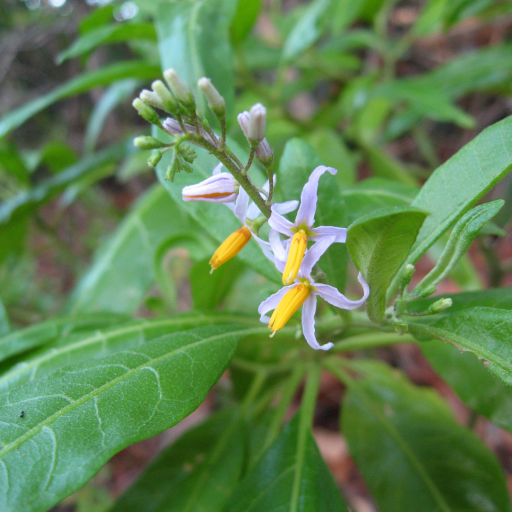
Plant Overview
Often called the Bahama Nightshade or Canker Berry, this resilient shrub is a touch of the Caribbean wild brought to life in your landscape. It thrives in the salt-misted air of Florida and the West Indies, offering a striking visual contrast between its delicate, star-shaped purple blooms and its fiery, ruby-red berries. While it looks like a miniature garden jewel, it carries the rebellious spirit of the Nightshade family, complete with protective prickles and a hardy constitution.
🔍 How to Identify
- 🌸 Starry Flowers: Small, five-petaled flowers in shades of pale lavender to deep violet, featuring a prominent bright yellow "beak" of anthers in the center.
- 🔴 Jewel-Tone Berries: Clustered, glossy, spherical fruits that transition from a marbled green to a vibrant, translucent red as they ripen.
- 🌵 Prickly Stems: The woody branches and sometimes even the midribs of the leaves are armed with small, sharp prickles designed to discourage hungry wildlife.
🏡 In Your Garden
- 🌊 Coastal Warrior: This plant is exceptionally salt-tolerant, making it a "must-have" for seaside gardens where salt spray and sandy soil usually make gardening a challenge.
- 🐦 Avian Buffet: While the berries are strictly off-limits for humans, they are a high-energy favorite for songbirds. Planting it is a great way to invite local feathered friends to your yard for a snack.
⚠️ Safety & Toxicity
- 🚫 Toxic if Ingested: As a member of the Solanum genus, the entire plant—especially the berries—contains solanine. It is toxic to humans, dogs, cats, and horses if eaten.
- 🧤 Handle with Care: Beyond the chemical toxicity, the physical prickles can cause skin irritation or small puncture wounds. Always wear sturdy gardening gloves when pruning or weeding around this plant.
✨ Fun Fact
📜 The nickname "Canker Berry" stems from historical folk medicine in the Bahamas, where the juice of the berries was once used as a traditional treatment for mouth sores (cankers). However, because the plant is poisonous, modern herbalists strongly advise against this "old-school" remedy!

Detailed Care Instructions
If you want to grow Solanum bahamense, also known as the Bahama nightshade, you can follow these steps:
- Obtain seeds or seedlings: You can either collect seeds from mature plants or purchase them from a reputable nursery or online seed supplier. Alternatively, you can also look for seedlings or young plants at nurseries or garden centers.
- Choose a suitable location: Solanum bahamense prefers a warm and sunny location with well-draining soil. It can be grown both in pots or directly in the ground.
- Prepare the soil: Make sure the soil is well-draining, loose, and enriched with organic matter. You can add compost or well-rotted manure to improve the soil's fertility.
- Sow the seeds or transplant seedlings: If you have seeds, sow them in small pots or seed trays filled with compost-rich soil. Ensure the seeds are lightly covered with soil and keep them moist. If using seedlings, transplant them into larger containers or directly into the garden bed.
- Watering and maintenance: Keep the soil consistently moist, but not waterlogged. Water the plant regularly, especially during dry periods. Mulching around the base of the plant can help retain moisture. Weed the surrounding area regularly to reduce competition.
- Provide support: Solanum bahamense is a vine-like plant, so it may require support to climb and grow. You can provide trellises, stakes, or other support structures to help it grow upright.
- Pruning: Regularly prune the plant to promote bushier growth and control its size. You can remove any dead or damaged branches as well.
- Protect from pests and diseases: Keep an eye out for common garden pests like aphids or whiteflies. If necessary, use organic insecticides or insecticidal soaps to control them. Make sure to check for any signs of diseases or fungal infections, and take appropriate measures to prevent their spread.
- Harvesting: Solanum bahamense produces small, green fruits that resemble cherry tomatoes. Harvest the fruits when they are fully ripe and slightly soft. They can be eaten raw or used in cooking or preserving.
Remember to research and understand any specific care requirements for Solanum bahamense in your particular climate or growing region.

Place in a bright room that is sun drenched almost all day. Or directly in a south-facing window.

To properly water this plant, it is important to thoroughly saturate the soil around its roots. This can be achieved by giving the plant a deep watering once a week, ensuring that the soil is moist but not waterlogged. It is also important to check the soil moisture regularly and adjust watering frequency as needed based on the plants' individual needs and environmental conditions. When watering, avoid getting water on the leaves as this can increase the risk of fungal diseases. In addition, ensure that the plant has good drainage and that any excess water can easily drain away from the roots.
To fertilize the Solanum Bahamense plant, you should use a balanced fertilizer with equal amounts of nitrogen, phosphorus, and potassium. Apply the fertilizer every two weeks during the growing season, diluting it to half strength before application. Make sure to apply the fertilizer evenly around the plant, avoiding direct contact with the leaves or stems. Water the plant after fertilization to ensure proper absorption of nutrients.
The recommended soil for the plant in question is a well-draining, loamy soil that is rich in organic matter. The soil pH should be around 6.0-7.0. The soil should be moist but not waterlogged, and the plant should not be allowed to sit in standing water. The plant prefers full sun to partial shade and should be watered regularly during dry periods. It is also recommended to fertilize the plant with a balanced fertilizer every 2-3 weeks during the growing season.
To propagate this plant, one can take stem cuttings of mature woody stems in the summer, and place them in a rooting hormone solution to encourage root growth. After a few weeks, these cuttings can be carefully transplanted into a well-draining soil mixture and placed in indirect sunlight until new growth appears. Another method is to collect the berries of the plant in the fall, remove the seeds and sow them in a seed starting mix. The seeds should be kept moist and warm, and once they have sprouted and have developed their first set of true leaves, they can be transplanted into individual pots.








