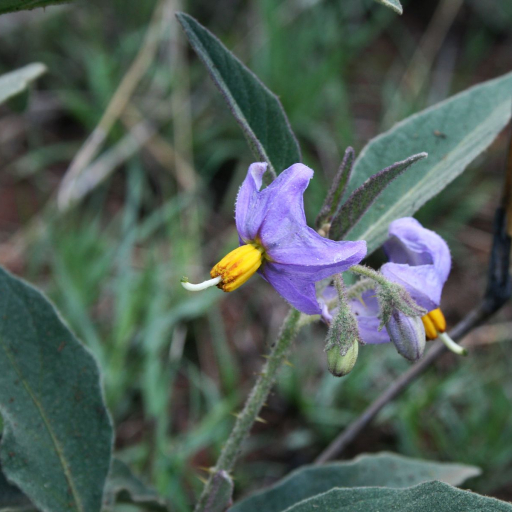
Plant Overview
Commonly known as the Sodom Apple or Silver-leaf Bitter-apple, Solanum campylacanthum is a rugged, spiny shrub that thrives in the sun-drenched landscapes of Africa. While it produces bright, cherry-like fruits that might look tempting, this plant is a classic "look but don't touch" member of the nightshade family. In many regions, it is a symbol of resilience, often found guarding rural paths with its formidable thorns and dusty, silver-green foliage.
🔍 How to Identify
- 🌵 Curved Spines: Look for woody stems armed with sharp, downward-curving spines that are often orange or brownish in color.
- 🍃 Velvety Leaves: The leaves are typically egg-shaped with wavy margins and are covered in a fine, star-shaped fuzz that gives the plant a distinct silvery-grey or "dusty" appearance.
- 🟣 Starry Blooms: It produces beautiful star-shaped flowers ranging from pale lilac to deep purple, featuring a prominent cone of bright yellow anthers at the center.
- 🟡 Waxy Berries: The most striking feature is the round, smooth fruit which starts green with white marbling and matures into a bright, waxy yellow.
🏡 In Your Garden
- ☀️ Heat Specialist: This plant is an absolute survivor in high-heat and drought-prone areas. It prefers well-draining, sandy soil and can thrive where other plants wither, making it a "tough-as-nails" specimen.
- 🚧 Space Management: Because it can spread aggressively and possesses sharp thorns, it is rarely used as a decorative garden plant. It is more commonly seen as a wild pioneer species that colonizes disturbed ground or acts as a natural, albeit painful, barrier fence.
⚠️ Safety & Toxicity
- 🚫 Toxic Status: High Toxicity. Every part of this plant, particularly the attractive yellow berries, contains solanine and other potent alkaloids.
- 🐾 Risk Factor: Ingestion can cause severe stomach pain, vomiting, and respiratory distress in humans and pets. Additionally, the spines are sharp enough to puncture skin easily, which can lead to localized irritation or infection if not cleaned.
✨ Fun Fact
Historically, the juice from the "Sodom Apple" fruit has been used in various cultures as a traditional curdling agent for making cheese or as a source of yellow dye for leatherwork!

Detailed Care Instructions
To grow Solanum Campylacanthum (often known as Syrian Eggplant), follow these steps:
- Obtain seeds or a seedling: You can buy Solanum Campylacanthum seeds online or from a reputable nursery. Alternatively, you can also obtain a small seedling from a garden center.
- Choose a suitable location: Solanum Campylacanthum prefers full sun, which means it needs at least 6-8 hours of direct sunlight per day. Select a spot in your garden that receives ample sunlight and has well-draining soil.
- Prepare the soil: Ensure that the soil is well-draining and has good fertility. Add compost or well-rotted manure to improve the soil's fertility and structure. Solanum Campylacanthum prefers slightly acidic soil, so you may need to amend the soil if it's too alkaline.
- Start seeds indoors (optional): If you are starting with seeds, sow them indoors in small pots about 6-8 weeks before the last frost date. Sow the seeds about a quarter-inch deep in a well-draining seed-starting mix. Keep the soil moist but not waterlogged, and place the pots in a warm, bright location. Once the seedlings have developed a few sets of true leaves, they can be transplanted outdoors.
- Planting outside: If you're using seedlings, transplant them outside once all danger of frost has passed and the soil has warmed up. Dig a hole slightly larger than the root ball and place the seedling in the hole. Backfill the hole with soil and gently firm it around the seedling. Space multiple plants about 2-3 feet apart.
- Watering: Water the plants regularly, keeping the soil consistently moist but not soaked. Avoid overwatering, which can lead to root rot. Mulching around the plants can help retain moisture and suppress weed growth.
- Fertilization: Apply a balanced, slow-release fertilizer or organic compost once every 4-6 weeks during the growing season to ensure optimal growth. Follow the instructions on the fertilizer package for proper application rates.
- Staking and support: Solanum Campylacanthum can grow tall and may require staking or support. Install stakes or cages around the plants when they are young to prevent them from bending or breaking under their weight.
- Pruning: Regularly prune the plants to remove any dead, damaged, or overcrowded branches. Pruning can also help improve air circulation and prevent diseases.
- Pest and disease control: Keep an eye out for common pests like aphids, flea beetles, and spider mites. Promptly address any pest issues using organic control methods, such as insecticidal soap or neem oil. Regularly inspect the plants for signs of diseases like powdery mildew or leaf spot, and take appropriate measures to control their spread if necessary.
- Harvesting: Syrian Eggplants typically start producing fruits about 70-90 days after transplanting. Harvest the fruits when they reach the desired size and color. Cut the fruits from the plant with a sharp knife or pruning shears, leaving a small stem attached.
By following these steps, you will be able to successfully grow Solanum Campylacanthum plants in your garden.

Place in a bright room that is sun drenched almost all day. Or directly in a south-facing window.

Solanum campylacanthum is a type of plant that requires regular and appropriate watering to thrive. Here are some details on how to water this plant effectively:
1. Understanding watering needs: It is important to understand the water requirements of Solanum campylacanthum. This plant prefers moist soil but not waterlogged conditions. Study the plant's growth pattern, environmental conditions, and soil moisture level preferences to determine how often it needs watering.
2. Observe the soil: Before watering, always observe the soil moisture level. You can do this by sticking your finger about an inch or two deep into the soil. If it feels dry at that depth, it's an indication that the plant requires watering. However, if the soil feels slightly damp or moist, it may not need watering just yet.
3. Watering technique: When watering Solanum campylacanthum, it is important to water at the base of the plant, near the root zone. Avoid entirely wetting the foliage as excessive moisture can lead to diseases or fungal growth.
4. Watering schedule: The frequency of watering will depend on various factors, including the plant's size, pot size, environmental conditions, and season. Typically, it is better to water deeply and less frequently rather than giving small amounts of water frequently. This allows the roots to grow deeper and develop a stronger root system. However, ensure the plant does not undergo extreme water stress between watering sessions.
5. Consider the potting medium: If the Solanum campylacanthum plant is in a container, different types of potting mediums may have different water retention capabilities. Some may dry out faster than others, while some retain more moisture. Knowing the characteristics of the potting medium will help you adjust the watering schedule accordingly.
6. Drainage: Adequate drainage is crucial for the health of Solanum campylacanthum. Ensure the plant is potted in a container with drainage holes at the bottom. This helps prevent waterlogging, which can lead to root rot and other problems. If excess water accumulates in the drip tray, make sure to empty it after watering.
7. Climate consideration: Climate plays a significant role in determining watering needs. In hot and dry conditions, the plant will likely require more frequent watering compared to cooler or more humid climates. Consider the specific climatic conditions in your area to adjust the watering schedule accordingly.
8. Water quality: The quality of water used for watering may also affect the plant's health. Ensure the water is not excessively high in salts or chemicals. If using tap water, let it sit overnight to allow chlorine to evaporate. Alternatively, you can use rainwater or filtered water for watering.
Remember that while these guidelines can provide general information on watering Solanum campylacanthum, it is crucial to observe the individual plant's response and adjust the watering routine accordingly.
To fertilize the Solanum Campylacanthum plant, you can follow these instructions:
- Choose a balanced, slow-release fertilizer specifically formulated for flowering plants.
- Start fertilizing in the early spring, when new growth appears.
- Dilute the fertilizer according to the manufacturer's instructions.
- Apply the diluted fertilizer around the base of the plant, avoiding contact with the leaves.
- Gently work the fertilizer into the soil using a hand cultivator or rake.
- Water the plant thoroughly after fertilizing to help the nutrients soak into the soil.
- Repeat the fertilization process every 4-6 weeks during the growing season.
- Make sure not to over-fertilize, as it can lead to nutrient burn and damage the plant.
- Monitor the plant's response to the fertilizer and adjust the frequency or strength if needed.
- Discontinue fertilizing in late summer to allow the plant to prepare for dormancy.
Remember to always consult specific fertilization guidelines for your particular Solanum Campylacanthum plant, considering factors such as soil type and current health of the plant.
The preferred soil type for Solanum Campylacanthum plants is well-draining soil with a loose texture. It should ideally be slightly acidic to neutral in pH, ranging from 6.0 to 7.0. The soil should have good water-holding capacity while allowing excess moisture to drain easily, preventing waterlogging.
Solanum Campylacanthum plants appreciate a soil that is rich in organic matter, as it provides essential nutrients and improves overall soil fertility. Organic matter can be incorporated into the soil by adding compost or well-rotted manure during planting or through regular application as a top dressing.
To maintain healthy growth, it is important to ensure that the soil is adequately aerated. This can be achieved by avoiding compacted soil and incorporating coarse sand or perlite into the planting area to improve soil structure.
In terms of texture, the soil should be friable and crumbly, allowing moisture and air to move freely through it. Sandy soils can be amended with organic matter to enhance water and nutrient retention, while clay soils can be improved by adding coarse sand and organic matter to improve drainage and prevent waterlogging.
Lastly, it is essential to regularly monitor the moisture levels in the soil to avoid under or overwatering Solanum Campylacanthum plants. Additionally, proper mulching can help retain soil moisture while suppressing weed growth.
Overall, providing well-draining, slightly acidic to neutral soil with good organic matter content and sufficient aeration will promote optimal growth and development for Solanum Campylacanthum plants.
To propagate Solanum Campylacanthum, you can follow these steps:
- Select a healthy and mature Solanum Campylacanthum plant from which you want to propagate. Choose a plant that is disease-free and has strong, robust stems.
- Prepare a sterile potting mix that is well-draining. You can mix equal parts of peat moss, perlite, and vermiculite to create a suitable medium for rooting.
- Take a 6 to 8-inch cutting from the selected plant, preferably from a non-flowering stem. Make sure the cutting includes a node, which is a swollen area where leaves attach to the stem.
- Remove any lower leaves on the cutting, leaving only a few leaves at the top to reduce water loss through transpiration.
- Optional: Some gardeners recommend applying a rooting hormone to the cut end of the stem to encourage root development. Follow the instructions on the rooting hormone package for the correct application method.
- Create a small hole in the potting mix using a pencil or similar tool. Insert the stem cutting into the hole, ensuring that at least one-third of the cutting is buried in the soil. Gently press the soil around the base to provide stability.
- Mist the cutting with water to provide moisture and encourage root development. Place a clear plastic bag or a plastic dome over the cutting to create a humid environment that promotes rooting.
- Position the cutting in a location that receives bright, indirect sunlight. Avoid direct sunlight, as it can scorch the delicate cutting.
- Check the moisture level of the potting mix regularly. Keep it slightly moist but not waterlogged. Overwatering can cause the cutting to rot, while underwatering may prevent root development.
- After a few weeks, gently tug on the cutting to check for resistance. If you feel resistance, it indicates that roots have begun to develop. Once the cutting shows signs of root growth, it can be carefully transplanted into a larger pot with standard potting mix.
- Continue to provide appropriate care, including regular watering and indirect sunlight, to help the young Solanum Campylacanthum plant establish itself. Over time, it will grow and develop into a mature plant.
Remember that propagation success can vary depending on various factors, including environmental conditions and the plant's health. It is advisable to perform multiple cuttings to increase the chances of successful propagation.








