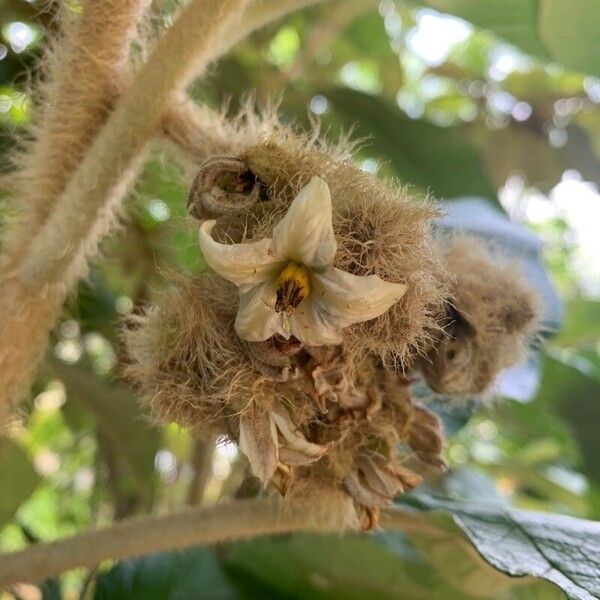
Plant Overview
Often called the Velvetleaf Nightshade or "Brava-da-folha-branca" in its native Brazil, Solanum cernuum is a striking woody shrub that looks like it belongs in a prehistoric jungle. Its name "cernuum" translates to "nodding," referring to the heavy, downward-curving clusters of flowers that seem to bow gracefully toward the earth. In Brazilian folklore, it is a respected medicinal plant, often associated with skin healing and protection.
🔍 How to Identify
- ☁️ The Foliage: Massive, broad leaves that are densely covered in soft, velvety hairs. The most striking feature is the underside, which is often a silvery-white color, contrasting beautifully with the deep green tops.
- 🔔 The Flowers: Small, star-shaped blossoms that are typically white or pale lilac. They grow in dense, drooping clusters (cymes) that hang underneath the large leaves.
- 🌳 Growth Habit: Unlike many smaller nightshades, this species is a robust, upright shrub or small tree. It can reach heights of 2 to 5 meters, featuring a sturdy, woody trunk.
🏡 In Your Garden
- 🌱 The Pioneer Spirit: In the wild, this plant acts as a "pioneer species." This means it is exceptionally good at reclaiming disturbed land or forest edges, making it a hardy choice for large, tropical-style landscapes where you need fast-filling greenery.
- 💧 Humidity Lover: Coming from the Atlantic Forest of South America, it craves high humidity and moist, well-draining soil. It doesn't handle frost well and prefers a sheltered spot where its large leaves won't be shredded by high winds.
⚠️ Safety & Toxicity
- 🚫 Status: Exercise Caution.
- 🐾 Details: As a member of the Solanaceae (Nightshade) family, most parts of the plant contain alkaloids like solanine. While it has historical uses in traditional topical medicine for skin conditions, no part of the plant should be ingested by humans or pets, as it can cause gastrointestinal distress and neurological symptoms if eaten in large quantities.
✨ Fun Fact
The velvety hairs on the leaves aren't just for show—they act as a defense mechanism! These tiny structures, called trichomes, help the plant retain moisture in the heat and make the leaves unappealing to many munching insects.

Detailed Care Instructions







