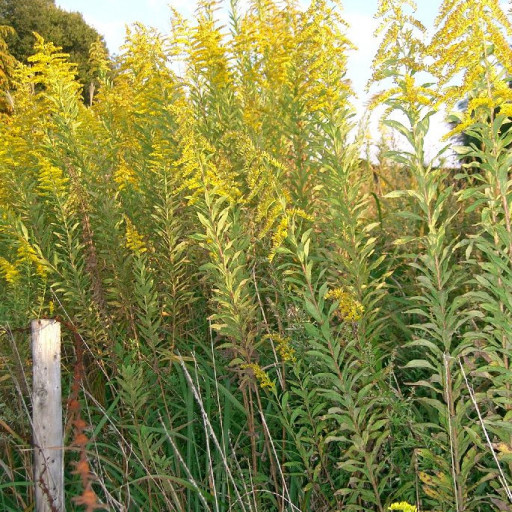
Plant Overview
Often called the Tall Goldenrod, this plant acts as nature’s golden torch, signaling the transition from late summer into autumn. While it is frequently blamed for seasonal allergies, it is actually a beneficial native perennial that provides a vital nectar buffet for migrating butterflies. In folklore, it was once believed that carrying a sprig of Goldenrod would lead a person to hidden treasure or underground springs.
🔍 How to Identify
- 🌼 Golden Panicles: Tiny, brilliant yellow flowers bloom in dense, pyramid-shaped clusters (panicles) at the top of the stems, often branching out horizontally or nodding slightly at the tips.
- 🍃 Triple-Veined Leaves: Look closely at the lance-shaped leaves; they feature three prominent parallel veins running from the middle toward the tip, a key giveaway for this specific species.
- 📏 Stately Stems: True to its name, Altissima (meaning "tallest") can reach heights of 3 to 7 feet. The stems are usually grayish-green and covered in fine, tiny hairs that give them a soft, matte texture.
🏡 In Your Garden
- 🦋 The Pollinator Gas Station: This plant is a critical resource for Monarch butterflies during their southward migration and a favorite for honeybees. If you want a "living" garden, this is a must-have.
- 🌱 Spreading Habit: It is a vigorous grower that spreads via underground rhizomes. In a small garden, it can be a bit of a "space hog," so it is best suited for wildflower meadows or the very back of a perennial border where it has room to roam.
- ☀️ Drought Warrior: Once established, Tall Goldenrod is incredibly tough. It thrives in full sun and isn't picky about soil, easily handling heavy clay or dry spells that would wither more delicate garden flowers.
⚠️ Safety & Toxicity
- ✅ Generally Safe: Tall Goldenrod is non-toxic to humans and most common household pets like cats and dogs.
- 🤧 The Great Misunderstanding: It is almost never the cause of hay fever! Its pollen is heavy and sticky (designed to be carried by bees), not wind-borne. The real culprit is usually the inconspicuous Ragweed, which blooms at the same time.
- 🐄 Livestock Note: While safe for humans, it can sometimes be a "nuisance" plant in hay fields, and some livestock may experience minor digestive upset if they graze on it exclusively.
✨ Fun Fact
Inventor Thomas Edison once experimented with Goldenrod as a source for domestic rubber! Through cross-breeding, he produced plants over 12 feet tall containing 12% latex. Henry Ford even gifted Edison a Model T with tires made entirely from Goldenrod rubber.

Detailed Care Instructions
To grow Solidago Altissima, also known as tall goldenrod, follow these steps:
- Choose the right location: Solidago Altissima prefers full sun to partial shade. Select a well-draining area in your garden.
- Prepare the soil: The plant can adapt to various soil types but prefers slightly acidic to neutral soil. Add organic matter like compost or aged manure to improve soil fertility and drainage.
- Planting: Dig a hole twice as wide and deep as the plant's root ball. Place the plant in the hole, ensuring that the top of the root ball is level with or slightly above the soil surface. Backfill the hole with soil, gently pressing it down around the plant.
- Watering: Water the newly planted Solidago Altissima thoroughly and maintain regular watering until it establishes itself. Once established, the plant is drought-tolerant and resilient.
- Mulching: Apply a layer of mulch around the base of the plant to conserve moisture, suppress weeds, and regulate soil temperature.
- Pruning: In early spring, before new growth appears, trim back any dead or damaged branches. This will promote healthy growth and improve the plant's overall appearance.
- Fertilizing: Solidago Altissima typically does not require additional fertilization if the soil is adequately prepared. However, if you notice poor growth or weak foliage, you can use a balanced fertilizer specifically formulated for flowering plants.
- Pests and diseases: Solidago Altissima is generally pest-resistant. However, keep an eye out for aphids, caterpillars, or leaf-mining insects, which may occasionally infest the plant. Treat any infestations promptly using organic or chemical insecticides as needed.
- Propagation: You can propagate Solidago Altissima through division in early spring or by collecting and sowing seeds in late fall or early spring. Seeds can be planted directly outdoors or started indoors and transplanted once they have developed.
- Maintenance: Keep an eye on the plant's overall health, ensuring it receives adequate sunlight, water, and nutrients. Remove any dead or diseased parts as needed.
By following these guidelines, you should be able to successfully grow Solidago Altissima in your garden.

Place in a bright room that is sun drenched almost all day. Or directly in a south-facing window.

Solidago altissima is a plant that requires regular watering to thrive. It prefers moist soil, but it is essential not to overwater it as this can lead to root rot. It is best to water the plant deeply once a week, ensuring that the soil is thoroughly saturated. You can tell if the plant needs watering by checking the top inch of soil. If it feels dry to the touch, it is time to water.
When watering, avoid getting water on the leaves and stem, as this can lead to fungal diseases. Water the plant from the base, and avoid splashing the soil onto the stems and leaves. If the plant is growing in a container, ensure that there are drainage holes to allow excess water to drain away. If the plant is in the ground, ensure that the soil has good drainage to avoid waterlogged roots.
During periods of hot and dry weather, it may be necessary to water the plant more frequently. It is also a good idea to mulch around the base of the plant to help retain moisture in the soil and prevent evaporation.
To promote healthy growth and flowering of this plant, it is recommended to apply a balanced fertilizer in early spring before new growth appears. Use a slow-release granular fertilizer or a liquid fertilizer diluted according to package instructions. Apply the fertilizer evenly around the plant, avoiding direct contact with the stems. Water thoroughly after fertilizing to help the nutrients penetrate the soil. Repeat the application every six to eight weeks throughout the growing season.
Solidago Altissima plant grows well in well-drained soil that is loamy in texture and has a pH level between 6.0 and 7.0. The soil should be rich in nutrients and organic matter, which can be achieved by adding compost or well-rotted manure before planting. It is important to ensure that the soil is not too compact and allows for adequate water drainage. The plant prefers to grow in full sun but can tolerate some shade. It is also important to avoid planting the Solidago Altissima plant in areas with standing water or where the soil is constantly wet. Regular watering and fertilization are necessary to ensure healthy growth and blooming of the plant.
Solidago Altissima is a perennial plant belonging to the genus Solidago. It is commonly propagated through root division and seeds.
For root division, the plant is dug up in the early spring or late fall. The roots are carefully separated into smaller sections, each section being at least 4 inches long with at least one growth bud. The divided sections are then planted in soil that has been amended with compost or organic matter.
Seeds are collected in the fall, after the flowers have bloomed and the seed heads have turned brown. The seed heads are cut off and allowed to dry. The seeds are then removed by rubbing the seed head between the fingers. The seeds are then stored in a cool, dry place until the following spring.
In the spring, the seeds are sown outdoors in a prepared seed bed or directly into the garden soil. The soil should be kept moist until the seeds have germinated and the seedlings have become established. Solidago Altissima plants grown from seed will usually bloom in their second or third year.








