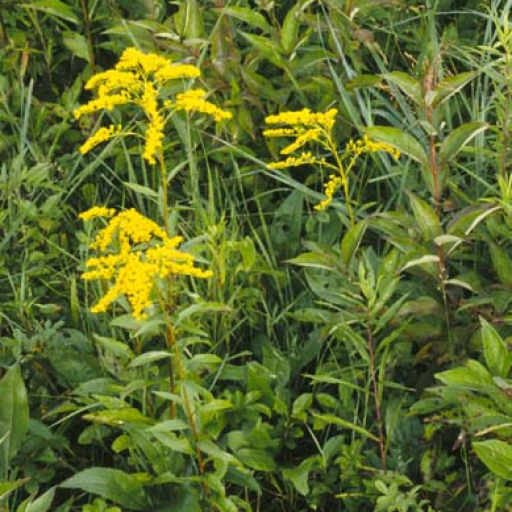
Plant Overview
Often called the "First Herald of Autumn," the Early Goldenrod (Solidago juncea) actually arrives much sooner than its cousins, splashing sunny yellow across meadows as early as July. Native to North America, this resilient perennial is a favorite for gardeners who want to bridge the gap between mid-summer blooms and the late-season floral finale. It is a tough, sun-loving plant that brings a wild, wind-swept aesthetic to any naturalized landscape.
🔍 How to Identify
- 🌼 Flower Panicles: The tiny, brilliant yellow flowers grow in plume-like clusters that arch gracefully to one side, resembling a golden fountain.
- 🌿 Smooth Stems: Unlike many other goldenrods that feel hairy or fuzzy, the stems of this species are remarkably smooth and often have a distinct reddish or purplish tint.
- 🍃 Basal Leaves: It features large, spoon-shaped leaves at the base of the plant that often stay green and vibrant even after the flowers have begun to bloom.
🏡 In Your Garden
- ☀️ Drought Warrior: This species thrives in dry, sandy, or rocky soil where other plants might wither. Its deep root system makes it an excellent choice for "xeriscaping" or low-maintenance rock gardens.
- 🦋 The Pollinator Gas Station: Because it blooms earlier than other goldenrods, it provides a vital early-season food source for native bees, honeybees, and migrating butterflies before the late-summer rush begins.
- 🌱 Well-Behaved Growth: While some goldenrods are known to be garden "bullies" that spread aggressively, Solidago juncea is much more polite, growing in tidy clumps that don't take over your entire flower bed.
⚠️ Safety & Toxicity
- ✅ Safe for Humans: This plant is non-toxic to humans and has a long history of being used in traditional herbal teas.
- 🤧 The Allergy Myth: Goldenrod is frequently blamed for hay fever, but this is a case of mistaken identity! Its pollen is heavy and sticky (moved by bees), not wind-borne. The real culprit is usually the inconspicuous Ragweed, which blooms at the same time.
- 🐾 Pet Safety: It is generally considered non-toxic to dogs and cats, though any plant matter can cause mild stomach upset if ingested in large quantities.
✨ Fun Fact
Thomas Edison was a huge fan of Goldenrod! He worked closely with George Washington Carver to extract a form of natural rubber from the leaves, eventually breeding a giant version of the plant that could grow over 10 feet tall.

Detailed Care Instructions
To grow the Solidago juncea plant, also known as early goldenrod or rush goldenrod, follow these steps:
- Determine the growing zone: Solidago juncea is a perennial plant and its hardiness varies based on the USDA hardiness zone. Make sure you are in a suitable range, which is typically zones 4-9.
- Choose a planting location: Solidago juncea prefers full sun, although it can tolerate partial shade. Select a location with well-draining soil.
- Planting time: The best time to plant Solidago juncea is in spring or fall. Ensure the threat of frost has passed before planting.
- Prepare the soil: Amend the soil with organic matter, such as compost, to improve drainage and fertility. Loosen the soil to a depth of at least 6-8 inches.
- Seed sowing/Transplanting: There are two options for propagating Solidago juncea:
- Sowing Seeds: Sow the seeds in a prepared seedbed in early spring, lightly covering them with soil. Keep the soil evenly moist until germination occurs.
- Transplanting: Alternatively, you can start with nursery-grown seedlings purchased from a garden center. Dig a hole slightly larger than the root ball, place the plant in the hole, and backfill with soil. Ensure the plant is at the same depth as it was in the nursery pot.
- Sowing Seeds: Sow the seeds in a prepared seedbed in early spring, lightly covering them with soil. Keep the soil evenly moist until germination occurs.
- Watering: Keep the soil consistently moist but not waterlogged, especially during the establishment period. Once the plants are established, they can tolerate some drought.
- Mulching: Apply a layer of organic mulch around the plants to help retain soil moisture and suppress weed growth. This is particularly beneficial during the early stages of growth.
- Fertilizing: Solidago juncea typically does not require regular fertilization. However, if the plants show signs of nutrient deficiency, you can apply a balanced, slow-release fertilizer according to the instructions on the package.
- Pruning: Solidago juncea does not require regular pruning. However, you can remove spent flowers or thin out overcrowded stems if desired.
- Pests and diseases: Solidago juncea is generally resistant to pests and diseases. However, keep an eye out for common garden pests like aphids, spider mites, or powdery mildew. If necessary, treat with suitable organic or chemical controls.
Remember, Solidago juncea is a native North American plant and can spread rapidly through rhizomes. Consider the growth habit and potential invasiveness before planting and plan accordingly.

Place in a bright room that is sun drenched almost all day. Or directly in a south-facing window.

Solidago Juncea plants require regular watering to thrive. Watering should be done deeply, allowing the water to soak into the soil and reach the roots of the plant. It is important to avoid over watering, as this can cause root rot and other issues. The frequency of watering will depend on the climate and soil conditions, but generally, these plants require about 1 inch of water per week. It is also important to monitor moisture levels in the soil and adjust watering accordingly. In addition to regular watering, it is recommended to add mulch around the base of the plant to help retain moisture and prevent evaporation.
To fertilize this plant, use a balanced fertilizer with equal amounts of nitrogen, phosphorus, and potassium. Apply the fertilizer once a month during the growing season, which is typically in the spring and summer. Mix the fertilizer with water according to the package instructions and pour it around the base of the plant, being careful not to get the fertilizer on the leaves or stem. Water the plant well after fertilizing. Avoid fertilizing in the fall and winter as the plant is dormant during this time.
Solidago Juncea plant is a herbaceous perennial plant that belongs to the Asteraceae family. When growing Solidago Juncea, it is crucial to use the appropriate soil for optimal growth and development. The best soil for Solidago Juncea plant is a well-draining, loamy soil that is rich in organic matter.
It should be noted that Solidago Juncea prefers a slightly acidic to neutral soil pH range of 6.0 to 7.5. To maintain this pH range, it is recommended to mix in peat moss or aged pine bark into the soil. Solidago Juncea can tolerate a variety of soil textures, including sandy, loamy, and clay soils, as long as they are well-drained.
Additionally, Solidago Juncea plants require regular watering to ensure their soil is moist at all times. However, care should be taken to avoid overwatering, as it can lead to root rot and other problems. Therefore, it is recommended to water your Solidago Juncea plant once or twice a week depending on weather conditions.
Lastly, regular feeding is recommended for Solidago Juncea plants to ensure their healthy growth. A balanced, all-purpose fertilizer can be applied once a month during the growing season to provide the necessary nutrients. It is important to follow the manufacturer's instructions regarding fertilizer application rates.
The Solidago Juncea plant can be propagated using both seeds and cuttings. For propagation through cuttings, select a healthy stem from an established plant and cut a length of about 3-4 inches from the tip. Remove the leaves from the lower part of the cutting and dip the cut end in rooting hormone. Then, plant the cutting in a pot filled with well-draining soil and keep it moist and in a shaded area until roots develop.
For propagation through seeds, collect mature seeds from an established plant and plant them in a pot filled with well-draining soil. Cover the seeds with a thin layer of soil and keep them moist. Seeds usually germinate within 1-2 weeks. Once they have germinated, gradually move them to a brighter area with more sunlight.
It is important to note that Solidago Juncea plants are typically hardy and can easily adapt to different growing conditions. However, it is important to ensure that the soil is well-draining and the plant is not overwatered. With proper care and attention, the newly propagated Solidago Juncea plants will reach maturity and produce beautiful flowers that attract pollinators and add color to any garden.








