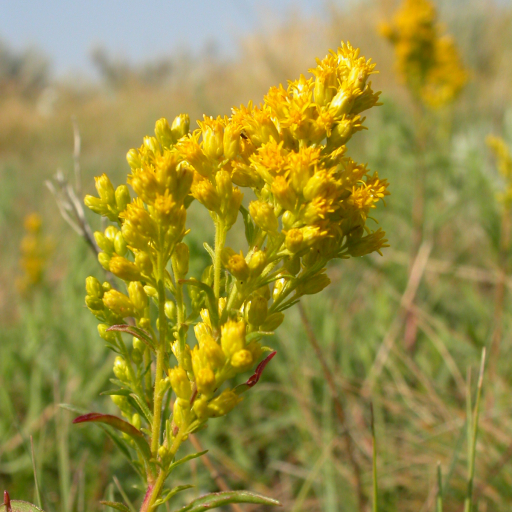
Plant Overview
Often called the Missouri Goldenrod or Prairie Goldenrod, this sunny perennial is a cheerful harbinger of late summer. Unlike many of its cousins that wait for the crisp air of autumn, this variety is an "early bird," often painting prairies and gardens in buttery yellow as early as July. In folklore, goldenrods were sometimes viewed as "divining rods" for finding hidden springs of water or even gold, though today we value them most for their incredible ability to support honeybees and butterflies.
🔍 How to Identify
- 🌼 The Bloom: Small, vibrant yellow flower heads arranged in plume-like, pyramidal clusters. The tiny flowers often sit primarily on the upper side of the branching stems, creating a one-sided, feathery appearance.
- 🌿 The Foliage: Long, narrow, lance-shaped leaves that are smooth to the touch. Look for three distinct parallel veins on the larger leaves, a signature trait of this species.
- 🍷 The Stem: The stems are notably smooth and hairless, often developing a handsome reddish or purplish tint as the plant matures throughout the season.
🏡 In Your Garden
- ☀️ Sun & Resilience: This is a tough-as-nails plant that thrives in full sun and well-drained soil. Because it has a deep root system, it is exceptionally drought-tolerant, making it a perfect candidate for "low-water" or xeriscape gardens.
- 🦋 The Pollinator Hub: It serves as a vital pit stop for migrating Monarch butterflies and native bees. If you want a garden that "hums" with life, this plant is an essential addition to your local ecosystem.
- 🌱 Space to Wander: It spreads through underground rhizomes to form colonies. While beautiful in a meadow or large border, you may want to give it space where it can roam without crowding out smaller, more delicate neighbors.
⚠️ Safety & Toxicity
- ✅ Safe for All: Missouri Goldenrod is non-toxic to humans, dogs, and cats. It is a very "friendly" plant to have in high-traffic family areas.
- 🤧 The Allergy Myth: Many people blame Goldenrod for their hay fever, but this is a case of mistaken identity! Its pollen is heavy and sticky (designed for bees, not the wind). The real culprit is usually Ragweed, which blooms at the same time but has inconspicuous green flowers.
- 🧤 Skin Sensitivity: While not toxic, some sensitive individuals may experience mild contact dermatitis (a localized rash) if handling the sap in large quantities.
✨ Fun Fact
Native American tribes, including the Meskwaki and Lakota, traditionally used infusions of this plant's roots and leaves to treat everything from burns to intestinal distress. It was a staple in the "prairie pharmacy" for centuries!

Detailed Care Instructions
To grow Solidago missouriensis (Missouri goldenrod), you can follow the steps below:
- Climate and Soil Requirements: This plant thrives in full sun to partial shade and prefers well-draining soil. It tolerates a wide range of soil types, including sandy or clay soils.
- Propagation: There are two main methods of propagation - growing from seeds or dividing established plants.
- Growing from seeds: Collect seeds from mature Solidago missouriensis plants in late summer or early fall. Sow the seeds in well-prepared soil in the desired location in your garden. Lightly cover the seeds with a thin layer of soil and water gently. Keep the soil moist during germination, which usually takes around 1-2 weeks.
- Dividing established plants: If you already have an established Solidago missouriensis plant, you can divide it in the early spring or fall. Dig out the entire clump and carefully separate it into smaller divisions, making sure each division has some stems and roots. Replant the divisions at the same depth as they were previously growing and water thoroughly.
- Planting and Care:
- Choose a sunny or partially shaded spot in your garden with well-draining soil.
- Dig a hole that is slightly larger than the root ball and place the plant in the hole.
- Backfill the hole with soil and gently firm it around the plant.
- Water thoroughly after planting to help the plant establish its roots.
- Mulch around the base of the plant to help retain moisture and suppress weed growth.
- Water regularly, especially during dry spells, to keep the soil evenly moist. Avoid overwatering as it may lead to root rot.
- Deadhead faded flowers to encourage continuous blooming and prevent self-seeding, if desired.
- In late fall, cut back the stems to the ground to prepare the plant for winter.
- Solidago missouriensis is generally pest and disease resistant, but keep an eye out for any signs of problems, such as aphids or powdery mildew, and take appropriate measures if necessary.
With proper care, Solidago missouriensis should grow well and provide beautiful golden blooms in late summer and fall.

Place in a bright room that is sun drenched almost all day. Or directly in a south-facing window.

When watering this plant, it is important to avoid getting the leaves and stem wet, as this can lead to disease and rot. Instead, water the plant directly at the base, using a hose or watering can with a spout to deliver a gentle stream of water. Avoid over-watering, as this can also lead to the development of root rot. It is best to let the soil dry out slightly between watering sessions, and to water only when the top 1-2 inches of soil feel dry to the touch. It is also important to monitor the drainage of the soil, as standing water can also promote disease and root rot. Overall, it is best to provide this plant with consistent, moderate watering, and to avoid extremes in either direction.
Solidago Missouriensis is a herbaceous perennial plant that belongs to the Asteraceae family. To encourage healthy growth and vibrant blooms, follow the following fertilizing instructions:
- Before planting, amend the soil with organic matter such as compost or well-rotted manure. This will provide the plant with essential nutrients and improve soil drainage.
- Apply a slow-release fertilizer to the soil in spring when new growth appears. Use a balanced fertilizer with a ratio of 10-10-10 or 20-20-20.
- Repeat fertilization every four to six weeks during the growing season to maintain healthy growth and blooms. Apply fertilizer according to the manufacturer's instructions and ensure it is well-distributed around the plant.
- Avoid over-fertilization as this can result in excessive foliage growth at the expense of blooms.
- Water the plant thoroughly after fertilization to help the nutrients penetrate the soil and reach the plant's roots.
- In fall, stop fertilizing as the plant prepares for dormancy.
By following these fertilizing instructions, Solidago Missouriensis will thrive and provide an abundance of beautiful blooms with long-lasting impact.
The Solidago Missouriensis plant requires well-draining soil that is rich in organic matter. The soil should be slightly acidic with a pH between 5.5 and 7.5. Sandy loam soil is ideal for this plant. It should be kept moist but not waterlogged, with good air circulation around the roots. Fertilizers high in nitrogen should be avoided as they can lead to excessive foliage growth at the expense of flower production. Mulching around the base of the plant with organic materials can help retain moisture and keep the soil temperature stable. Overall, the soil should allow for healthy root development and nutrient uptake to support the plant's growth and flowering.
One way to propagate this plant is by digging up and dividing an existing plant. Choose a healthy plant with multiple stems, and carefully dig up the plant with a digging fork or shovel. Use a clean, sharp knife or pruning shears to divide the plant into several smaller sections, each with a healthy root system and at least one stem. Plant the divisions in well-draining soil and keep the soil moist until the roots are established. Another method of propagation is by taking stem cuttings. Select a healthy stem with several leaves and cut it just below a node with a clean, sharp knife. Remove any leaves from the lower part of the stem, and dip the cut end in rooting hormone powder. Plant the stem in a container filled with moist, well-draining soil and cover with a plastic bag to help retain moisture. Keep the soil moist and place the container in a bright, but not direct, light until roots have formed.








