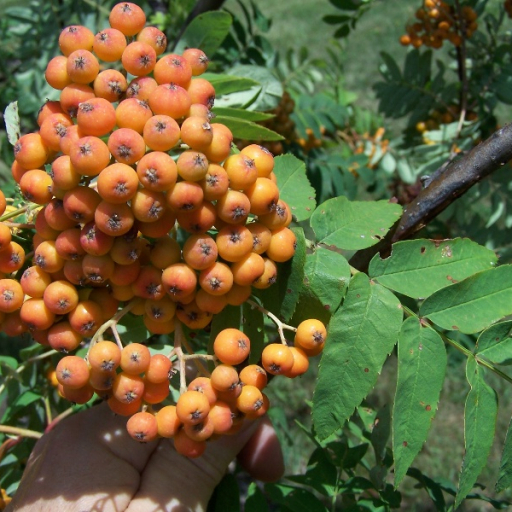
Plant Overview
Often called the "Roundwood" or "American Mountain Ash," this small, elegant tree is a vibrant jewel of the northern forests and cool mountain slopes. Despite its common name, it isn’t a true ash tree; it belongs to the Rose family (Rosaceae), sharing its lineage with apples and pears. In historical folklore, species of Mountain Ash were often planted near homes to ward off evil spirits and protect the inhabitants from lightning strikes.
🔍 How to Identify
- 🌿 Feather-Like Foliage: The leaves are "pinnately compound," meaning they look like delicate green feathers with 11 to 17 narrow, sharply toothed leaflets.
- 🌸 Frothy Blooms: In late spring, the tree is topped with dense, flat-topped clusters of tiny, creamy-white flowers that have a distinct, slightly sweet fragrance.
- 🍒 Neon Clusters: Its most striking feature is the heavy bunches of bright orange-to-red berries (pomes) that weigh down the branches from late summer through the heart of winter.
🏡 In Your Garden
- ❄️ Climate Preference: This tree is a "cool-weather specialist." It thrives in acidic, moist, and well-drained soil but struggles significantly in hot, humid urban environments or southern heat.
- 🐦 A Bird's Buffet: If you want to attract wildlife, this is your tree. It is a vital winter food source for Cedar Waxwings and Robins. Be aware that as the berries freeze and thaw, they can ferment, occasionally leading to "tipsy" birds fluttering around your yard!
⚠️ Safety & Toxicity
- 🐾 Mildly Toxic to Pets: Like many members of the Rose family, the seeds contain small amounts of cyanogenic glycosides. While the fruit is generally safe in small quantities, ingestion by curious dogs or cats can lead to stomach upset or lethargy.
- 👅 Bitter for Humans: While the berries are not poisonous to humans and are high in Vitamin C, they are incredibly bitter and astringent when raw. They are traditionally used in jellies or wines where sugar can balance their sharp punch.
✨ Fun Fact
In the 1800s, the bark of the American Mountain Ash was used by pioneers as a substitute for quinine to treat fevers. Today, it remains a favorite for "edimental" landscaping—plants that are both edible and ornamental!

Detailed Care Instructions
To grow a Sorbus Americana plant, also known as American Mountain Ash, follow these steps:
- Select a suitable location: Choose a spot that receives full sun to partial shade. The soil should be moist, well-draining, and slightly acidic.
- Prepare the soil: Loosen the soil in the selected area and remove any weeds or grass. You can amend the soil with organic matter like compost to improve its fertility and drainage.
- Plant the seed or seedling: There are two options for growing Sorbus Americana: from seeds or seedlings. If using seeds, stratify them by storing them in a moist environment at around 40°F (4°C) for 90-120 days before planting. Plant the stratified seeds 1/4 inch deep in the prepared soil. If using seedlings, dig a hole slightly larger than the root ball and place the seedling in it, making sure the crown of the plant is level with or slightly above the soil surface.
- Water regularly: Keep the soil consistently moist but not saturated. Water the plant regularly, especially during dry periods, to ensure proper hydration.
- Mulch: Apply a layer of organic mulch, such as wood chips or shredded bark, around the base of the plant. Mulch helps retain soil moisture, suppresses weeds, and insulates the roots.
- Pruning: Prune the tree in late winter or early spring to remove any damaged, diseased, or crossing branches. This will help maintain a healthy and attractive shape.
- Fertilizer: Sorbus Americana generally does not require much fertilization. However, you can apply a balanced, slow-release fertilizer in early spring if desired. Follow the instructions on the fertilizer packaging for application rates.
- Pest and disease management: Monitor the plant regularly for signs of pests or diseases, such as aphids, mites, or fungal infections. If noticed, take appropriate measures, such as using insecticidal soap or contacting a professional arborist for assistance.
- Harvesting the fruits: American Mountain Ash produces clusters of small, bright red berries that are attractive to birds and wildlife. If you wish to harvest the fruits, wait until they are fully ripe and collect them by hand. Note that the fruits are slightly bitter if eaten raw, but they can be used in jams, jellies, or as a food source for birds.
By following these guidelines, you can successfully grow a Sorbus Americana plant and enjoy its beauty in your garden.

Place in a bright room that is sun drenched almost all day. Or directly in a south-facing window.

To properly water this plant, you should first assess the moisture level of the soil. Stick your finger about 2 inches into the soil near the base of the plant and feel for moisture. If the soil feels dry, it's time to water.
When watering, make sure to do so slowly and deeply. Pour water onto the soil around the base of the plant, rather than on top of the leaves or flowers. Allow the water to fully penetrate the soil before stopping.
It's important not to overwater this plant, as too much water can cause root rot and other issues. Only water when the soil feels dry and adjust your watering frequency based on the plant's needs and the climate in your area.
To fertilize this plant, choose a slow-release fertilizer high in nitrogen, phosphorus, and potassium. Apply the fertilizer in early spring before new growth appears and again in midsummer. Spread the granules evenly over the soil, staying at least six inches away from the trunk and extending to the drip line. Water thoroughly after application to allow the fertilizer to soak into the soil. Avoid over-fertilizing, as too much can harm the plant.
The Sorbus Americana plant prefers well-draining soil that is slightly acidic with a pH range of 5.5 to 6.5. It thrives in moist but not waterlogged soil. The ideal soil for this plant is a loamy soil that is rich in organic matter. It should be planted in an area with good air circulation and receives full sunlight to partial shade. The soil should be kept slightly moist, but not wet, and fertilized regularly during the growing season to promote healthy growth. It is important to avoid using heavy or compacted soil, as this can hinder root growth and lead to root rot.
There are several ways to propagate this particular plant. One method is through seed collection. The seeds can be collected from the ripe fruit, which usually occurs in the fall. The fruit should be harvested before it drops from the tree. The seeds can then be extracted and cleaned before being stored or planted.
Another method is through cuttings. Softwood cuttings should be taken in early summer and hardwood cuttings in the late fall. The cuttings should be about 6 inches long and should be taken from healthy, disease-free branches.
The cuttings should then be dipped in rooting hormone and planted in fertile, well-draining soil. The soil should be kept moist and the cutting should be in a warm, shaded area.
Layering is another method of propagation. This involves bending a low-hanging branch to the ground and covering a section of it with soil. After a year, roots should have formed, and the new plant can be separated from the parent plant and transplanted.
Finally, grafting can also be used to propagate this plant. This involves joining a rootstock of a closely related plant to the scion of the Sorbus Americana plant. The graft should be made during the dormant season, and it should be placed in a warm, moist environment until it begins to grow.








