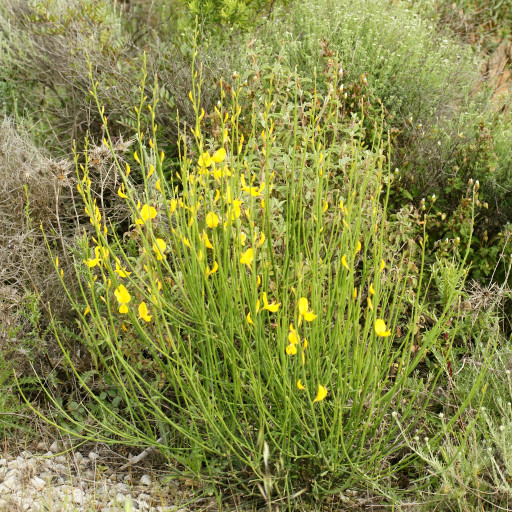
Plant Overview
Often called the "Spanish Broom" or "Weaver’s Broom," this Mediterranean native is a sun-drenched shrub that turns hillsides into a sea of molten gold. Historically, its tough, flexible stems were harvested to weave baskets and mats, earning it a reputation as a practical tool for ancient craftsmen. It is a resilient survivor, known for its ability to thrive in poor, rocky soil where other plants might wither.
🔍 How to Identify
- 🌼 The Flowers: Bright, sunshine-yellow blossoms that resemble pea flowers and emit a sweet, heavy fragrance that fills the air in late spring.
- 🎋 The Stems: Cylindrical, rush-like green stems that stay vibrant all year round, often appearing almost leafless.
- 🍃 The Foliage: Tiny, simple leaves that appear briefly in early spring but fall off quickly, leaving the green stems to handle the plant's photosynthesis.
🏡 In Your Garden
- ✂️ Pruning Needs: To keep it from becoming "leggy" or sparse at the bottom, it requires a firm haircut right after the flowering season ends.
- 🌍 Soil Specialist: It actually prefers "bad" soil; overly rich or wet earth can make the plant unstable and prone to root rot.
- 🚀 Invasive Potential: Because its seed pods "pop" and throw seeds several feet away, it can escape garden borders and take over wild spaces in certain climates.
⚠️ Safety & Toxicity
- 🚫 Toxic Status: All parts of the plant, especially the seeds and pods, contain quinolizidine alkaloids (such as cytisine).
- 🐕 Risk Factor: Highly toxic if ingested by humans, dogs, cats, or horses. Symptoms include nausea, coordination loss, and in severe cases, respiratory issues.
✨ Fun Fact
The name junceum comes from the Latin word juncus, meaning "rush." This refers to the plant’s reed-like branches, which were once used as a source of fiber to make high-quality linen and ship cables!

Detailed Care Instructions
| Humidity | Dry |
| Lighting | Full Sun |
| Toxicity | Poisonous |
| Difficulty | Easy |
| Hibernation | Cold Period |
| Hardiness Zones | 8 - 11 |
To grow Spartium junceum, also known as Spanish broom, follow these steps:
- Select a suitable location: Spanish broom prefers full sun and well-draining soil. It can tolerate poor soil conditions, but it thrives in sandy or loamy soil.
- Prepare the soil: If the soil is compacted or clayey, mix in organic matter like compost to improve drainage and fertility.
- Propagation: Spanish broom can be propagated through seeds, cuttings, or division.
- Seeds: Soak the seeds in water for 24 hours before planting to improve germination. Sow the seeds directly in the ground in spring or early summer, making sure they are spaced about 2 feet apart.
- Cuttings: Take 6-8 inch long semi-hardwood cuttings from a healthy plant during late summer or early fall. Remove the lower leaves, dip the cut end in rooting hormone, and plant it in a pot filled with well-draining soil. Keep the soil moist and provide indirect sunlight until the cutting roots.
- Division: Divide an established plant during early spring. Dig up the clump and carefully separate the roots. Replant each division in a suitable spot.
- Seeds: Soak the seeds in water for 24 hours before planting to improve germination. Sow the seeds directly in the ground in spring or early summer, making sure they are spaced about 2 feet apart.
- Watering: Spanish broom is drought-tolerant once established, but it benefits from regular watering during its first year of growth. Water deeply but infrequently, allowing the soil to dry out between waterings.
- Pruning: Prune the plant regularly to maintain its shape and encourage bushier growth. Remove any dead, damaged, or diseased branches. Pruning can be done in late winter or early spring before the new growth starts.
- Mulching: Apply a layer of organic mulch around the base of the plant to suppress weed growth and conserve moisture. Keep the mulch a few inches away from the stems to prevent rot.
- Fertilization: Spanish broom generally does not require much fertilization. However, you can apply a balanced slow-release fertilizer in early spring to promote healthy growth.
- Pest and disease control: Spanish broom is usually not severely affected by pests or diseases. However, watch out for aphids, spider mites, or powdery mildew. To control pests, you can use insecticidal soap or neem oil.
Remember to check the specific care instructions for the particular variety of Spartium junceum you have, as some cultivars may have slightly different requirements.

Place in a bright room that is sun drenched almost all day. Or directly in a south-facing window.

To water this plant, it is important to first consider the soil type and environmental conditions. It prefers well-draining soil and does not tolerate standing water or waterlogged conditions. Watering frequency will depend on the moisture level of the soil, so it is recommended to check the soil moisture using a moisture meter or by feeling the soil with your fingers.
Water deeply and slowly to ensure the roots receive adequate hydration, but avoid overwatering. During the growing season, it may require watering more frequently, while during the dormant season, it can tolerate drier conditions.
It is important to note that this plant can withstand drought conditions, so it is better to err on the side of underwatering than overwatering. In addition, avoid getting water on the foliage as this can cause fungal diseases and damage the plant.
To fertilize the plant, apply a balanced, slow-release fertilizer once in the spring and again in midsummer. Spread the granules evenly over the soil around the base of the plant and water thoroughly to distribute the nutrients. Avoid over-fertilizing, as this can damage the roots and foliage. Monitor the plant for signs of nutrient deficiency, such as yellowing leaves or stunted growth, and adjust the fertilizer application accordingly.
The preferred soil for the plant should be well-draining, slightly acidic to neutral, and nutrient-rich. A mixture of loamy soil and sand with added organic matter such as compost or rotted manure is suitable. The plant does not tolerate clay soil or waterlogging, so adequate drainage is essential. It can also grow in poor soil conditions such as sandy or gravelly soil. It is advisable to avoid adding too much nitrogen to the soil as it can promote excessive vegetative growth at the expense of flower production. The plant prefers a sunny location but can tolerate partial shade.
The process of propagating this plant involves collecting seeds from the plant and allowing them to dry out completely. Once the seeds are dry, they can be sown in a suitable planting medium and lightly covered with soil.
The seeds should be kept moist but not wet, and placed in a warm, well-lit area. Germination should occur within 2 to 3 weeks.
Alternatively, the plant can be propagated from cuttings. Take 6-8 inch cuttings from young growth, making sure to include a few leaves. Strip the lower leaves off of the cutting and dip the cut end in rooting hormone.
Plant the cutting in a well-draining potting mix, and keep the soil moist. Place the pot in a warm, well-lit location. Roots should form in 2 to 4 weeks, and new growth will appear soon after.
Common pests of the yellow spanish broom include Scale insect, spider mites, aphids. Make a habit of checking your yellow spanish broom frequently for pests so that any infestations can be caught and managed early.








