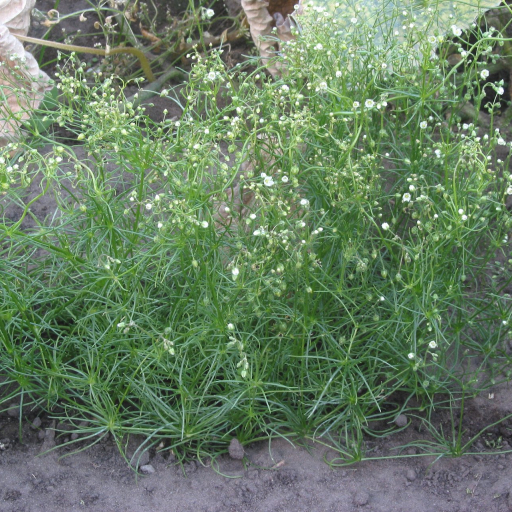
Plant Overview
Often called "Devil’s Gut" by frustrated farmers or the more charming "Yarr" in parts of Europe, Corn Spurrey is a delicate-looking wildflower that packs a punch of resilience. While it is technically a member of the carnation family, it behaves more like a soft, green mist covering the ground. Historically, it was a vital "famine food" and a favored snack for dairy cows, rumored to make their milk even richer.
🔍 How to Identify
- 🌿 Thread-like Leaves: The foliage consists of very thin, fleshy, needle-like leaves that grow in circular whorls around the stem, resembling a miniature, airy pine branch.
- 🌸 Starry Blooms: It features tiny white flowers with five petals that only fully open during bright, sunny hours, tucked away at the ends of the stems.
- 🧤 Sticky Texture: If you run your fingers along the stems, you’ll notice they feel slightly sticky or "tacky" due to minute glandular hairs.
🏡 In Your Garden
- 🧪 Acid Indicator: Finding this plant in your yard is a natural soil test; it is a specialist that thrives in "sour" or highly acidic, sandy soils where other plants might struggle to grow.
- 💧 Drought Strategy: Despite its fragile appearance, its slender taproot dives deep into the earth, allowing it to remain green and lush even when the surface soil has completely dried out.
- 🕸️ The "Tangle" Habit: Because its stems are weak but highly branched, it often leans on neighboring plants for support, creating the tangled "gut" mats that give it its notorious nickname.
⚠️ Safety & Toxicity
- ✅ Low Risk: Corn Spurrey is generally considered non-toxic to humans, dogs, and cats.
- 🐄 Livestock Note: While it was once used as fodder, it contains saponins. In massive quantities, this can cause mild digestive upset in certain livestock, though it is usually safe in a typical grazing mix.
- 🌾 Seed Longevity: Be aware that one plant can drop thousands of seeds that remain viable in the soil for years, so it can quickly become a permanent resident if not managed.
✨ Fun Fact
In the 18th century, Corn Spurrey was so highly valued as a crop for poor, sandy soils that it was intentionally sown in the Netherlands to improve the quality of butter produced by local cattle!

Detailed Care Instructions
To grow Spergula Arvensis (Corn Spurry) plants, follow these steps:
- Choose the right location: Select a sunny spot in your garden or outdoor area with well-drained soil. Spergula Arvensis prefers full sun exposure.
- Prepare the soil: Clear the area of any weeds or debris. Loosen the soil with a garden fork or tiller, and remove any rocks or large clumps of soil. This will help ensure good root growth.
- Sow the seeds: Scatter the seeds over the prepared soil. Spergula Arvensis seeds are tiny, so you can mix them with sand to help distribute them more evenly. Lightly press the seeds into the soil, but do not bury them too deep, as they require light to germinate.
- Water consistently: Water the soil gently after sowing the seeds to ensure they make good contact with the moist soil. Avoid overwatering, as this can lead to fungal diseases. Keep the soil consistently moist until germination occurs, which typically takes around 10-14 days.
- Thin the seedlings: Once the seedlings emerge and grow to about 2-3 inches (5-8 cm) in height, thin them out to allow proper spacing. Aim for a spacing of about 6-8 inches (15-20 cm) between the remaining plants.
- Provide regular care: Spergula Arvensis is a low-maintenance plant, but regular care will help it thrive. Water the plants during dry spells or when the soil feels dry to the touch. Avoid overwatering, as it can lead to rot. Pull any weeds that compete with the plants for nutrients and water. Mulching around the plants can help suppress weed growth and conserve moisture.
- Harvest the seeds: Spergula Arvensis produces small, seed-containing capsules. Allow the capsules to dry on the plant, then harvest them by gently shaking or collecting them when they turn brown. Store the seeds in a cool, dry place for future sowing or to share with others.
By following these steps, you should be able to successfully grow Spergula Arvensis plants in your garden or outdoor space.

Place in a bright room that is sun drenched almost all day. Or directly in a south-facing window.

To water this particular plant, it is important to consider its natural habitat and watering requirements. Spergula Arvensis typically grows in dry, well-drained soils and can tolerate some drought.
When irrigating, it is important to avoid over-watering as this can cause root rot and damage to the plant. It is best to water deeply and less frequently to encourage healthy root growth.
One method of watering is to use a drip irrigation system, which slowly releases water directly to the roots of the plant, minimizing evaporation and water waste. Alternatively, hand-watering with a watering can or hose is also effective.
It is important to monitor the soil moisture level by checking the top few inches of the soil regularly. If the soil feels dry to the touch, it may be time to water. It is also important to avoid watering the foliage of the plant, as this can lead to disease and pest issues.
In general, providing proper watering and moisture management can help encourage healthy growth and flowering of Spergula Arvensis.
To fertilize this plant, use a balanced fertilizer with equal parts nitrogen, phosphorus, and potassium. Apply the fertilizer evenly around the base of the plant, taking care not to get it on the leaves or stem. It is important to follow the manufacturer's instructions for the amount of fertilizer to use based on the size and age of the plant. Fertilize once a month during the growing season, reducing the frequency in the winter months. Over-fertilizing can damage the plant and reduce its overall health, so it is important to stick to the recommended application rate.
The soil that is recommended for the growth of Spergula Arvensis plant should be loose, well-draining, and fertile. The pH level of the soil should be slightly acidic to neutral. These plants grow best in soils that are rich in organic matter and have good water retention capabilities.
The soil texture for Spergula Arvensis should be sandy loam to loamy soil. Additionally, clay soils can be amended with sand or perlite to improve the soil structure and drainage.
It is important that the soil is not waterlogged as the plant may suffer from root rot. Moreover, it is recommended to add a layer of organic mulch to the soil surface around the plant to boost soil moisture retention.
Overall, the ideal soil for Spergula Arvensis should be well-drained, nutrient-rich, and have good water retention capabilities.
To propagate this plant, you will need to collect seeds from the mature plants. Wait for the plant to produce seed pods, which will dry and turn brown. Collect the pods before they split open and scatter the seeds.
Once you have the seed pods, place them in a paper bag and allow them to dry further for a few days. Once the pods are completely dry, use your fingers to crush them and release the small black seeds.
Prepare a well-draining soil mix, and sow the seeds on the surface of the soil. Lightly press down on the soil to ensure good contact between the seeds and the soil.
Keep the soil moist, but not too wet, and place the container in a bright, sunny area. The seeds should germinate within a couple of weeks.
Once the plant has grown large enough, it can be transplanted into its permanent location outdoors. Take care to avoid disturbing the roots when transplanting.








