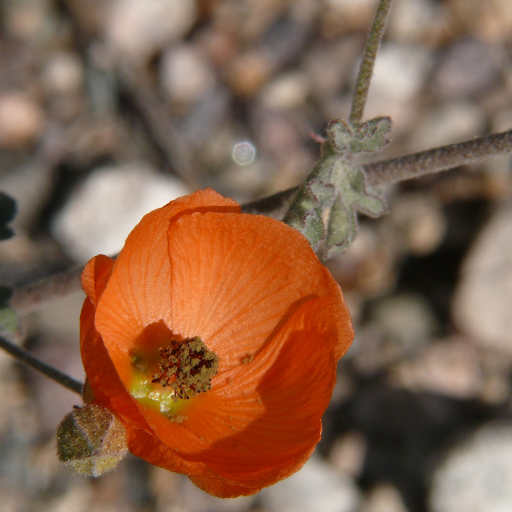
Plant Overview
Known fondly as the Desert Globemallow or the "Apricot Mallow," this resilient desert dweller is a star of the American Southwest. Its vibrant, cup-shaped blooms seem to glow against the parched landscape, earning it a reputation as one of the toughest yet most beautiful wildflowers. In local folklore, it is sometimes called the "Sore-eye Poppy" due to the tiny, irritating hairs that coat its silvery foliage.
🔍 How to Identify
- 🧡 Vibrant Blooms: Deeply cupped, five-petaled flowers that are traditionally a brilliant apricot-orange, though they can occasionally appear in shades of pink, lavender, or white.
- Dusty Velvety Foliage: Small, heart-shaped or three-lobed leaves covered in fine, star-shaped silvery hairs that give the plant a distinct grayish-green hue.
- 🌿 Growth Habit: A multi-stemmed, woody-based perennial that forms a rounded, somewhat "wild" shrubby clump, typically reaching 2 to 4 feet in height.
🏡 In Your Garden
- ☀️ Desert Survivor: This plant is a champion of xeriscaping; it thrives in intense heat and full sun, requiring very little supplemental water once its root system is established.
- 🏜️ Drainage Specialist: It refuses to tolerate "wet feet." To keep it happy, ensure your soil is sandy or rocky, mimicking the well-draining desert washes where it naturally grows.
- 🐝 Pollinator Buffet: It is a vital nectar source for native bees and butterflies, making it an excellent choice for gardeners looking to support local wildlife in arid climates.
⚠️ Safety & Toxicity
- 👁️ Physical Irritant: While not chemically toxic, the plant is covered in "stellate" hairs. If handled, these can rub off and cause significant irritation to the skin or eyes (hence the "Sore-eye" nickname).
- 🐾 Pet Safety: It is generally considered non-toxic to cats and dogs. However, if a curious pet chews on the leaves, the physical texture of the hairs may cause mild mouth or throat irritation.
✨ Fun Fact
The Desert Globemallow was historically used by various Native American tribes for its medicinal properties; the roots were often made into a poultice to treat skin sores, and a tea made from the leaves was used to soothe upset stomachs.

Detailed Care Instructions
| Humidity | Normal |
| Difficulty | Medium |
| Hibernation | Cold Period |
| Temperature | 16°C - 26°C |
| Hardiness Zones | 6 - 9 |
To grow Sphaeralcea ambigua, also known as desert globemallow or apricot mallow, follow these steps:
- Choose a sunny location: Sphaeralcea ambigua thrives in full sun, so select a spot in your garden that receives at least six hours of direct sunlight daily.
- Prepare the soil: The plant prefers well-draining soil with good fertility. Loosen the soil in the planting area and amend it with compost or well-rotted organic matter to improve drainage and nutrient content.
- Planting: Dig a hole slightly larger than the root ball of the plant. Place the root ball in the hole, ensuring that the top of the root ball is at ground level. Fill the hole with soil, gently firming it around the plant. Water thoroughly after planting.
- Watering: Water the newly planted Sphaeralcea ambigua deeply and regularly, especially during dry periods. After the establishment period, which typically takes a few months, the plant becomes more drought-tolerant and requires less water.
- Mulching: Apply a layer of organic mulch, such as wood chips or straw, around the plant to help retain moisture and suppress weed growth. Keep the mulch about two inches away from the base of the plant to prevent rotting.
- Pruning: Sphaeralcea ambigua benefits from annual pruning to remove dead or damaged branches and to maintain a more compact shape. Pruning can be done in late winter or early spring.
- Fertilizing: While Sphaeralcea ambigua generally doesn't require frequent fertilization, you can apply a balanced slow-release fertilizer in early spring to promote healthy growth. Follow the recommended dosage on the fertilizer label.
- Pest and disease control: Sphaeralcea ambigua is generally resistant to pests and diseases but may occasionally be affected by powdery mildew or aphids. Monitor the plant regularly and treat any infestations with appropriate organic or chemical solutions.
- Propagation: Sphaeralcea ambigua can be propagated from seeds or stem cuttings. Collect the seeds in late summer or early autumn and sow them in well-draining soil. For stem cuttings, take 3-4 inch cuttings from the terminal growth and plant them in a well-draining rooting medium.
By following these steps, you can successfully grow and care for Sphaeralcea ambigua in your garden.

Place in a bright room that is sun drenched almost all day. Or directly in a south-facing window.

The watering requirements for this plant vary depending on the climate and the soil. In general, it prefers well-draining soil and moderate watering. It is important not to overwater this plant as it is drought-tolerant. When watering, ensure that the water reaches the root zone, which is about 6 inches deep. One way to test if the soil is dry enough to water is to stick your finger into the soil, and if it feels dry up to your second knuckle, then it's time to water. Watering should be done early in the morning or late in the day to reduce evaporation. Avoid watering in the middle of the day when the sun is high and temperatures are hot, as this can damage the plant's leaves. It is recommended to water this plant deeply but infrequently, about once every two weeks or when the soil is dry.
To fertilize this plant, you should use a balanced, slow-release fertilizer in the early spring. Apply the fertilizer according to the instructions on the label. You can also use a liquid fertilizer every two weeks during the growing season. However, be careful not to over-fertilize as it can harm the plant. It is best to water the plant before applying the fertilizer to avoid any potential root burn.
When planting Sphaeralcea Ambigua, it is recommended to use a well-draining soil that is rich in organic matter with a slightly alkaline pH level. The soil should be sandy or loamy to provide adequate drainage and prevent waterlogging of the roots. A soil mixture consisting of equal parts garden soil, sand, and composted organic matter can be used for best results. It is also important to ensure that the soil is moist but not waterlogged, as the plant is highly tolerant of drought but does not tolerate wet or poorly drained soil. Providing proper soil conditions will ensure healthy growth and blooming of the plant.
To propagate this plant, you can collect mature seeds from the plant when they are fully ripe. The seeds should be stored in a dry, cool place until you are ready to plant them.
To plant the seeds, you will need to prepare a well-draining potting mix with a pH between 6.0 and 7.0. You will also need to sterilize your planting containers to prevent the growth of harmful pathogens.
Once your planting containers are prepared, fill them with the potting mix and moisten the soil. Then, plant your seeds about 1/4 inch deep and cover them lightly with soil. Water the soil lightly, and place the containers in a warm and sunny location.
The seeds should germinate after 7-21 days, depending on the temperature and humidity levels. When the seedlings are about 2-3 inches tall, you can transplant them to larger containers or into a garden bed.
To transplant the seedlings, simply dig a hole in the soil and gently place the seedling inside. Cover the roots with soil, and water the plant lightly. Be sure to give your new plant plenty of sunlight and water as it establishes itself in its new home.
Common pests of the apricot globe-mallow include Spider mites, aphids, thrips, larvae. Make a habit of checking your apricot globe-mallow frequently for pests so that any infestations can be caught and managed early.








