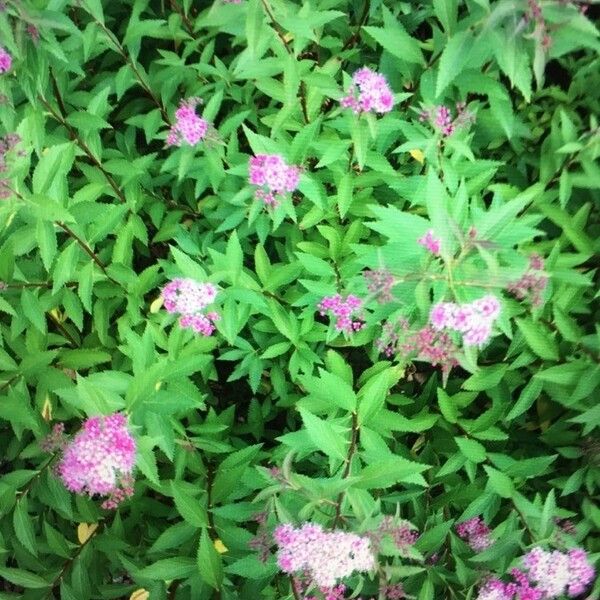
Plant Overview
Often called the "Reliable Workhorse" of the landscape, Spiraea × bumalda is a classic hybrid loved for its compact shape and vibrant summer displays. A cross between two East Asian species, this shrub is a staple for gardeners who want high-impact color without high-intensity maintenance. It is perhaps most famous for the "Anthony Waterer" cultivar, which has graced suburban gardens for over a century with its dependable rose-pink blooms.
🔍 How to Identify
- 🌿 Leaf Texture: Small, lance-shaped leaves with sharply toothed (serrated) edges. The foliage is dense, giving the shrub a lush, full appearance throughout the growing season.
- 🌸 Flower Clusters: It produces "corymbs," which are flat-topped clusters of tiny, star-shaped flowers. These clusters sit atop the stems like delicate pink umbrellas.
- 🎨 Seasonal Tints: One of its most charming traits is the color of its new growth; young leaves often emerge with a reddish or bronze tint before maturing to a deep forest green.
🏡 In Your Garden
- ☀️ Sun and Bloom: This shrub thrives best in full sun. While it can tolerate partial shade, the flower colors will be less intense and the growth habit will become "leggy" or sparse as it reaches for the light.
- ✂️ The Rebloom Secret: To keep the plant looking tidy and encourage a second wave of flowers in late summer, you should "deadhead" (trim off) the faded flower clusters. It responds very well to hard pruning in early spring to maintain its mounded shape.
- 💧 Adaptability: Once established, it is remarkably drought-tolerant and isn't picky about soil types, provided the ground doesn't stay soggy, which can lead to root rot.
⚠️ Safety & Toxicity
- ✅ Non-Toxic: Spiraea × bumalda is generally considered non-toxic to humans, dogs, and cats. It is a "worry-free" choice for family backyards.
- 🦋 Wildlife Magnet: While safe for pets, it is highly attractive to pollinators. Expect to see bees and butterflies hovering around the nectar-rich clusters all summer long.
✨ Fun Fact
The name Spiraea comes from the Greek word speira, meaning "wreath" or "coil." This refers to the plant's flexible, wiry stems, which in ancient times were often woven into decorative garlands and floral crowns.

Detailed Care Instructions
To grow Spiraea × bumalda, commonly known as the Bumald spirea, you can follow these steps:
- Select a suitable location: Bumald spirea thrives in full sun to partial shade. Choose a location that receives at least 6 hours of direct sunlight per day.
- Prepare the soil: The plant prefers well-draining soil. Amend the soil with organic matter like compost to improve its fertility and texture. Bumald spirea can tolerate a wide range of soil pH.
- Planting: Dig a hole slightly larger and deeper than the plant's rootball. Place the spirea in the hole, ensuring that the top of the rootball is level with or slightly above the soil surface. Backfill the hole with soil, gently firming it around the plant.
- Watering: Water the plant deeply after planting to help establish the root system. Keep the soil consistently moist but not waterlogged during the first growing season. Once the plant is well-established, it can tolerate some drought but performs best with regular watering.
- Mulching: Apply a layer of mulch around the base of the plant to conserve moisture, suppress weed growth, and regulate soil temperature. Keep the mulch a few inches away from the plant's stems to prevent rot.
- Pruning: Prune the plant in late winter or early spring to maintain its shape and promote vigorous growth. Remove any dead, damaged, or diseased branches. You can also prune after flowering if you wish to control the size of the plant.
- Fertilizing: Apply a balanced slow-release fertilizer in early spring to provide essential nutrients for healthy growth. Follow the manufacturer's instructions for dosage and application.
- Pest and disease control: Bumald spirea is generally resistant to most pests and diseases. However, it is a good practice to inspect the plant regularly and take necessary measures, such as removing any affected parts or using appropriate organic pest control methods if needed.
With proper care and maintenance, your Spiraea × bumalda plant should grow well and provide beautiful pink or red flowers throughout the growing season.
To water this plant, you should first check the soil moisture level by inserting your finger about an inch deep into the soil. If the soil feels dry, water the plant deeply, letting the water soak in until it reaches the root zone. Be careful not to overwater the plant, as this can lead to root rot. Water the plant slowly to allow the water to soak in evenly. It is best to water this plant in the morning or evening when the temperature is cooler to avoid evaporation and to prevent water from sitting on the leaves during the hot sun. Avoid watering the plant from overhead, as this can lead to foliar diseases. Instead, water at the base of the plant. When watering, avoid getting water on the foliage as this can encourage fungal growth.
To fertilize this plant, use a balanced fertilizer with an N-P-K ratio of 10-10-10 or 20-20-20. Apply the fertilizer evenly around the base of the plant, being careful not to spill it on the leaves or stems. Water the plant thoroughly after fertilizing to help the nutrients penetrate the soil. Fertilize this plant once in the spring before new growth begins and again in mid-summer to encourage more blooms. Avoid fertilizing in the fall as this can stimulate new growth, which may not have enough time to harden off before winter.
When planting Spiraea × Bumalda, it is important to choose the appropriate soil type. The ideal soil composition for this plant should be well-draining and nutrient-rich, with a pH range of 5.5 to 7.5. The soil texture should be loamy or sandy loam, which allows proper aeration and water circulation around the plant's roots. It is also recommended to mix organic matter, such as compost or peat moss, into the soil to improve its overall fertility. Additionally, Spiraea × Bumalda prefers slightly acidic soils that are rich in organic matter as this will promote healthy growth and flowering periods. Therefore, using a high-quality soil that is rich in organic matter and has good drainage properties is essential for maintaining healthy Spiraea × Bumalda plants.
To propagate this plant, you will need to start by taking stem cuttings from a healthy, mature plant. Choose a stem that is about six inches long and has at least three or four leaves attached to it. Cut the stem right below a leaf node using sharp, clean shears.
Next, remove the leaves from the lower half of the stem, leaving only a few at the top. Dip the cut end of the stem in rooting hormone powder to encourage root growth. Then, plant the stem in a pot filled with a well-draining potting mix. Water the plant well and place it in a warm, bright location, out of direct sunlight.
Keep the soil moist and provide air circulation to prevent mold or fungal growth. In a few weeks, new roots should start to form, and new leaves will begin to grow. Once the plant has established a strong root system, it can be transplanted into a larger pot or directly into the garden.
Repeat this process with multiple stems to increase your chances of success, and be patient as it may take a few months for the plant to establish itself.








